Clear Sky Science · en
Architectural and geotechnical aspects affecting earthquake resilience for the antique Egyptian Khufu pyramid
Why an ancient tomb still stands firm
The Great Pyramid of Khufu has survived thousands of years of desert winds and nearby earthquakes with only minor scars. This study asks a simple but fascinating question: what is it about the pyramid’s shape, stonework, and bedrock that makes it so resistant to shaking, and can modern science measure that hidden strength?
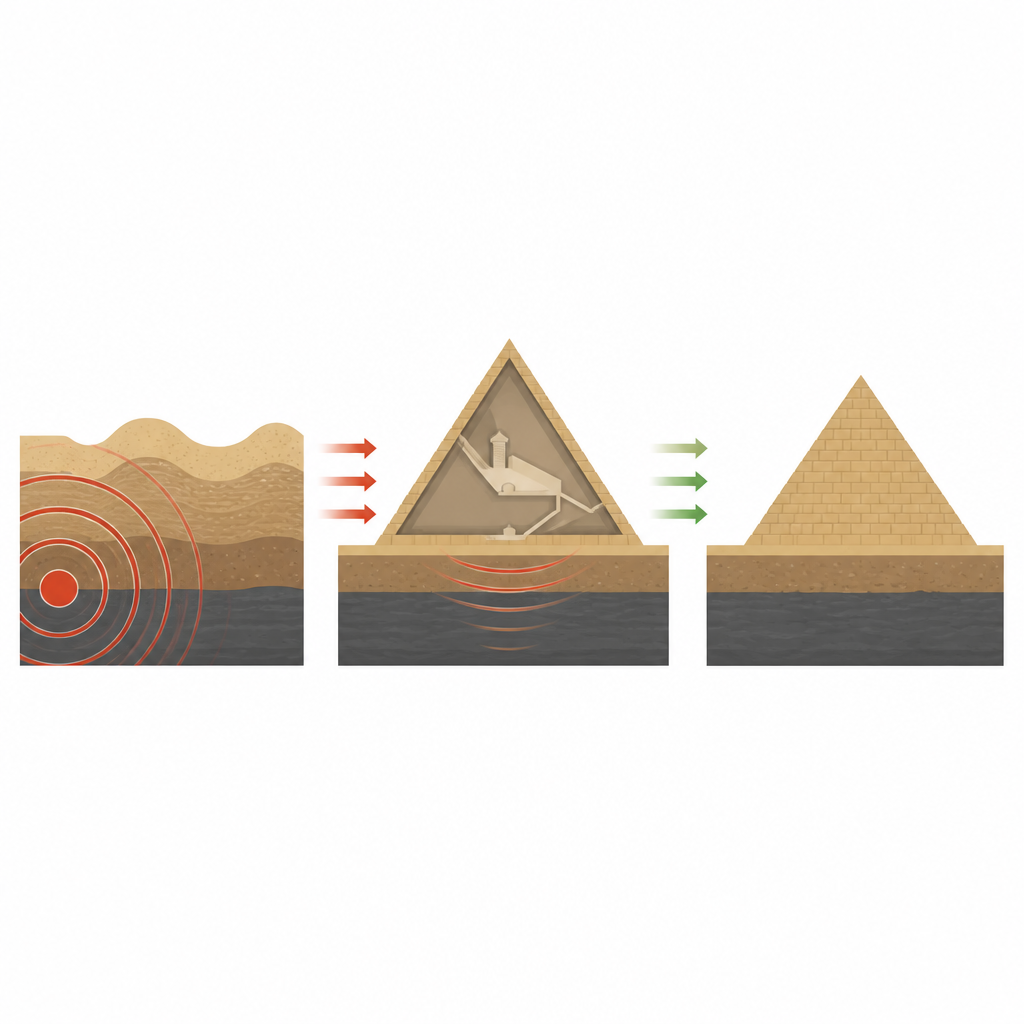
Listening to the pyramid’s quiet vibrations
Instead of waiting for a big quake, the researchers used a gentle method that listens to natural background vibrations already moving through the ground and stone. With a portable three‑axis sensor, they recorded 15 minutes of tiny motions at 37 spots inside and around the pyramid, from the underground chamber up to high roof spaces. By comparing side‑to‑side motions with up‑and‑down motions at each point, they could find the preferred vibration tone, or fundamental frequency, of both the monument and the soil beneath it.
Different tones for rock and stone
The measurements revealed that most parts of the pyramid vibrate in a very tight band between about 2.0 and 2.6 cycles per second, with an overall average near 2.3. This near‑uniform tone, seen in the Queen’s Chamber, the King’s Chamber, and many passages, suggests that stresses are spread evenly through the stonework and that the huge mass behaves as a single, well‑tied body. In contrast, the surrounding ground at the base responds at a much slower tone of about 0.6 cycles per second, reflecting the natural layering of the Giza limestone plateau.
How mismatch in motion helps protect the pyramid
Buildings are most at risk when their own vibration tone matches that of the shaking ground, because resonance can greatly amplify motion. The clear gap between the soil’s slow tone and the pyramid’s faster one means that typical local quakes are less likely to make the entire structure sway strongly in step with the ground. This mismatch fits with historical experience: several sizeable earthquakes have struck within about 80 kilometers over 4,600 years, yet the main pyramid body has escaped serious damage, while only some outer casing stones have fallen.
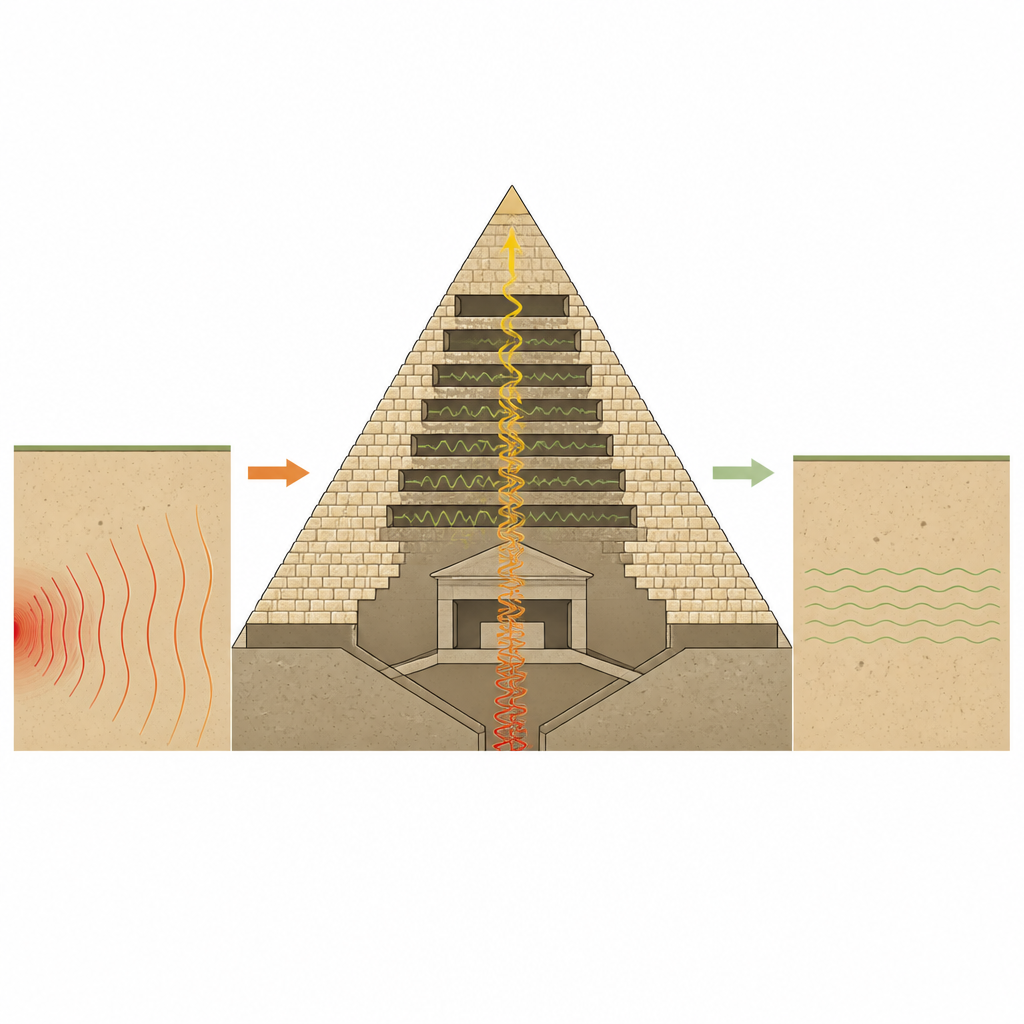
Special upper chambers that calm the shaking
The study also traced how shaking grows or shrinks with height. Relative amplification is lowest at ground level and generally increases upward, reaching about four times the base motion around the King’s Chamber. Surprisingly, this trend reverses in the stack of pressure‑relieving chambers just above it, where amplification drops to around three. These narrow stone rooms have long been known to ease the weight on the King’s Chamber; the new measurements show they also reduce how strongly earthquake vibrations build up at the very top of the surveyed zone.
Solid ground beneath a stable giant
Beyond the stones themselves, the team evaluated how easily the nearby soil deforms during shaking, using a simple index called the seismic vulnerability index. For the ground in front of the pyramid they found a low value, indicating that the supporting rock is stiff and unlikely to greatly magnify incoming waves. While this index does not directly rate the safety of the monument, it reinforces the picture of a heavy structure placed on strong bedrock rather than soft, quake‑sensitive sediments.
What this means for the pyramid’s future
To a non‑specialist, the message is clear: the Great Pyramid is not only large but also well tuned to its site. Its mass is concentrated near the ground, its stones vibrate together at a tone distinct from that of the underlying rock, and its upper chambers subtly trim the shaking that reaches key rooms. The authors stop short of claiming that ancient builders intentionally designed for earthquakes, but their measurements show that the combination of geometry, stone layout, and firm foundation has created a monument with strong natural resilience to seismic hazards, suggesting that future earthquakes are likely to cause only limited damage to its main body.
Citation: ELGabry, M., Hamed, A., Yoshimura, S. et al. Architectural and geotechnical aspects affecting earthquake resilience for the antique Egyptian Khufu pyramid. Sci Rep 16, 14032 (2026). https://doi.org/10.1038/s41598-026-49962-6
Keywords: Khufu pyramid, earthquake resilience, soil structure interaction, ambient vibration, heritage engineering