Clear Sky Science · en
Greywater recycling and solar photovoltaic integration for sustainable water and energy management in urban Egypt
Turning Everyday Waste into a Hidden Resource
In many cities, clean water and reliable electricity are under growing strain, especially in hot, dry countries like Egypt. This study explores how a large housing complex in New Cairo could turn two everyday by-products—used household water and abundant sunshine—into steady sources of water for toilets and gardens and power for homes. By reusing lightly used water from sinks and showers and capturing sunlight on rooftops, the project shows a practical path toward more self-sufficient neighborhoods that waste less and pay less for vital services. 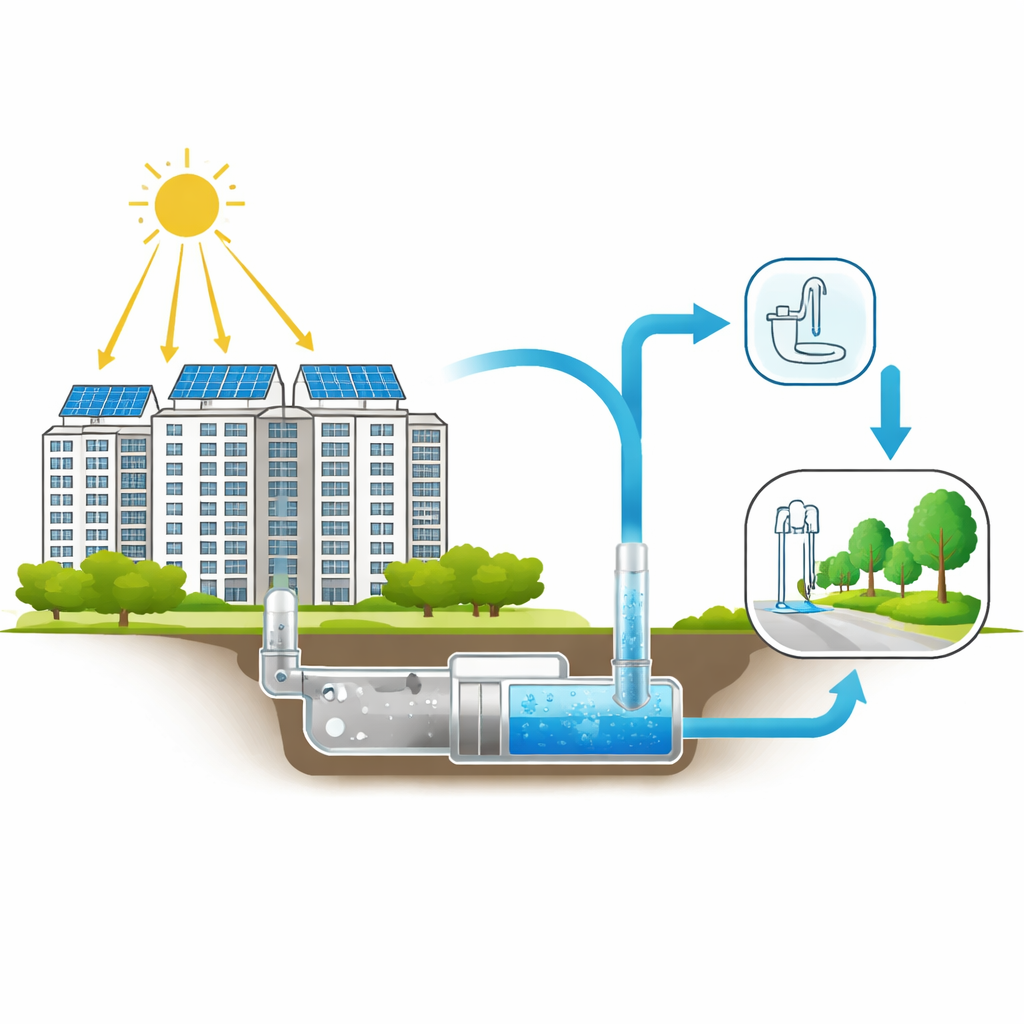
Why Used Water Still Has Value
Most homes send all their used water down the drain, mixing relatively clean flows from showers, basins, and washing machines (known as greywater) with water from toilets (blackwater). Greywater is far less polluted than sewage and, with proper treatment, can safely be used again for things that do not require drinking-quality water. In Egypt, where farms, factories, and power plants already release huge amounts of untreated wastewater into the Nile, tapping into greywater offers a way to ease pressure on the country’s limited freshwater supplies. The study focuses on a luxury residential compound with around 45,000 residents, asking how much greywater it can collect, clean, and reuse—and what that means for water savings.
How the Recycling System Would Work
The compound’s residents are expected to use about 250 liters of tap water per person per day, creating some 9,000 cubic meters of wastewater daily. Based on standard design values, roughly 6,300 cubic meters of that is greywater that can be captured before it mixes with toilet flows. The proposed system channels this stream into a dedicated treatment line that uses proven steps: adding chemicals to clump fine particles, passing the water through a layered filter bed to remove remaining solids, and then disinfecting with chlorine. With a small amount of water set aside to periodically wash the filters, the plant is designed to recover about 95 percent of the incoming greywater over a full year.
From Dirty to Useful Again
Once treated, the reclaimed water is stored in tanks and pumped back into the buildings for toilet flushing and potentially to irrigate parks and green areas. The study shows that the system would produce about 2.18 million cubic meters of clean water per year, more than double the 985,500 cubic meters needed annually to flush all toilets in the compound. In other words, toilet use—not treatment capacity—limits how much tap water can be replaced. Any extra volume could be routed to watering lawns and trees, further cutting demand on the city’s drinking-water network. Designed to be monitored routinely for clarity, basic chemistry, and germs, the system aims to keep the reused water safely within accepted health guidelines. 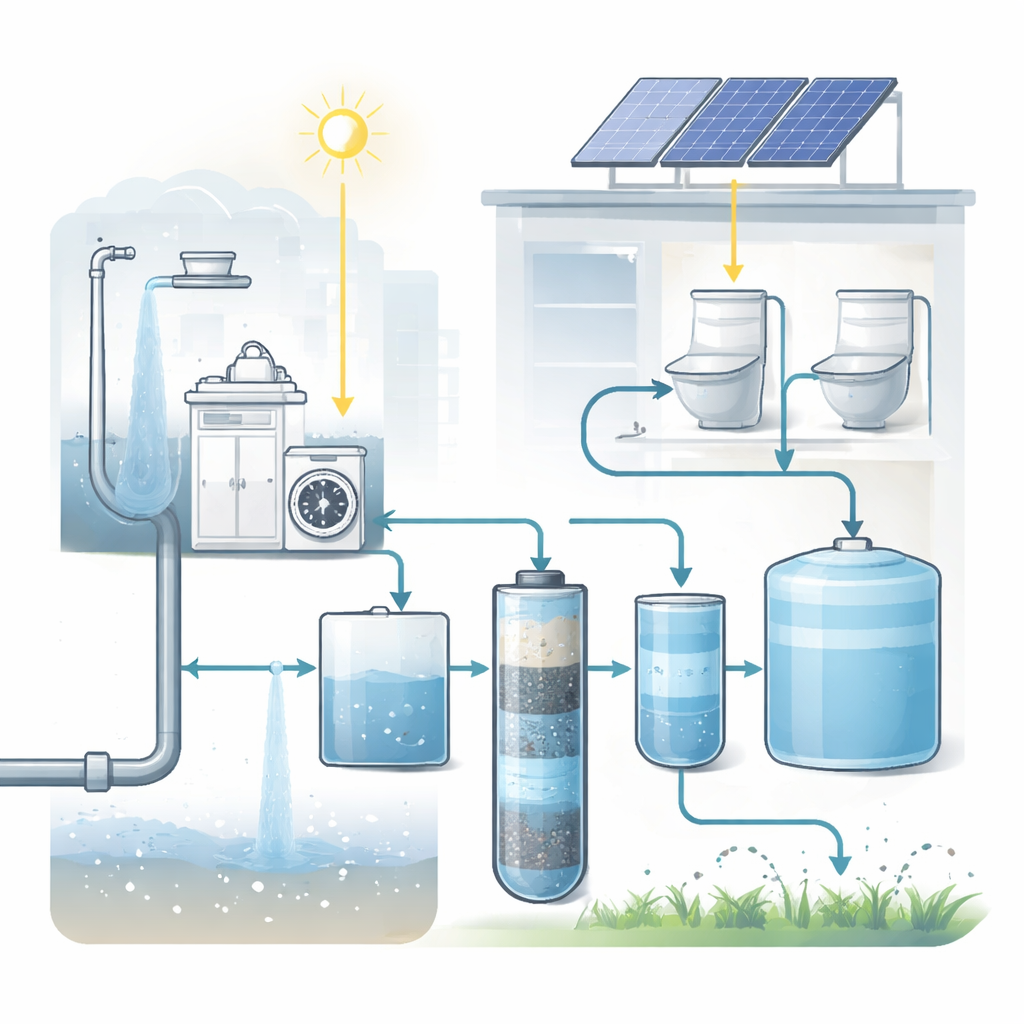
Power from the Rooftops
The second half of the concept deals with electricity. Egypt’s clear skies and long sunshine hours make it an ideal setting for solar power. The study sizes rooftop solar panel arrays for each of the compound’s 365 buildings and connects them in a grid-tied microgrid. These panels are expected to supply about 29–30 percent of each building’s electrical needs, with the rest coming from the national grid. Although the upfront investment is high—about 666 million Egyptian pounds—the panels cut the annual electricity bill by more than five million pounds. Under current price assumptions, the extra cost pays for itself in roughly ten years, and a simple sensitivity test suggests that performance remains attractive even if sunlight or system output is somewhat lower than expected.
What It Costs and What It Saves
Building the greywater system, including indoor piping, outdoor networks, and the treatment plant, is estimated at 3.37 million US dollars. Day-to-day running costs—covering energy, chemicals, routine checks, and minor repairs—come to around six cents per cubic meter of water processed. Spread over a 20-year life, this works out to a "levelized" cost of about 0.13 dollars per cubic meter of treated water and about 0.31 dollars per cubic meter of tap water actually replaced in toilets. Because the system creates more treated water than the toilets alone can use, adding more non-drinking uses would improve the economics further, making each unit of investment stretch across more saved drinking water.
A Blueprint for Thirsty Cities
In simple terms, the study shows that a large housing compound in New Cairo could safely reuse most of its lightly used household water and cover close to a third of its power needs with rooftop solar panels—all using off-the-shelf technology and clear design rules. The greywater system alone could replace nearly one-tenth of the community’s total tap-water demand, while the solar arrays would trim energy bills and carbon emissions for decades. Together, these measures offer a concrete blueprint for how fast-growing, water-stressed cities can use what they already have—wastewater and sunshine—to build more secure and sustainable neighborhoods.
Citation: Abdo, A., Othman, A.M. & Ahmed, D. Greywater recycling and solar photovoltaic integration for sustainable water and energy management in urban Egypt. Sci Rep 16, 14389 (2026). https://doi.org/10.1038/s41598-026-49932-y
Keywords: greywater reuse, solar energy, urban sustainability, water conservation, Egypt