Clear Sky Science · en
Generation of multi-form exact wave solutions and linear stability analysis in the generalized (3+1)-D P-type plasma system using a modified extended mapping technique
Waves in a charged cosmic sea
Plasma, often called the fourth state of matter, fills stars, fusion devices, and much of outer space. This study dives into how complex waves move through such charged gases, uncovering a catalog of wave shapes that can form and testing which of them can travel steadily without falling apart. These insights help scientists better understand signal transport, energy focusing, and stability in advanced plasma and optical systems.
Why wave shapes matter
In many natural and technological settings, the behavior of a system is governed not by simple, gentle ripples but by intense, sharply focused waves. In plasmas and light-guiding structures, these special waves, called solitons, can carry energy over long distances while keeping their shape. The authors focus on a mathematical model that describes three-dimensional waves in a plasma and ask two key questions: what wave forms can this model support, and are the steady states stable when tiny disturbances are present?
A new way to scan the wave landscape
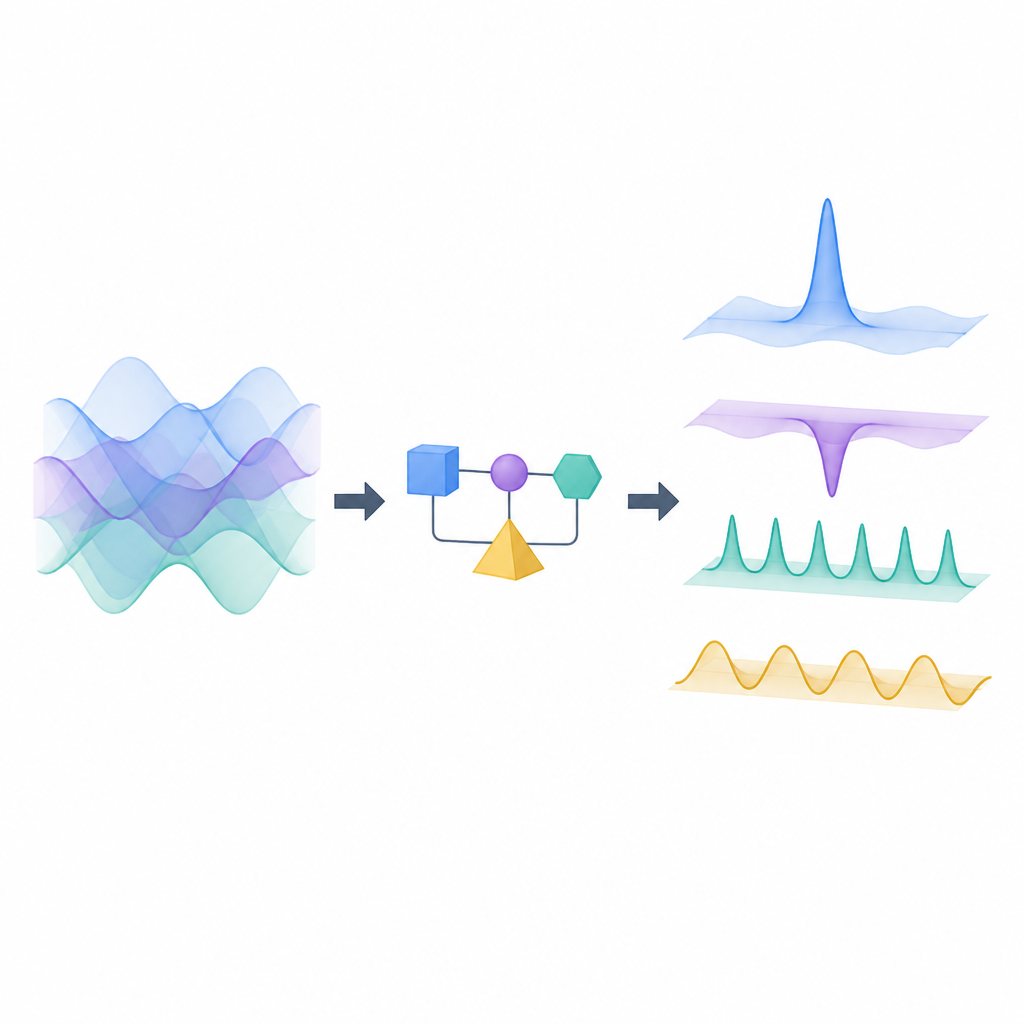
To explore this model, the researchers use an analytical tool known as the modified extended mapping method. Instead of solving the wave equation case by case, this method turns the problem into a simpler one involving an auxiliary function whose behavior is easier to describe. By carefully choosing how this helper function behaves, the team systematically generates many exact wave solutions. This framework reveals how different choices of parameters in the equation control a wave’s height, width, and speed, and whether it becomes localized or repeats in space.
Many faces of the same wave
The method uncovers a wide variety of wave forms. Some are bright solitons, which appear as isolated pulses rising above a calm background. Others are dark solitons, which look like local dips carved out of an otherwise uniform level. The study also finds singular solitons and singular periodic waves, where the wave height becomes extremely sharp, representing strong concentration of energy and mathematically allowed but often less physical states. In addition, the authors identify solutions based on Jacobi elliptic functions, which smoothly bridge the gap between fully localized pulses and regular repeating patterns as a single control parameter is varied.
Following the motion in three dimensions
To make these abstract solutions more tangible, the team plots several examples as three-dimensional surfaces, contour maps, and cross sections. These visualizations show, for instance, trains of repeating spikes, single bright pulses that maintain their profile while traveling, and dark notches that move without spreading. By examining how the patterns depend on space and time in multiple directions, the figures highlight how the same underlying equation can generate very different physical scenarios in a plasma, from strong focusing to regular oscillations.
Testing whether waves stay in line
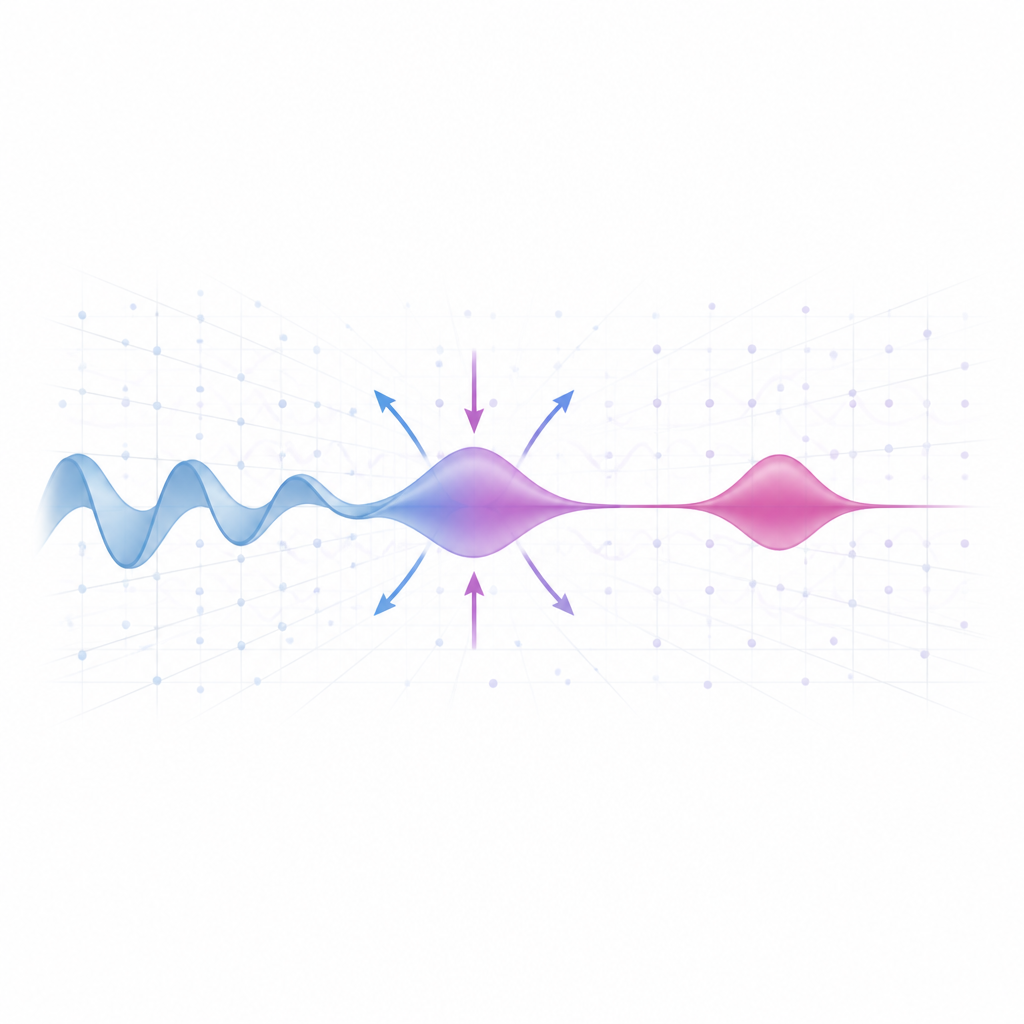
The researchers then probe stability by gently disturbing a uniform background state and tracking how the disturbance evolves. They look for simple wavelike disturbances and derive a relation that links their frequency to their spatial pattern. This calculation shows that, for generic choices of the model’s parameters, the growth rate of such disturbances is purely imaginary, meaning the perturbations only oscillate and do not grow or die out over time. In practical terms, the background is neutrally stable: it neither amplifies noise into wild behavior nor damps it away completely.
What this means for plasmas and devices
Overall, the study shows that this three-dimensional plasma model can host a rich family of exact wave patterns and that its steady states are not prone to the kind of instability that would make waves break up. For a nonspecialist, the key message is that the authors have mapped out both the possible shapes waves can take in such a medium and how robust those waves are against small disturbances. This kind of understanding is important groundwork for interpreting experiments and designing systems where controlled, stable wave propagation in plasmas or advanced optical media is essential.
Citation: Ghayad, M.S., Ahmed, H.M., Badra, N.M. et al. Generation of multi-form exact wave solutions and linear stability analysis in the generalized (3+1)-D P-type plasma system using a modified extended mapping technique. Sci Rep 16, 15173 (2026). https://doi.org/10.1038/s41598-026-49817-0
Keywords: plasma waves, soliton solutions, wave stability, nonlinear dynamics, Jacobi elliptic waves