Clear Sky Science · en
Evaluation of Pontederia crassipes as bioindicator of heavy metals in Lake Manzala, Egypt
Why this matters for lakes and people
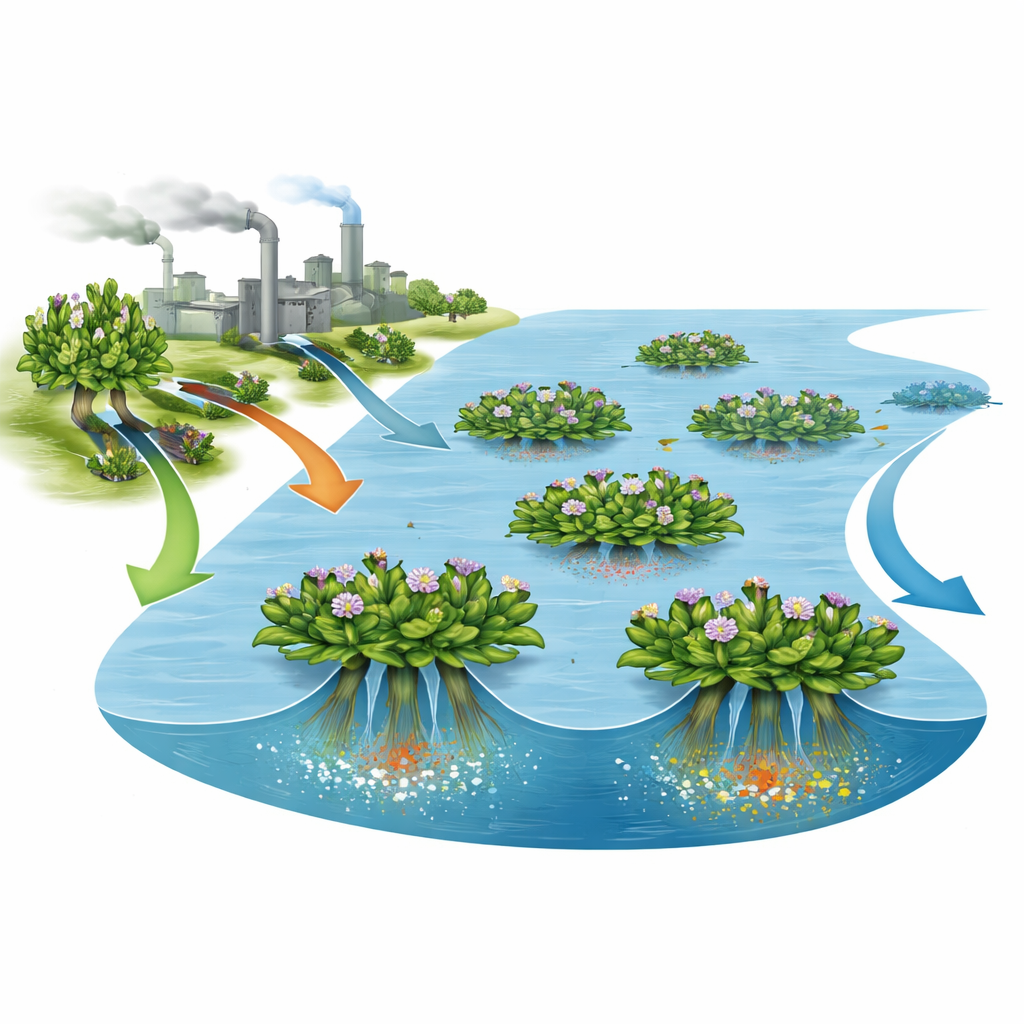
Across the world, lakes and rivers are quietly collecting toxic metals from farms, factories, and cities. These pollutants do not break down and can move up the food chain into the fish we eat. In Egypt, Lake Manzala is a vital source of fish and income for thousands of families, yet it lies downstream of major drainage canals. This study asks a surprisingly hopeful question: can a common floating plant, often treated as a weed, help reveal and reduce this invisible metal burden in the lake?
A busy lake under pressure
Lake Manzala, Egypt’s largest coastal lake on the Mediterranean shore, supports a thriving fishing community but is also a sink for agricultural runoff, industrial discharge, and household wastewater. The authors sampled water and a widespread floating plant, water hyacinth (Pontederia crassipes), at three sites spanning more and less polluted parts of the lake. They focused on six metals of concern—iron, zinc, copper, lead, nickel, and cadmium—because these are common in fertilizers, sewage, and industrial effluents, and can harm both aquatic life and human health when present at high levels.
The weed that thrives in dirty water
Water hyacinth is notorious for its explosive growth and ability to blanket waterways. Those same traits make it interesting as a natural cleanup tool: it produces a lot of biomass, has thick, dangling roots, and tolerates harsh conditions. In this study, researchers collected roots and leaves from plants at each site, then dried, ground, and chemically analyzed them. They compared metal levels in the plant tissues to those in the surrounding water using standard ratios that describe how strongly a plant draws metals from water and how readily it moves them from roots into above-water parts.
Where the metals collect
The lake water itself showed clear signs of heavy contamination, especially at the northeastern site closest to major drainage canals. Metal levels followed a consistent pattern: iron was highest, followed by zinc and copper, with lead, nickel, and cadmium at lower but still worrisome levels. When the team looked inside the plants, they found that water hyacinth soaked up all six metals, but mostly trapped them in its roots rather than in its leaves. For every metal and at all sites, the roots held much higher concentrations than the floating foliage. Statistical tests showed that as metal levels in water increased, levels in both roots and leaves rose as well—strong evidence that the plant’s metal content mirrors the lake’s pollution.
How the plant acts as a living filter
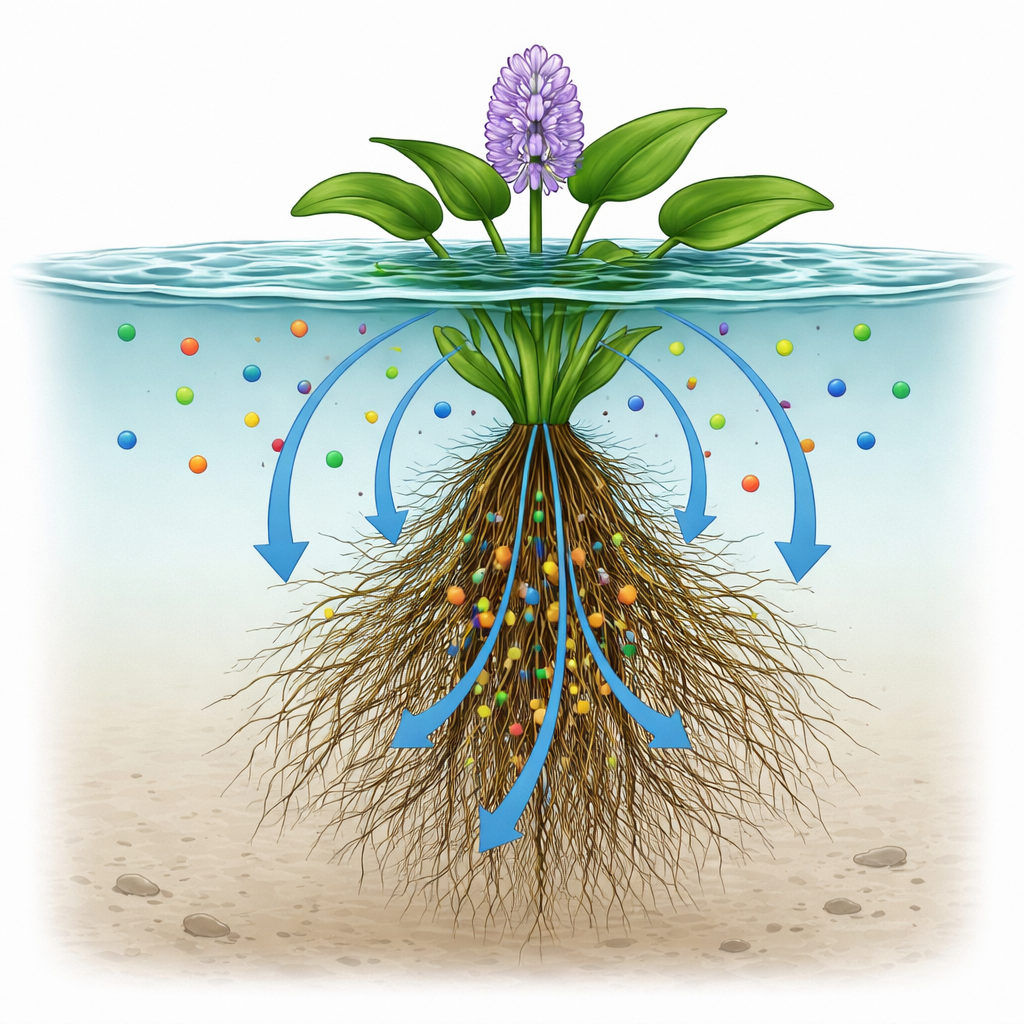
To judge the plant’s usefulness, the researchers calculated three key ratios. The first two—how much metal accumulates in roots and leaves compared with water—were generally greater than one, meaning the plant concentrated metals far above the levels found in the lake. The third ratio—how easily metals move from root to leaf—stayed below one for all metals at all sites. This pattern shows that water hyacinth is very good at pulling metals out of the water and locking them in its submerged roots, but it does not readily send them into the above-water parts that might be eaten by animals. In other words, the plant behaves more like a stabilizing barrier than a pump that exports metals into the air or food web.
What this means for cleaning and tracking pollution
Because metal levels in water hyacinth closely track those in the surrounding lake water, the species can serve as a living gauge of pollution in Lake Manzala and similar wetlands. At the same time, its dense root mats act like underwater filters, capturing and holding iron, zinc, copper, lead, nickel, and cadmium that would otherwise remain free in the water or settle only loosely into mud. The authors conclude that this abundant plant plays a dual role: it is both a sensitive indicator of heavy metal contamination and a natural stabilizer that helps keep these metals confined. Managed carefully, water hyacinth could become part of low-cost strategies to monitor and reduce metal pollution, helping protect fish stocks and water quality for communities that depend on lakes like Manzala.
Citation: Ramadan, S., Elshamy, M.M. & Nafea, E.M. Evaluation of Pontederia crassipes as bioindicator of heavy metals in Lake Manzala, Egypt. Sci Rep 16, 14643 (2026). https://doi.org/10.1038/s41598-026-49783-7
Keywords: water hyacinth, heavy metal pollution, Lake Manzala, phytoremediation, aquatic bioindicator