Clear Sky Science · en
Projecting water availability and quality for reuse under scarcity in the Bahr El-Baqar catchment in Egypt using the SIWARE model
Why this matters for people and food
In a country as dry as Egypt, every drop of water counts twice: once for people and once for food. This study looks at how Egypt can safely reuse water drained from farms in the Eastern Nile Delta when the Nile’s flow is under pressure. By asking what happens to both the amount and the saltiness of this drainage water as supplies shrink, the work sheds light on how to keep fields productive and taps running in a future with less certainty.
Egypt’s tight water budget
Egypt relies on a fixed share of Nile water that no longer keeps pace with population growth, upstream dams, and a changing climate. To close the gap, the country increasingly turns to agricultural drainage water—the runoff that leaves fields through a web of ditches and pipes. This water can be reused for irrigation, but it comes with a catch: it often carries high levels of dissolved salts that can damage crops and soils. Egyptian law sets a safety line at 2000 parts per million of total dissolved solids. Crossing that line risks lower harvests and long‑term soil harm, so planners must understand where and when reuse is safe.
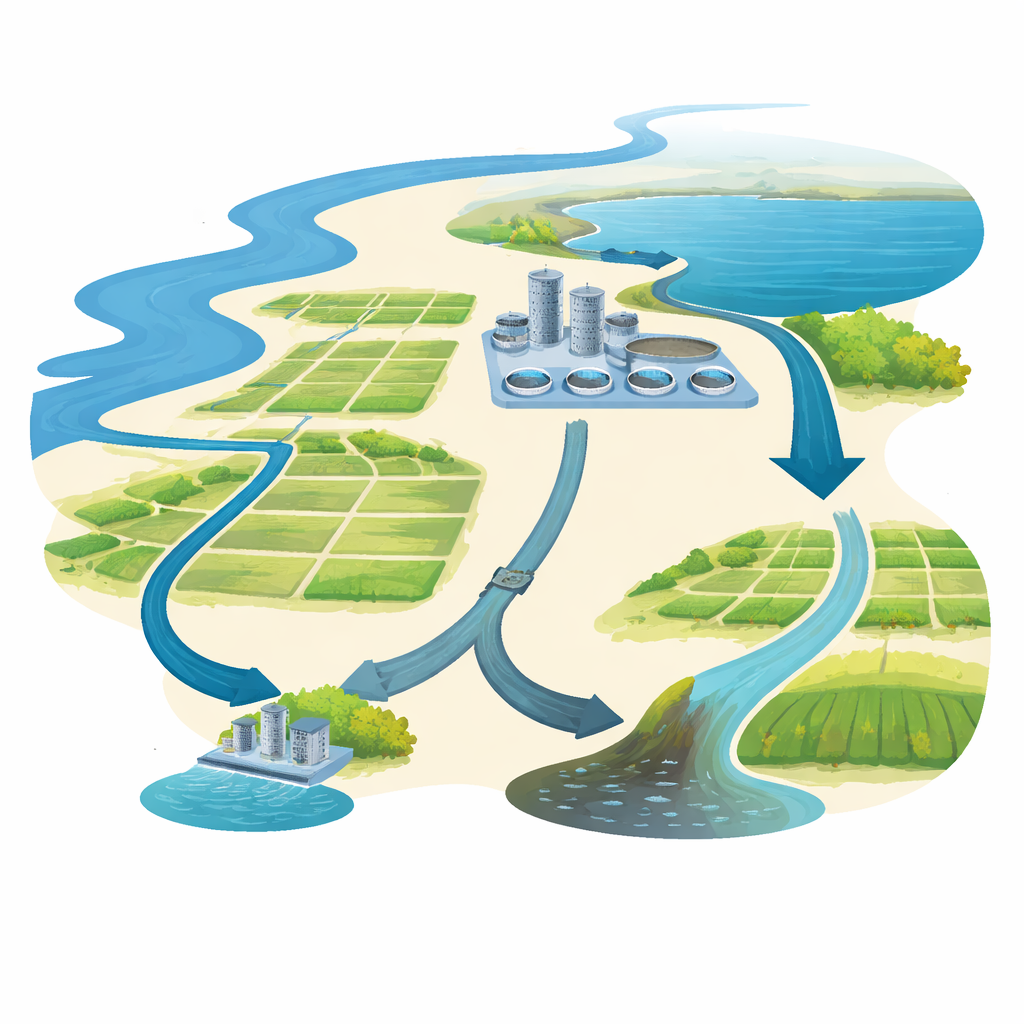
Two key control points on the drainage network
The study focuses on the Bahr El‑Baqar catchment, a strategically important drainage basin in the Eastern Nile Delta. Here, two main control points shape how reused water is managed. One is the Bahr El‑Baqar Feeder, which collects drainage from a large area and sends it under the Suez Canal to the world’s largest wastewater treatment plant. The other is the Bilad El‑Ayad Pump Station, which lifts blended drainage and fresh water directly to local farmers’ fields. These two sites represent very different fates for reused water: one headed for advanced treatment, the other going almost straight back onto crops.
Using a digital twin of the delta
To explore future conditions, the researchers used a detailed computer model called SIWARE that mimics how water moves, is reused, and picks up salt across the Nile Delta. They divided the region into more than a hundred small units, each with its own soils, crops, canals, drains, and groundwater behavior. After carefully tuning and checking the model against real‑world measurements from 2020 and 2021, they ran a series of “what‑if” experiments. In these experiments, the freshwater supply to the Eastern Delta was gradually cut from today’s level down to half, in steps of 5%, while everything else—climate, crops, and infrastructure—was held constant.
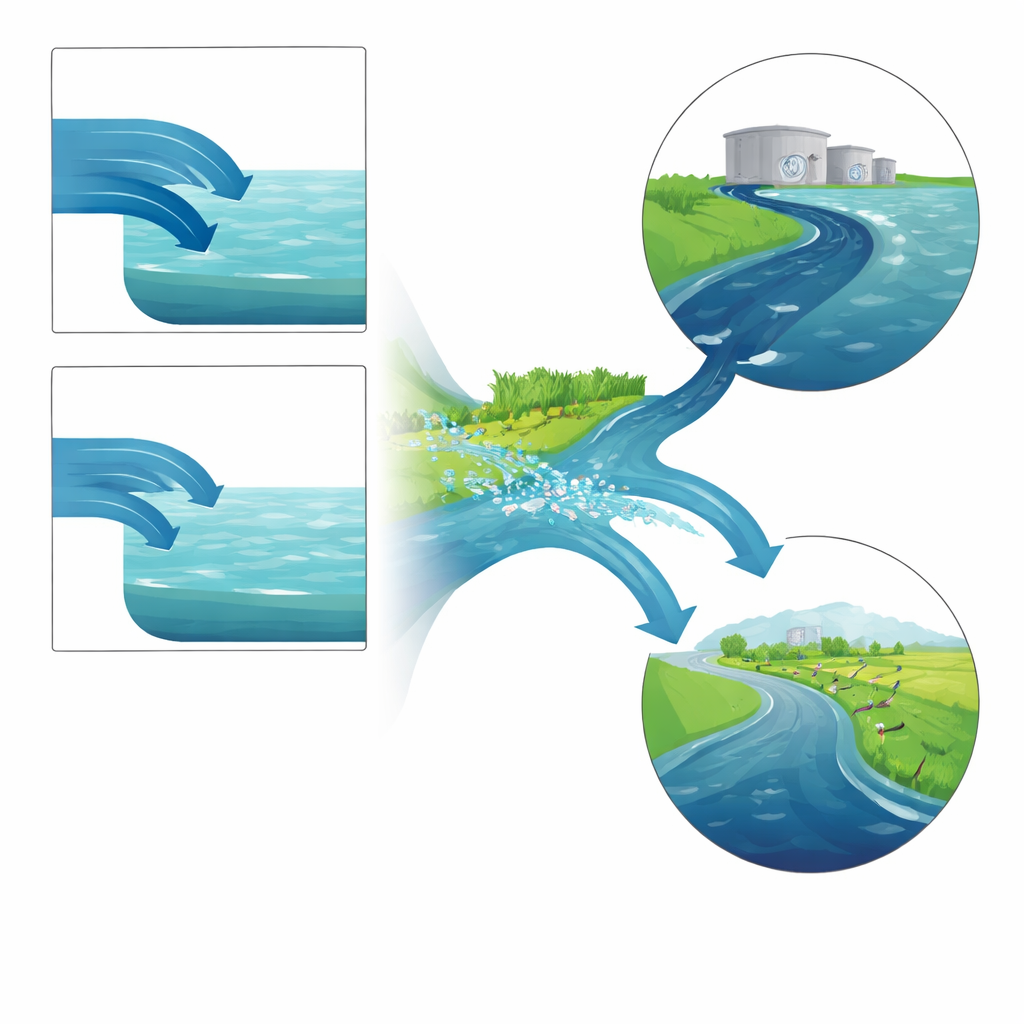
How less water changes salt and flow
The model shows that the two control points react very differently to scarcity. At the Bahr El‑Baqar Feeder, salt levels are already too high today, at around 2200 parts per million. As the freshwater share shrinks, this problem worsens sharply: with a 50% cut, salt levels climb above 3000 parts per million and the amount of water flowing through the feeder falls by nearly half. This happens because there is less clean water to dilute salts, drainage water spends longer in the system, and farmers upstream turn more to informal reuse, recycling salts again and again. In contrast, the Bilad El‑Ayad Pump Station stays comfortably below the legal limit even under the same severe cut, with salt levels rising only modestly from about 550 to 640 parts per million, though its flow also declines strongly.
Tools for planning under pressure
The team translated these model runs into simple curves that link any chosen cut in Nile water to the resulting salt level and flow at each control point. These curves fit the data very well and give planners a quick way to estimate future conditions without re‑running the full model. The results highlight that a one‑size‑fits‑all policy will not work. The Bahr El‑Baqar Feeder emerges as a hot spot where extra measures are unavoidable, such as membrane‑based treatment to strip out salts, attacking salt sources upstream, adjusting when water is abstracted to take advantage of naturally cleaner periods, or shifting nearby farms toward more salt‑tolerant crops. At Bilad El‑Ayad, the priority is different: preserving enough volume to irrigate fields, since quality remains acceptable over a wide range of scenarios.
What this means for Egypt’s water future
For non‑specialists, the main message is that reusing drainage water can ease Egypt’s water stress, but only if managed in a targeted, site‑specific way. Some parts of the network, like Bilad El‑Ayad, can safely reuse more water even in dry years, while others, like the Bahr El‑Baqar Feeder, already push the limits of salinity and will need active treatment and better upstream practices. By turning complex model behavior into simple relationships and a menu of practical actions, this study offers a roadmap for keeping both taps and crops supplied in an era of tightening water scarcity.
Citation: Abdul-Muttalib, M.A., El-Saadi, A., El-Gazzar, H. et al. Projecting water availability and quality for reuse under scarcity in the Bahr El-Baqar catchment in Egypt using the SIWARE model. Sci Rep 16, 14165 (2026). https://doi.org/10.1038/s41598-026-49708-4
Keywords: agricultural drainage water, water reuse, salinity, Nile Delta, water scarcity