Clear Sky Science · en
Analysis of capivasertib via ion-pairing with erythrocin B as a spectrofluorometric probe
Why this study matters for everyday health
Modern cancer drugs can be powerful allies in treatment, but only if we can measure them quickly, accurately, and safely in the lab. This study focuses on capivasertib, a targeted therapy used in certain breast cancers, and introduces a new way to measure tiny amounts of the drug without relying on harsh chemicals. For patients, this kind of advance supports safer manufacturing, better quality control, and potentially more accessible testing in routine hospital and pharmacy laboratories.
A cancer drug that needs careful tracking
Capivasertib is designed to shut down a key growth switch inside cancer cells, helping to slow tumors and trigger cell death. As its clinical use grows, laboratories need reliable methods to check how much of the drug is present in tablets and, potentially, in blood samples. Existing methods either require expensive equipment, such as advanced mass spectrometers, or depend on toxic organic solvents and complex preparation steps. These drawbacks limit their use in smaller laboratories and run counter to the growing push for more environmentally responsible chemistry.
A gentler way to make the drug “light up”
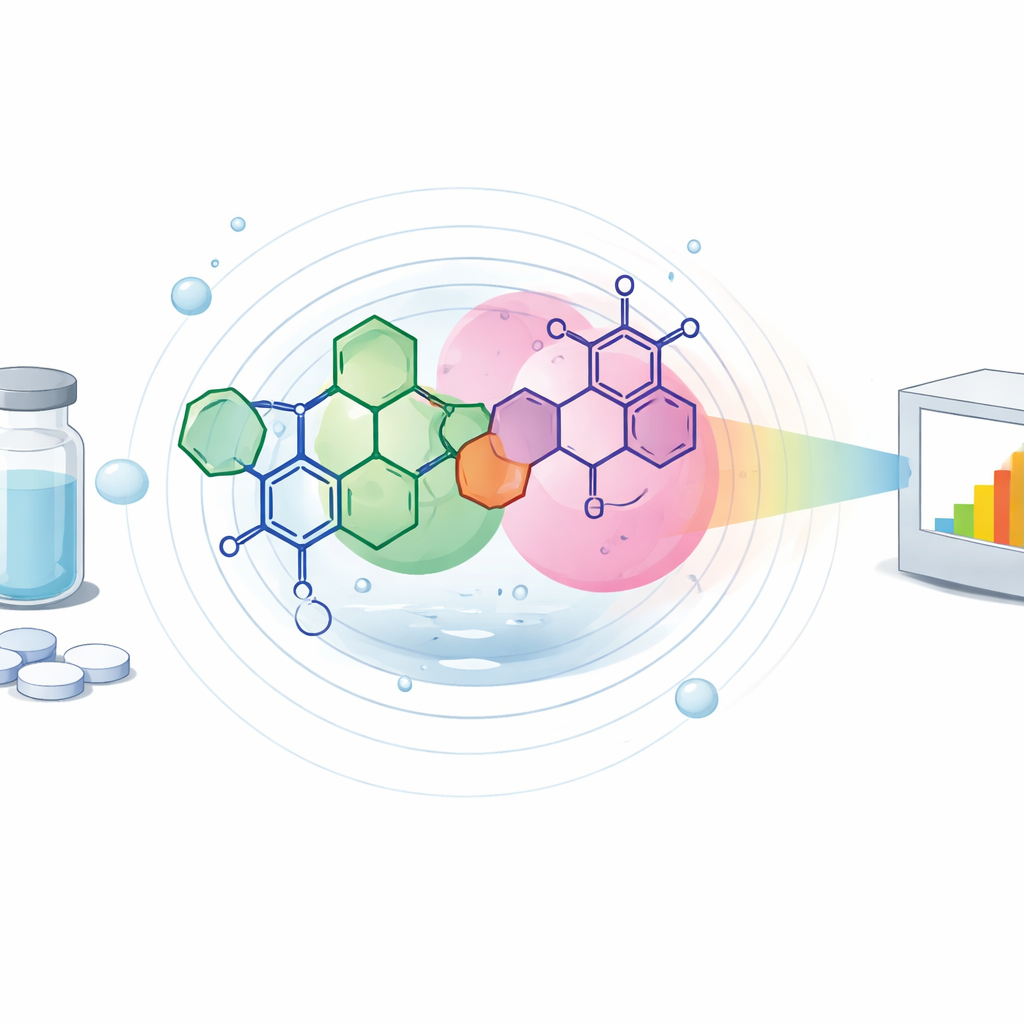
The researchers developed a simple water-based test that takes advantage of how light behaves when it meets tiny particles. They mixed capivasertib with a food-dye-like compound called erythrosine B in gently acidic water. The drug and the dye stick together to form a small, charged complex. When light shines on this complex, it scatters in a distinctive way known as resonance Rayleigh scattering. By measuring how the scattered light changes as more drug is added, the team can determine the amount of capivasertib present down to billionths of a gram per milliliter, well within the range needed for pharmaceutical testing.
Fine-tuning the conditions for a clear signal
To turn this idea into a reliable lab test, the team carefully adjusted the reaction conditions. They found that the complex forms best at a mildly acidic pH of about 4, using a simple acetate buffer, and that just the right amount of dye is needed for a strong, stable signal. Pure water turned out to be the best and greenest liquid to carry the reaction, outperforming common organic solvents such as methanol and ethanol, which actually weakened the signal. The complex formed quickly at room temperature and remained stable long enough for convenient measurement. Under these conditions, the light-scattering response was linear across a wide concentration range, and the test met international guidelines for accuracy, precision, and robustness.

Proving it works on real medicines
The method was then applied to commercial capivasertib tablets. After simply dispersing and sonicating the tablets in water, the team could measure the drug content without interference from the usual tablet additives. When they compared results with earlier fluorescence and chromatography methods, the new test matched them in accuracy while offering easier operation, lower cost, and far fewer chemical hazards. Because it uses only water, small amounts of buffer, and a safe dye, the method can be adopted in routine quality-control labs without specialized infrastructure.
Measuring “greenness,” “whiteness,” and real-world usefulness
Beyond analytical performance, the researchers formally assessed how eco-friendly and practical their method is using a suite of modern scoring tools. These tools evaluate factors such as chemical hazards, waste generation, energy use, cost, and overall usefulness. The new test scored highly on all fronts, outperforming previous methods in environmental impact while also ranking well for efficiency and day-to-day applicability. The authors note that the sensitivity of the method is high enough to be adapted to blood samples in the future, with only simple, water-based preparation steps.
What this means going forward
In plain terms, this work shows that it is possible to monitor an important cancer drug using a quick, sensitive, and much greener laboratory test. By replacing hazardous solvents with water and using a safe dye to create a light-responsive complex, the method supports both patient safety and environmental responsibility. It offers a practical tool for ensuring that capivasertib tablets contain the right dose today, and it lays the groundwork for cleaner, more accessible monitoring of advanced cancer therapies in the years ahead.
Citation: Salem, H., Raafat, H., Alaa, A. et al. Analysis of capivasertib via ion-pairing with erythrocin B as a spectrofluorometric probe. Sci Rep 16, 14019 (2026). https://doi.org/10.1038/s41598-026-49688-5
Keywords: capivasertib, green analytical chemistry, fluorescence, cancer drugs, quality control