Clear Sky Science · en
A numerical and experimental approach to oil recovery performances during combined xanthan gum and carbon dioxide flooding
Why squeezing more oil from old rocks matters
Even after an oil field has pumped for decades, much of its oil remains stubbornly trapped in the rock. Getting more of that oil out can delay the need for new drilling and, if done smartly, also help lock away carbon dioxide (CO2) underground. This study explores a cleaner, bio-based way to boost oil production by teaming up CO2 gas with xanthan gum, a common thickener found in foods and cosmetics, and shows how this pairing can recover far more oil than either method alone.
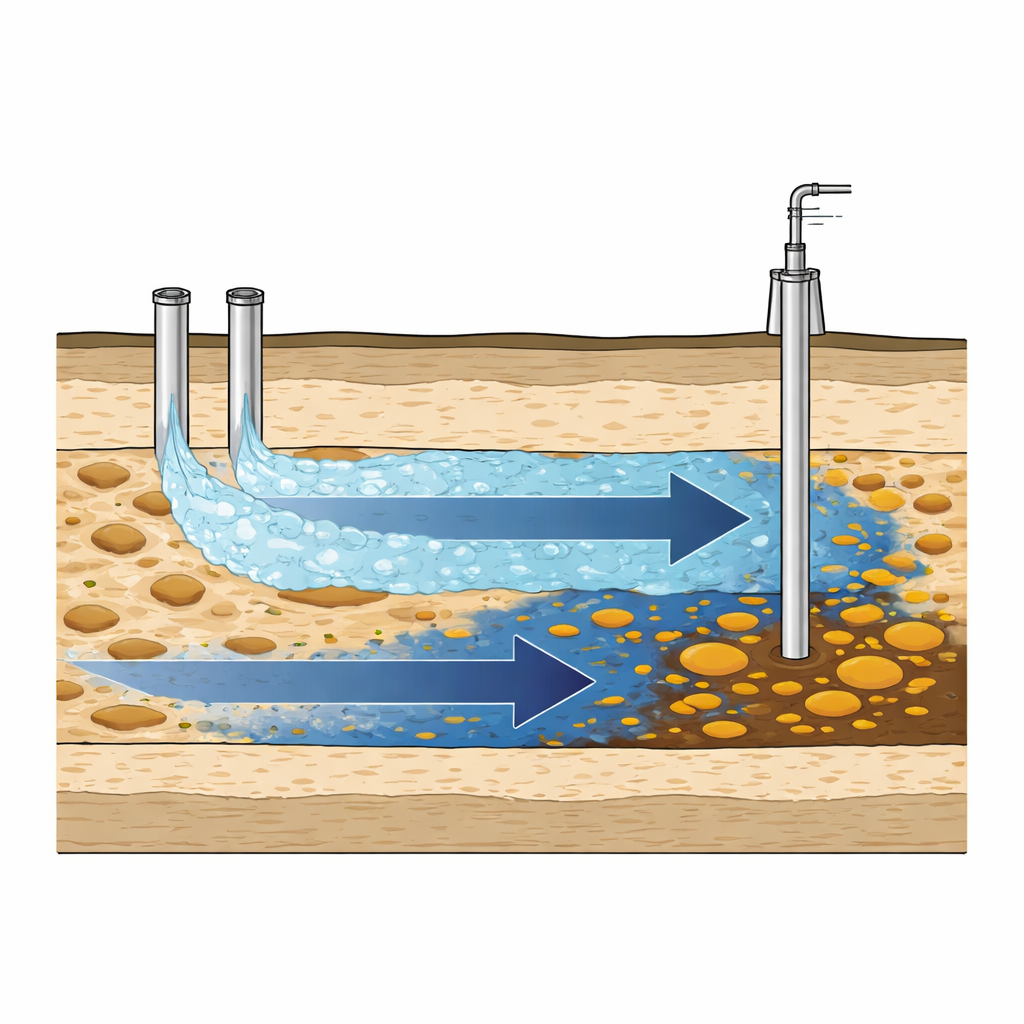
Teaming a kitchen‑shelf gum with a climate gas
Oil companies already use two key tricks when a reservoir ages: injecting CO2 to thin and swell the remaining oil so it can flow, and injecting thickened water (polymer flooding) to push oil more evenly through the rock. CO2 on its own moves too easily, racing through the most open paths and breaking through to production wells early, leaving pockets of oil behind. Polymer flooding pushes more uniformly, but many synthetic polymers struggle in hot, salty conditions underground and raise environmental concerns. Xanthan gum, a biodegradable biopolymer widely used in everyday products, can stay thick even in salty water and at high temperatures. The researchers set out to see whether combining CO2 with xanthan gum could marry their strengths: CO2 to loosen the trapped oil and xanthan to steer the flow so that more of the rock is swept clean.
From lab sand packs to life‑like reservoir rock
To mimic a real oil reservoir, the team packed a steel tube with clean sand of known porosity and permeability, then saturated it with brine and a light to medium crude oil similar to what is produced in many fields. They tested five recovery schemes after an initial water flood: water only (as a baseline); CO2 alone; xanthan gum alone at different concentrations; xanthan followed by CO2; and CO2 followed by xanthan. The xanthan solutions were carefully prepared in very salty water matching formation brine and characterized with a rheometer to see how their thickness changed with flow and temperature. At each step in the flooding experiments, they measured how much extra oil emerged and how the pressure across the sand pack evolved, then used those results to build a computer model representing a much larger sandstone reservoir.
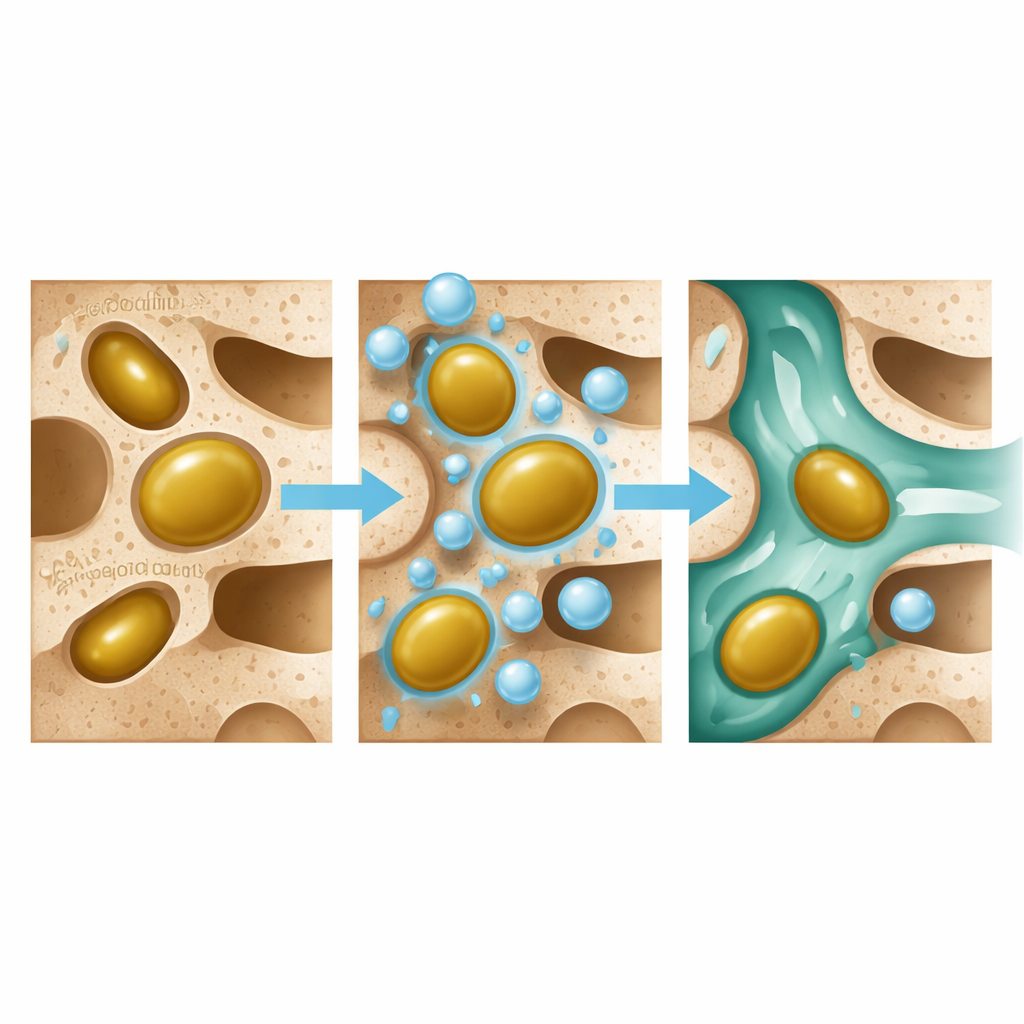
How the gum flows and why the dose matters
Measurements showed that xanthan solutions behave in a helpful way: they are very thick when moving slowly, but become easier to push when flow speeds up, a property known as shear thinning. That means they can be injected through wells without excessive pressure yet remain viscous deeper in the reservoir, where flow is gentle and mobility control is most needed. The polymer also behaves like a weak elastic gel, able to store and release some of the energy of flow. This elastic character helps pull oil droplets out of tight corners in the rock and smooths out the advancing front of injected fluid. Among the concentrations tested, 1.5 grams per liter stood out: more dilute solutions were too weak to control the flow effectively, while more concentrated ones added little extra benefit but risked clogging pores and raising costs.
When order of injection changes everything
The head‑to‑head flooding tests revealed how powerful the combination can be. After water flooding, about 70% of the original oil in place was produced. Switching to CO2 alone raised that to roughly 83%, while polymer alone (at its best dose) reached about 81%. Injecting xanthan first and then CO2 pushed recovery further to around 89%, because the polymer smoothed out the flow paths before the gas arrived. But the most effective strategy flipped that sequence: starting with CO2 to loosen and mobilize trapped oil, then following with a 1.5 g/L xanthan slug. In that case, the total recovered oil climbed to about 94%, a gain of more than 24 percentage points over water flooding and 11 points over CO2 alone. The later polymer injection blocked the easiest gas channels, forced fluids into previously unswept zones, and kept the mobilized oil moving toward the production well rather than leaving it behind.
Scaling up to the size of a real field
Using the experimental data, the researchers built a detailed numerical model of a sandstone reservoir with injector wells around the edges and a producer in the middle. The simulator reproduced the lab trends: combined CO2–xanthan injection led to higher oil production, a slower rise in water production, and more even use of the reservoir volume than water, CO2, or polymer alone. Maps of oil and gas saturation in the model showed that the hybrid process filled in gaps left by simpler floods, with the polymer extending the reach of CO2 and preventing narrow, inefficient channels from dominating the flow. Although the model reservoir was deliberately simpler than real rocks, its behavior closely matched the core experiments, giving confidence that the approach can be transferred to the field.
What this means for future oil and carbon use
For a general reader, the key message is that a familiar, eco‑friendly thickener can help both squeeze more oil from existing fields and make better use of injected CO2. By finding the right dose and, crucially, the right order—injecting CO2 first, then xanthan gum—the study shows that operators could recover much of the remaining oil from mature sandstone reservoirs while storing more CO2 underground and handling less produced water at the surface. This combined method does not eliminate the climate impact of using oil, but it offers a more efficient, potentially lower‑footprint way to tap fields that already exist, buying time as energy systems transition toward cleaner sources.
Citation: El-hoshoudy, A.N., Mansour, E.M. A numerical and experimental approach to oil recovery performances during combined xanthan gum and carbon dioxide flooding. Sci Rep 16, 14018 (2026). https://doi.org/10.1038/s41598-026-49640-7
Keywords: enhanced oil recovery, carbon dioxide flooding, xanthan gum polymer, oil reservoir simulation, carbon storage