Clear Sky Science · en
Wave propagation in a generalized magneto-micropolar thermoelastic medium with gravity and initial stress
Why tiny twists inside solids matter
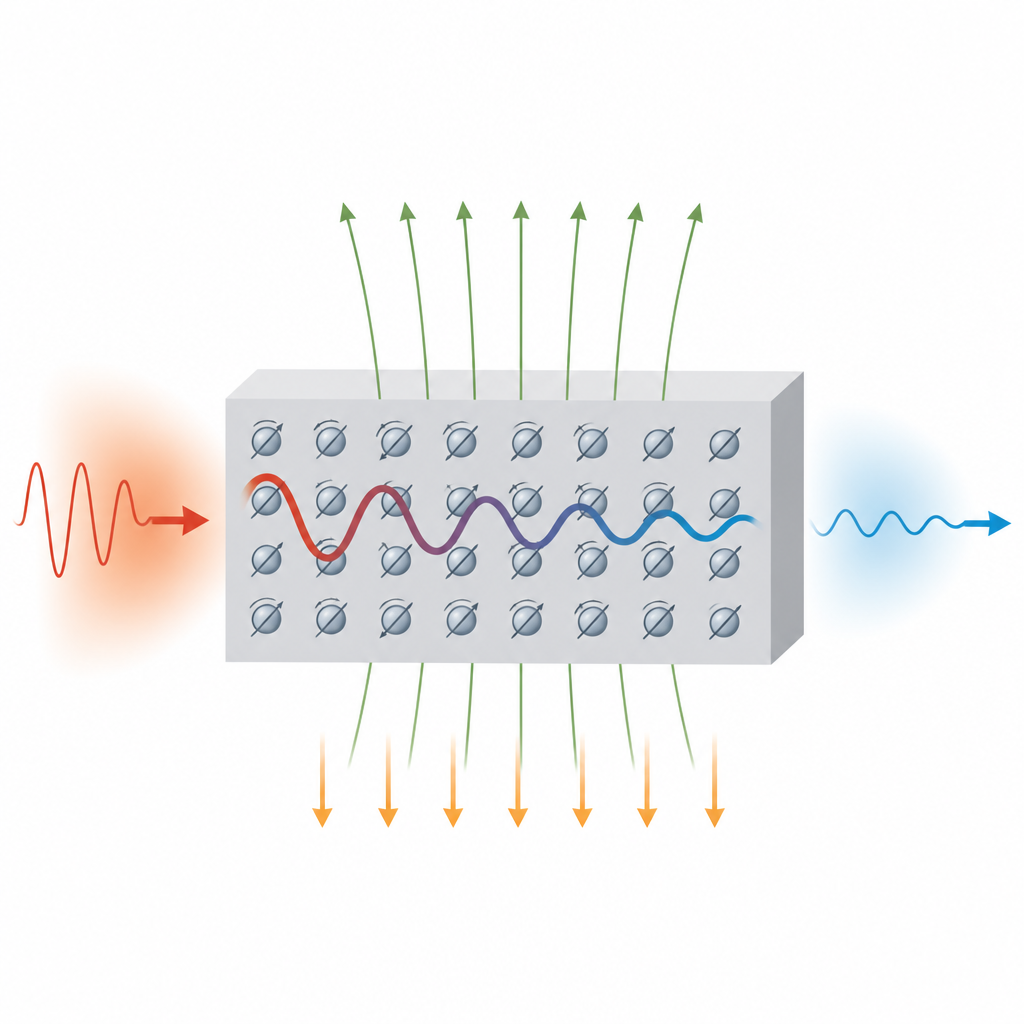
When earthquakes shake the ground or sensors probe aircraft parts, invisible waves race through solid materials. These waves do not travel through a simple, featureless block. Instead, they move through matter that can heat up, carry electric currents, respond to magnetic fields, feel gravity, and even twist at the microscopic level. This study explores how all of these influences combine to shape wave motion in such complex solids, opening doors for better smart materials, safer structures, and clearer views into the Earth.
Waves in a crowded environment
In many real settings, waves in solids must cope with several forces at once. Gravity pulls downward, magnetic fields thread through the material, and the solid may already be squeezed or stretched before any disturbance arrives. The material can warm up, expand, and conduct heat, while electric currents flow under changing magnetic fields. On top of this, some advanced materials allow their tiny building blocks to spin independently, adding extra ways for energy to move and dissipate. The authors focus on this busy environment and ask how waves behave when all these effects are present together, not just one or two at a time.
Building a detailed picture of the material
To tackle this problem, the researchers use a mathematical framework that treats each point inside the solid as able to move, rotate, heat up, and interact with electric and magnetic fields. They write down equations that capture how motion, tiny rotations, temperature changes, and electromagnetic fields push and pull on one another. Gravity and an initial built in stress are included so the medium mimics preloaded structures or deep rocks under pressure. By assuming waves of a particular shape, they obtain analytical formulas for how displacements, stresses, micro rotations, temperature, and magnetic quantities vary with distance and time. This approach provides a controlled way to see which physical ingredient changes the waves and in what manner.
Tracking how waves change with time and fields
With the general solution in hand, the authors turn to computer simulations using realistic data for a magnesium crystal. They examine how the main physical quantities behave as a wave travels away from a heated surface. Over time, temperature and motion spread into the solid, and the associated stresses and microscopic twists grow before gradually fading with distance. Comparing different times shows how thermal energy diffuses inward and how the wave front becomes more damped and dispersed as it moves, revealing how heat and mechanical motion are tightly linked in the material.
Roles of magnetic field, gravity, and built in stress
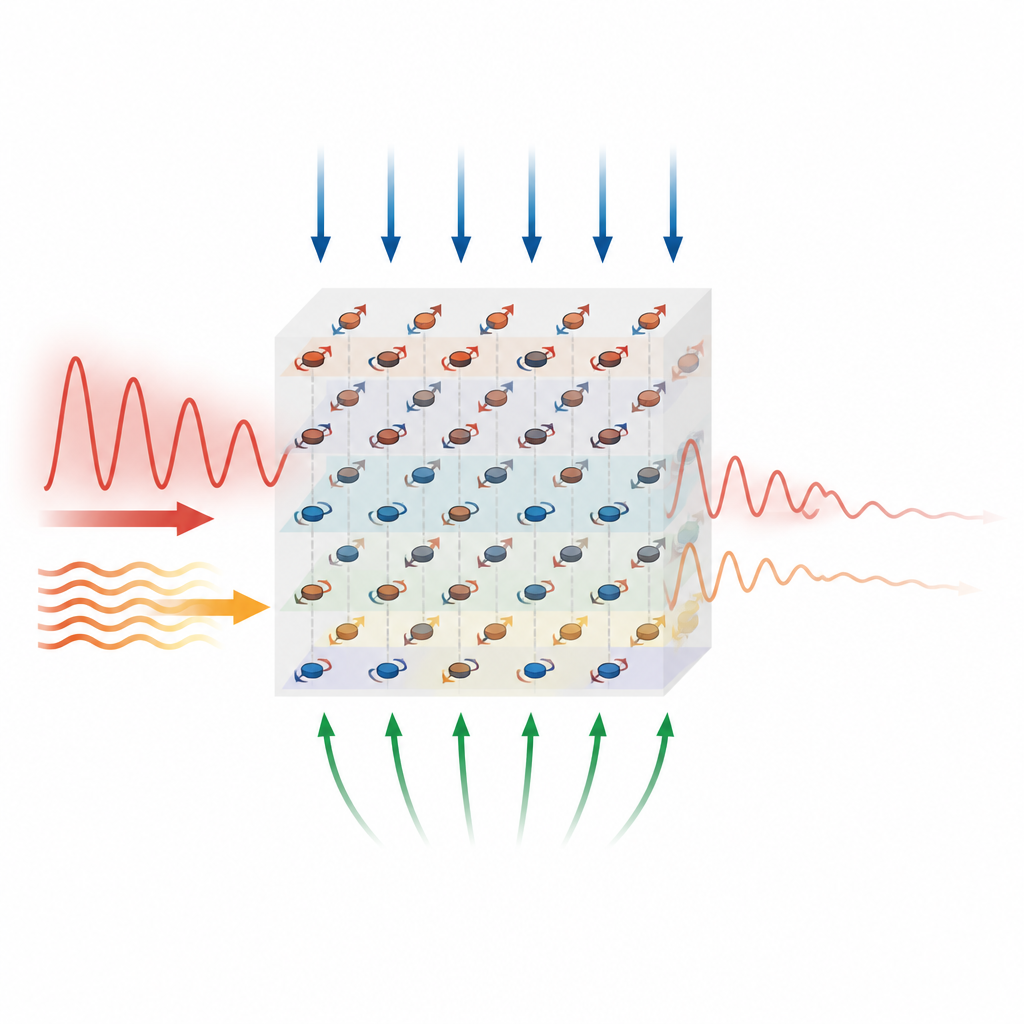
The team then varies the strength of the magnetic field, gravity, and initial stress one by one. A stronger magnetic field tends to lower temperature rise, displacement, and most stresses, while boosting shear and rotational activity due to the influence of electromagnetic forces on the moving charges in the solid. Gravity changes how the wave energy is distributed: it reduces temperature and certain stresses but increases overall displacement and special couple stresses that are tied to micro rotation. Preexisting stress acts like an internal brace that limits how much the material can expand or twist, cutting down temperature changes, motion, and micro rotation while enhancing shear. These patterns show that all three factors can act as tuning knobs for how waves spread and fade.
What the findings mean in practice
The study concludes that wave behavior in such complex solids is extremely sensitive to magnetic fields, gravity, and preloaded stress, especially when microscopic rotations are allowed. For a lay reader, this means that by adjusting these conditions, engineers could design materials where waves travel faster or slower, penetrate deeper or die out quickly, or steer more energy into gentle twisting instead of damaging strain. Such control is important for applications ranging from geophysical models of seismic waves in the Earth’s crust to thermal protection layers on spacecraft and micro devices where heat, electricity, and mechanical motion are tightly intertwined.
Citation: Salah, D.M., Abd-Alla, A.M. & Aljohani, M.A. Wave propagation in a generalized magneto-micropolar thermoelastic medium with gravity and initial stress. Sci Rep 16, 15175 (2026). https://doi.org/10.1038/s41598-026-49576-y
Keywords: thermoelastic waves, magnetoelasticity, micropolar materials, wave attenuation, initial stress