Clear Sky Science · en
Robust ZIF-67/AC/PDMS hybrid nanocomposite for superhydrophobic steel protection
Why keeping steel dry really matters
From ships and bridges to pipelines and factory equipment, steel quietly holds up much of modern life. Yet the same water and salt that make oceans so vital also eat away at steel through corrosion, costing industries billions and threatening safety. This study explores a new, water-repelling coating that makes steel so dry at the surface that droplets barely touch it, dramatically slowing rust and even blocking mineral scale that can clog systems.
A water-hating skin for steel
The researchers designed a thin hybrid coating that combines three ingredients, each with a different job. Tiny crystalline particles called ZIF-67 provide a rough, jagged landscape at the nanoscale. Flake-like activated carbon adds strength and extra texture. A flexible silicone, PDMS, binds everything together and naturally repels water. Applied to steel by a simple dip-coating step, this blend creates a surface where water beads up into nearly perfect spheres instead of spreading out, a state known as superhydrophobicity.
How trapped air keeps rust away
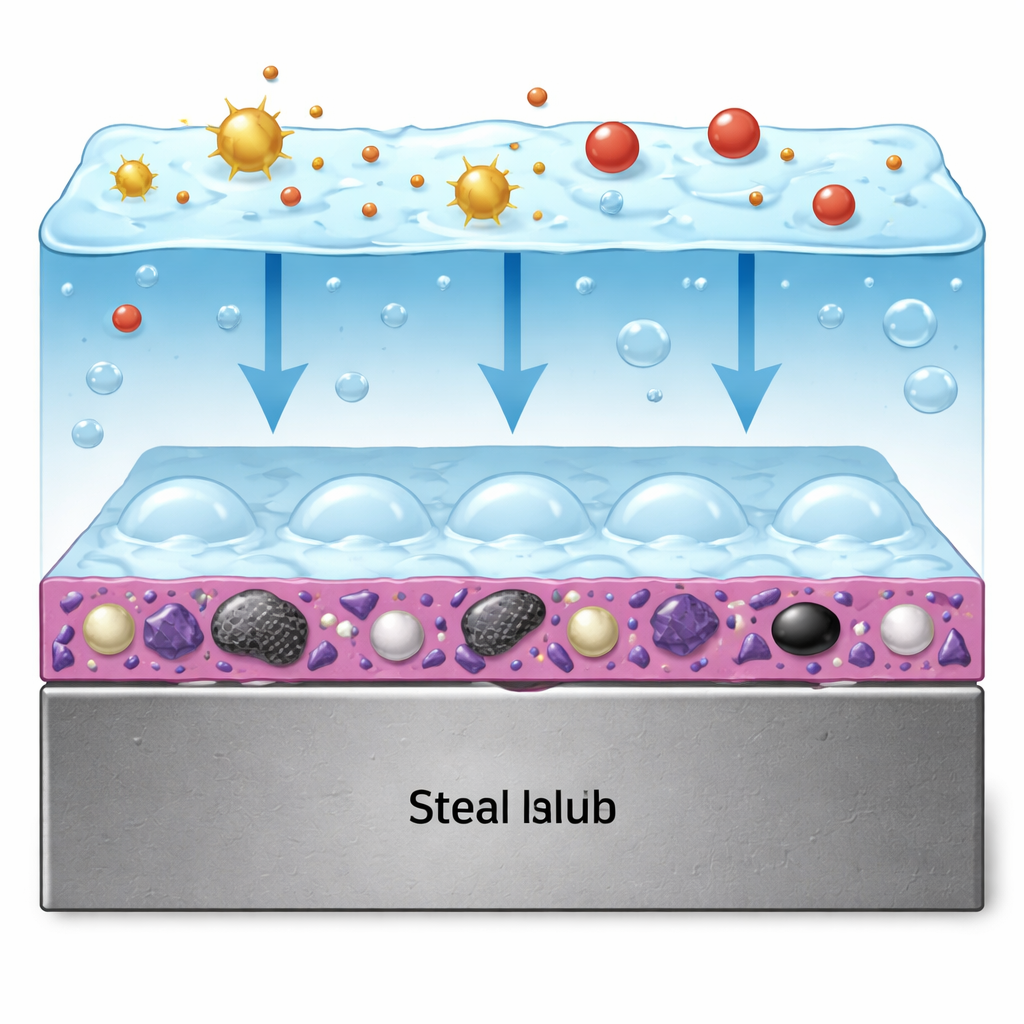
Under the microscope, the most successful version of the coating shows a multi-level landscape of bumps and pores. When a water droplet lands, it rests on the tips of this landscape with tiny pockets of air trapped underneath. This hidden “air cushion” acts like a shield between the liquid and the metal, forcing corrosive ingredients such as salt ions and oxygen to take a long, winding path if they attempt to reach the steel. Measurements of the coating’s electrical behavior in salty water confirm that this barrier is highly effective: the optimized formula increases the resistance to charge flow by about two orders of magnitude compared with uncoated steel, a clear sign that corrosion reactions are strongly suppressed.
Finding the sweet spot in the recipe
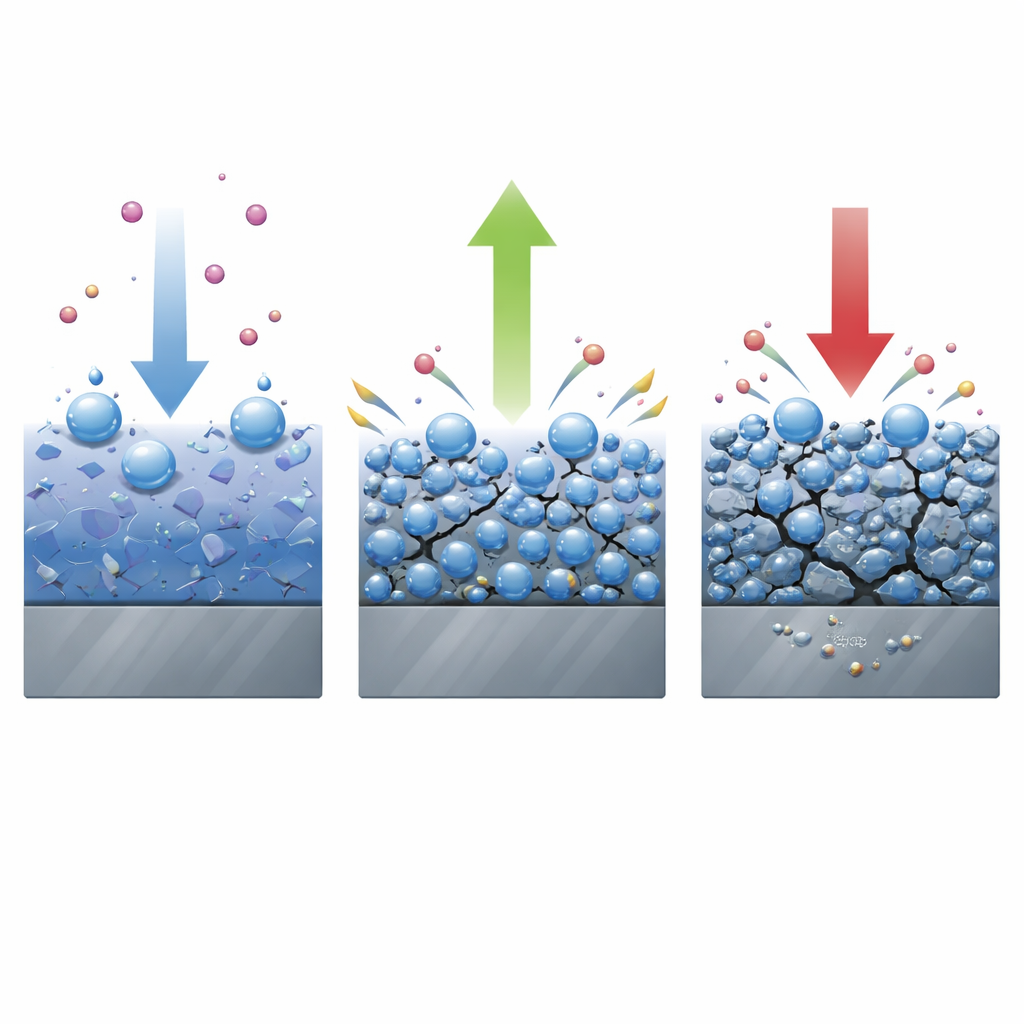
The team tested coatings with different amounts of the ZIF-67/activated carbon filler, labeled S2 to S5. Too little filler left the surface relatively smooth, so water could still wet the coating over time. Too much caused the nanoparticles to clump together, forming cracks and weak spots where water and ions could sneak through. At a middle value of 5 weight percent (sample S4), the surface structure was just right: water contact angles reached about 170 degrees, droplets slid off at tiny tilt angles, and this behavior remained stable for at least 48 hours even in strongly acidic or alkaline solutions. Mechanical tests using repeated tape peeling and abrasion showed that this “sweet spot” coating stayed attached and kept its water-repelling structure.
Guarding against both rust and mineral buildup
Beyond resisting rust, the coating also tackles another common industrial headache: mineral scale. In hot, hard water rich in calcium, deposits of calcium carbonate can form stubborn crusts on metal surfaces, triggering corrosion under the deposits. When the coated samples were placed in a strongly scaling solution at elevated temperature, the optimized coating accumulated roughly half as much mineral as bare steel over 48 hours. The same trapped air and roughness that keep water from wetting the surface also leave fewer places for crystals to start growing and stick.
What this means for real-world steel
By carefully balancing rough particles and a water-repelling binder, this study delivers a coating that keeps steel dry, clean, and protected in aggressive salty and chemically harsh environments. The best-performing formulation combines extreme water beading, high electrical resistance to corrosion, strong mechanical grip, and reduced mineral buildup. Because it can be applied with a straightforward dip process, this hybrid coating concept could be adapted to protect marine structures, industrial pipelines, and heat exchangers, helping them last longer while needing less maintenance.
Citation: Khalil, H.F., Rafea, M.A., El-Batouti, M. et al. Robust ZIF-67/AC/PDMS hybrid nanocomposite for superhydrophobic steel protection. Sci Rep 16, 14686 (2026). https://doi.org/10.1038/s41598-026-49485-0
Keywords: superhydrophobic coating, steel corrosion, metal-organic frameworks, antiscaling protection, surface roughness