Clear Sky Science · en
Canonical coherence for the estimation of within- and cross-frequency cortico-kinematic interactions
How brain waves and finger motion stay in sync
Every time you tap a finger, your brain and body exchange a flurry of signals that must stay precisely coordinated. This study asks a simple question with a complex answer: how can we measure not only whether brain activity matches the rhythm of a movement, but also how slower body motion links to faster brain waves at the same time? The authors introduce a new way to track this hidden dialogue between brain and movement, which could one day help us understand motor problems in conditions such as stroke or movement disorders.
Listening to the brain through motion
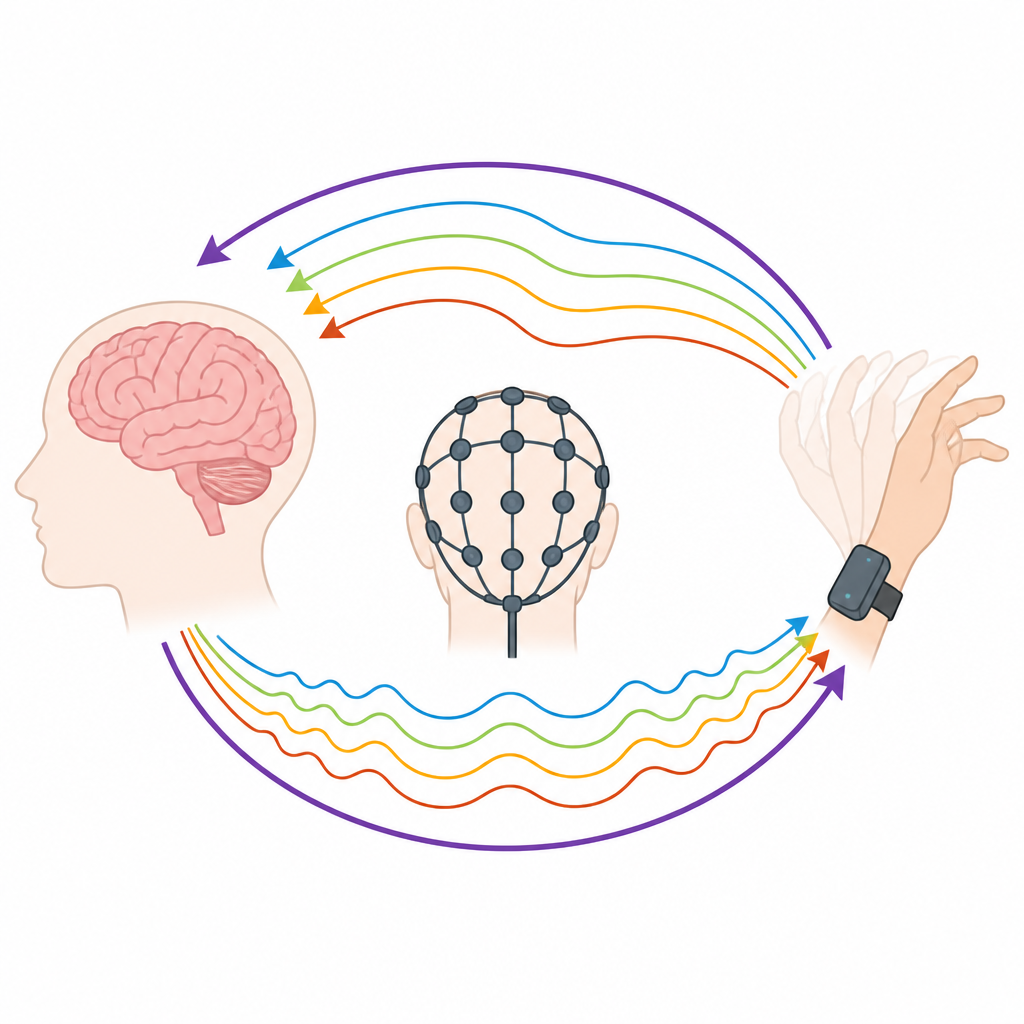
Researchers often study motor control by recording brain activity with sensors on the scalp while tracking movement with tiny accelerometers on the skin. A popular measure, called cortico-kinematic coherence, expresses how tightly a brain signal follows the up-and-down pattern of a moving limb. So far, most work has treated this link as if brain and movement both “sing” at the same tempo, focusing on one frequency band at a time. Yet real movements are richer: a finger tap at three cycles per second also contains harmonics at higher speeds, and the brain itself hums along at many rhythms simultaneously.
Catching slow and fast rhythms together
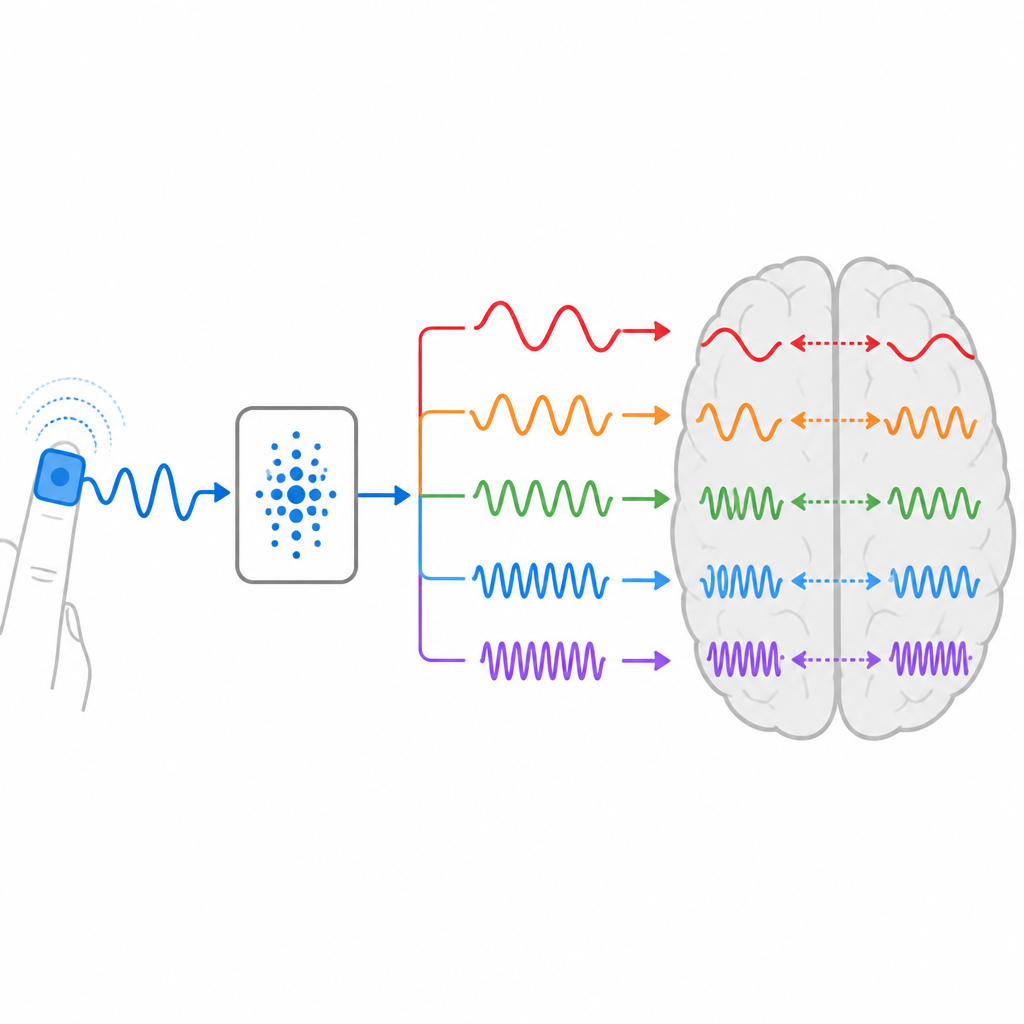
The authors extend an earlier technique named canonical coherence, which searches across many brain channels to find the pattern that best matches a given body signal. Their new framework, called cross-frequency canonical coherence, adds a clever twist: it mathematically reshapes the movement signal so that its slow rhythm can be compared directly to faster brain waves that are exact multiples of that rhythm. In practical terms, they can test whether a three-cycles-per-second finger motion is linked not only to brain activity at three cycles per second, but also to activity at six or nine, all while using information from dozens of sensors at once.
Testing the method in virtual and real brains
To check that the approach works, the team first built realistic computer simulations of brain and movement signals. They created artificial sources in a standard head model, mixed them with background noise, and asked whether their method could recover both same-speed and cross-speed links. Even when the useful signals were buried under strong noise, the algorithm still pinpointed the correct source patterns and identified which brain areas were tied to each type of coupling. Cross-frequency links were weaker and failed earlier as noise increased, but remained detectable at moderate noise levels typical for real recordings.
What real finger tapping revealed
The researchers then recorded brain activity and finger acceleration in young adults who tapped their index finger at three cycles per second. They found clear links between movement and brain signals at the tapping rhythm and its harmonics, mostly over the sensorimotor areas that control the hand, with stronger activity on the side opposite to the moving finger. Importantly, they also observed reliable cross-frequency connections between the slow movement and faster brain rhythms in most participants. By comparing the shapes and timing of the estimated brain patterns, they could begin to tease apart cases where slower and faster rhythms likely came from the same source from those that reflected distinct interacting networks.
Why this matters for movement and disease
For a layperson, the take-home message is that the brain does not control movement with a single beat. Instead, slow body motion and faster brain waves form a coordinated multi-speed code. The new method introduced here provides a powerful, non-invasive way to map that code across the whole head, without relying heavily on detailed head models. This opens the door to comparing how these patterns differ between tasks, between people, and between health and disease. In the future, such measures might help track subtle changes in motor control, guide rehabilitation, or support feedback systems that train the brain to regain smoother, more stable movement.
Citation: Vidaurre, C., Eguinoa, R., Maudrich, T. et al. Canonical coherence for the estimation of within- and cross-frequency cortico-kinematic interactions. Sci Rep 16, 15182 (2026). https://doi.org/10.1038/s41598-026-49471-6
Keywords: cortico-kinematic coherence, brain motor control, EEG movement coupling, cross-frequency coupling, sensorimotor integration