Clear Sky Science · en
An in vitro collagen gel contraction assay to assess the relaxing effect of potential pharmacological alternatives to oxytetracycline on foals’ tendons
Why Straight Legs Matter for Young Horses
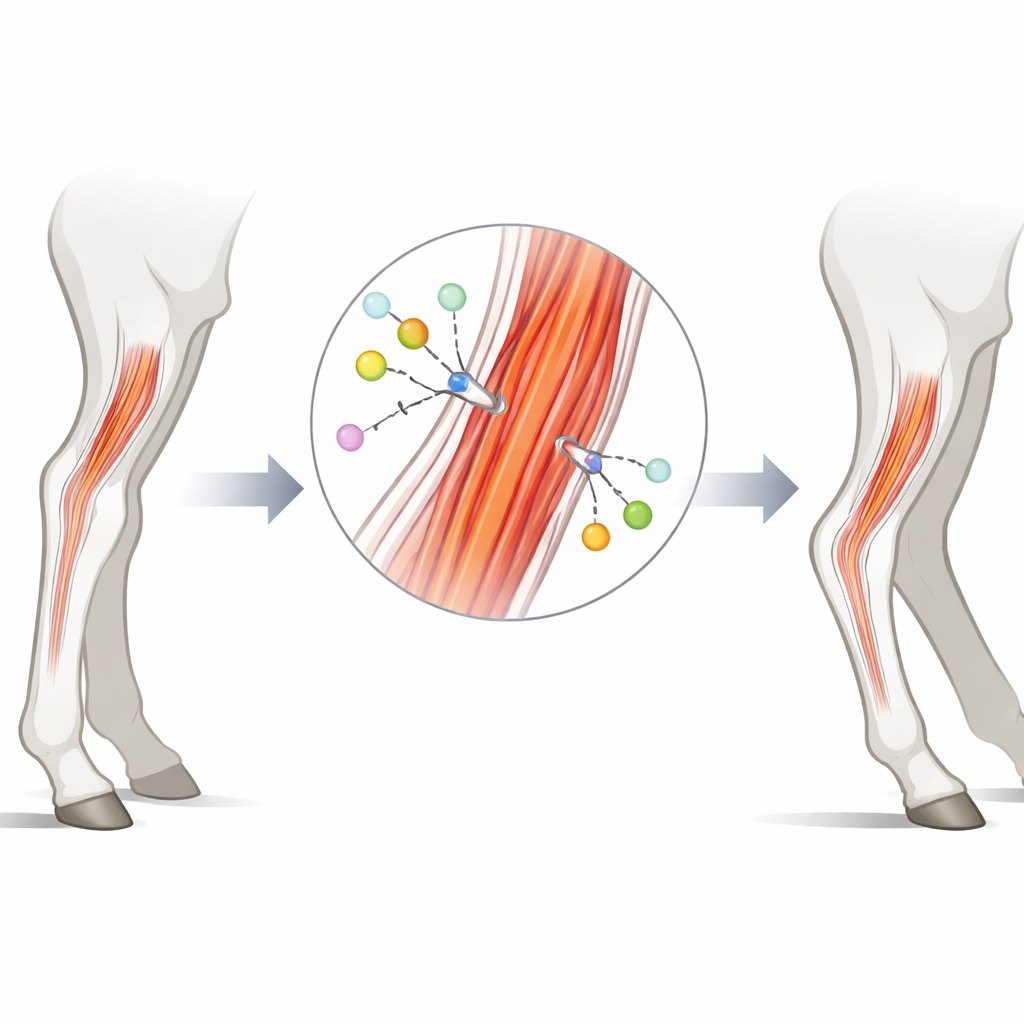
Foals are born with soft, growing legs, and if the tendons at the back of the leg are too tight, the foal can end up standing on tiptoe, unable to move comfortably or grow into a sound riding horse. For years, veterinarians have used the antibiotic oxytetracycline to help relax these tight tendons, with often impressive results. But because this drug is also a powerful antimicrobial with possible serious side effects, there is growing pressure to find safer, non‑antibiotic options. This study explores whether other compounds can mimic oxytetracycline’s tendon‑relaxing effect using a laboratory model that stands in for a young horse’s tendon.
A Bench‑Top Stand‑In for Growing Tendons
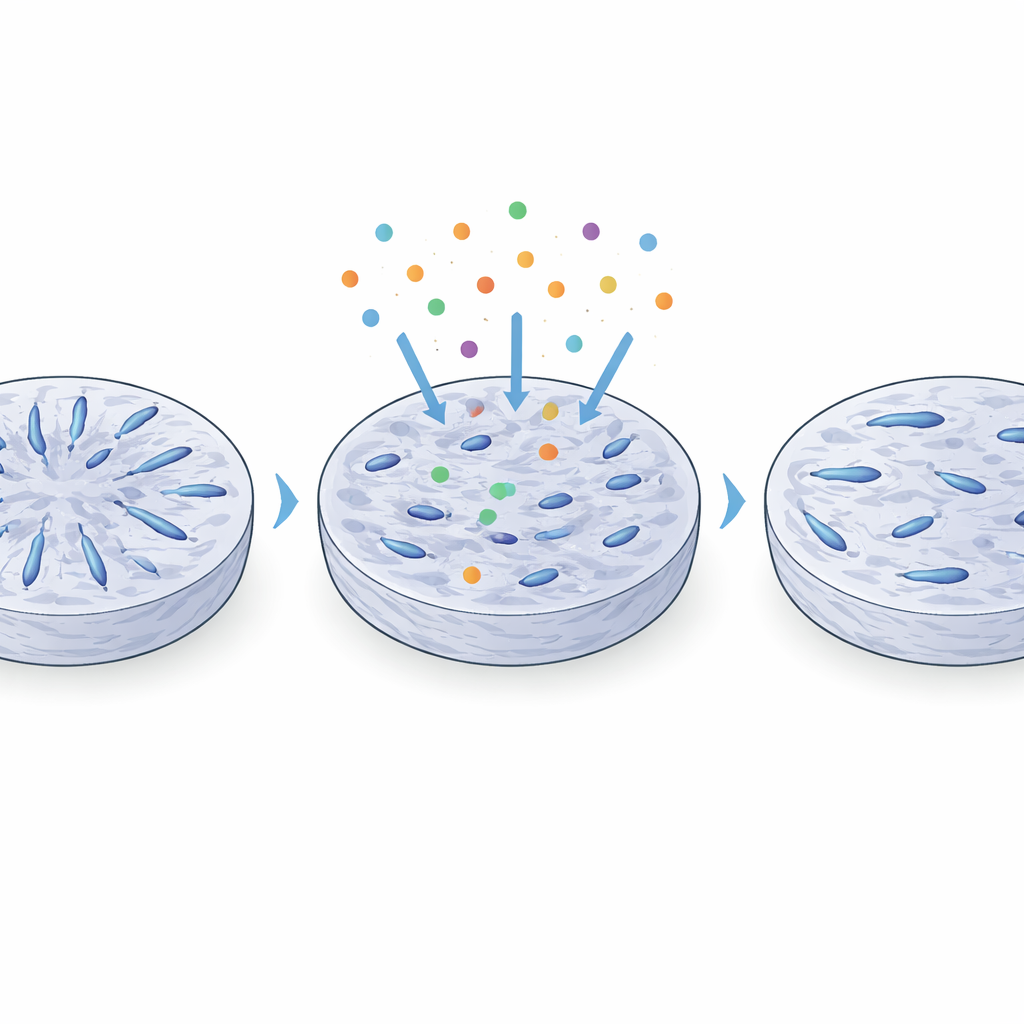
Studying tendons directly in live foals is difficult and raises animal‑welfare concerns, so the researchers turned to an in vitro (dish‑based) approach. They collected tiny samples of flexor tendons and their supporting ligaments from foals that had been euthanized for unrelated medical reasons. From these tissues they isolated myofibroblasts, a type of cell that is naturally abundant in young tendons and is skilled at gripping and remodeling the surrounding collagen. The team mixed these cells into a jelly‑like matrix made of collagen, poured the mixture into small circular wells, and allowed it to set. When the gels were gently detached from the plastic, the embedded cells began to pull on the collagen, causing each disc to contract over time, much like a tendon tightening.
Testing New Helpers for Tight Tendons
Into this collagen‑cell system the scientists added several candidate compounds that either interfere with enzymes called matrix metalloproteinases (which help remodel connective tissue) or disrupt the chemical cross‑links that stiffen collagen fibers. Alongside oxytetracycline, they tested incyclinide and ilomastat (both enzyme blockers related to or inspired by tetracyclines), aprotinin and pentoxifylline (drugs with known tissue‑modulating effects), and β‑aminopropionitrile fumarate (BAPN), a substance that prevents collagen fibers from forming their usual cross‑links. Over four days, they photographed the gels at regular intervals and used image‑analysis software to calculate how much each one had shrunk compared with its original size. Less shrinkage meant less pulling by the cells, and thus a stronger “relaxing” effect.
Which Substances Best Calm the Pulling Cells
The clearest standout was BAPN at a higher dose: after 96 hours, gels treated with this compound retained almost all of their original area, while untreated gels had shrunk to about a quarter of their starting size. A lower dose of BAPN still slowed contraction, but the effect weakened over time, suggesting that its action is both strong and dose‑dependent. Under the microscope, cells in high‑dose BAPN gels looked more rounded, while cells in other conditions remained slender and elongated, hinting that BAPN might change how the cells grip and pull on their collagen surroundings. Incyclinide also consistently reduced gel contraction at all measured times, and ilomastat produced a marked effect at most time points, although interpreting ilomastat’s impact is complicated because its solvent (a small amount of dimethyl sulfoxide) also tended to dampen contraction on its own.
How the Old Drug Compares and What Did Not Work
Oxytetracycline itself only modestly slowed gel contraction at the lower tested dose; its effect became clearly detectable only at the higher concentration, and even then it was weaker than that of BAPN or incyclinide. Two other candidates, aprotinin and pentoxifylline, did not significantly change how much the gels tightened under the pull of the cells, at least at the doses used here. Importantly, earlier work by the same group showed that, under standard conditions, BAPN and incyclinide do not kill or halt the growth of these tendon cells, suggesting that the reduced contraction reflects changes in how cells interact with collagen rather than simple cell loss. Still, the authors note that exposing cells to BAPN from the very start, as done in this assay, might influence cell health or behavior in ways that need deeper investigation.
What This Could Mean for Young Horses
For horse owners and veterinarians, the key message is that there may be promising non‑antibiotic ways to help straighten the legs of foals with tight tendons. In this laboratory tendon model, BAPN and incyclinide both strongly reduced the ability of tendon‑like cells to tighten and organize the collagen around them, a process that echoes how real tendons stiffen. That suggests these substances could potentially relax the muscle‑tendon unit in growing foals at least as well as, and perhaps better than, oxytetracycline—without adding to antibiotic use. However, BAPN has known toxic effects at high systemic doses, and incyclinide’s behavior in the bodies of young horses is not yet defined. The study therefore points to exciting candidates rather than ready‑to‑use treatments, underscoring the need for careful follow‑up work on dosing, safety, and delivery before these approaches can move from the dish to the barn.
Citation: Cardinaux, E.M., Oltmanns, H., Rohn, K. et al. An in vitro collagen gel contraction assay to assess the relaxing effect of potential pharmacological alternatives to oxytetracycline on foals’ tendons. Sci Rep 16, 13412 (2026). https://doi.org/10.1038/s41598-026-49449-4
Keywords: foal tendon deformities, oxytetracycline alternatives, collagen gel contraction, equine myofibroblasts, tendon relaxation therapy