Clear Sky Science · en
Deep learning and attention mechanisms to identify key genes and their implications for the origin of insect wings
Why insect wings matter to us
Insects rule the planet in terms of sheer numbers and kinds, and their wings are a big reason why. Wings let insects spread, find food, escape enemies, and shape entire ecosystems. Yet scientists still debate how these delicate structures first arose from ancient, wingless ancestors. This study uses modern artificial intelligence to search insect DNA for clues, revealing a shared genetic program between wings and gills that sheds new light on where wings came from.
Looking back to ancient seas
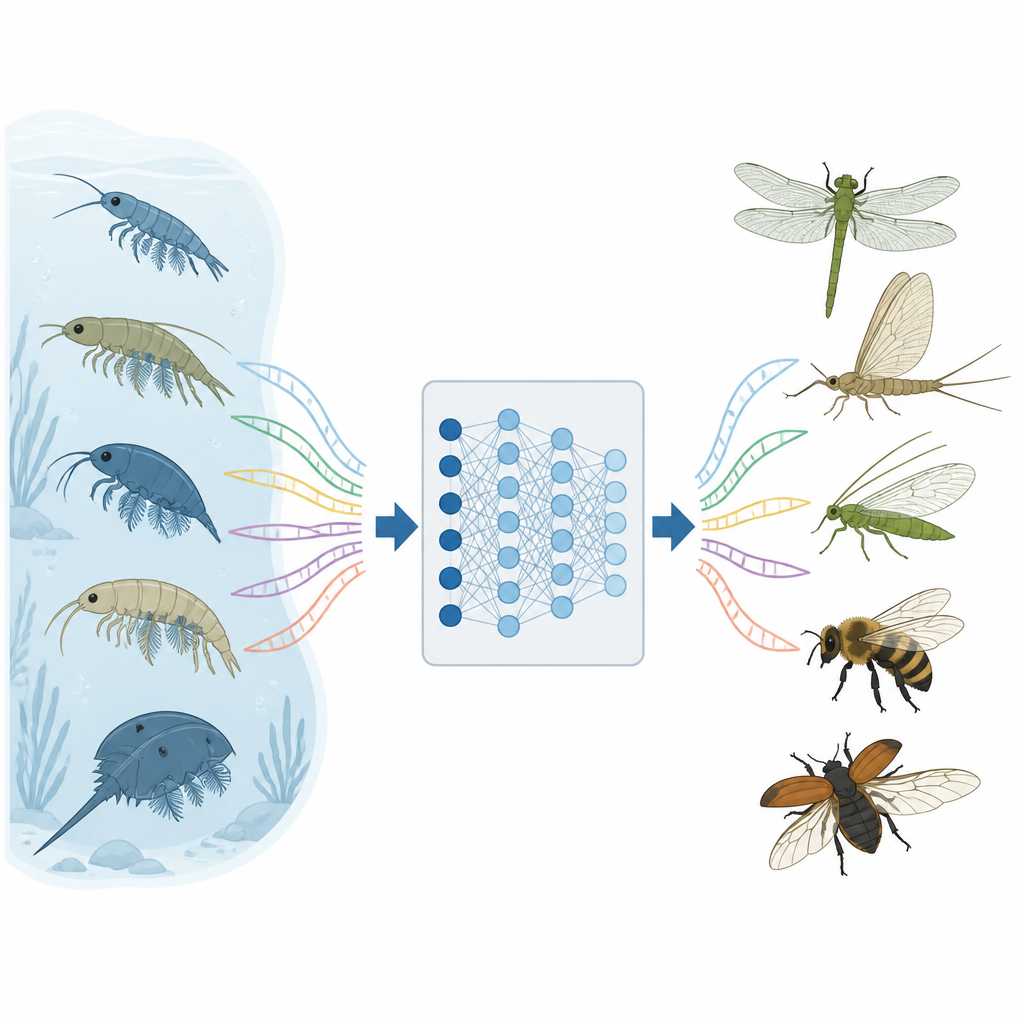
To understand insect wings, the authors start from a simple idea: today’s insects likely evolved from crustacean-like animals that lived in water and breathed with gills. Competing ideas suggest wings could have grown from gill-like breathing organs, flat plates on the body, or side lobes of the thorax, and some research points to a mix of these sources. If wings really trace back to gills, then key genes should show similar activity in insect wings and in the gills of related aquatic species. Rather than testing just a few genes at a time, the team set out to scan the full protein sets of many species to find hidden patterns linked to wings.
Teaching a neural network to read genes
The researchers built a deep learning system they call DeepWG to tell apart proteins from winged and wingless species. They gathered proteomes from 119 species, including insects and their close relatives, and kept only high-quality data. Each protein sequence was chopped into short three-letter building blocks, much like splitting sentences into short word fragments. These fragments were turned into numerical vectors using techniques borrowed from language processing, then fed into a bidirectional memory network with an added attention layer. This setup lets the model scan protein sequences in both directions and focus on the most informative regions without hand-crafted rules.
Finding the genes that wings depend on
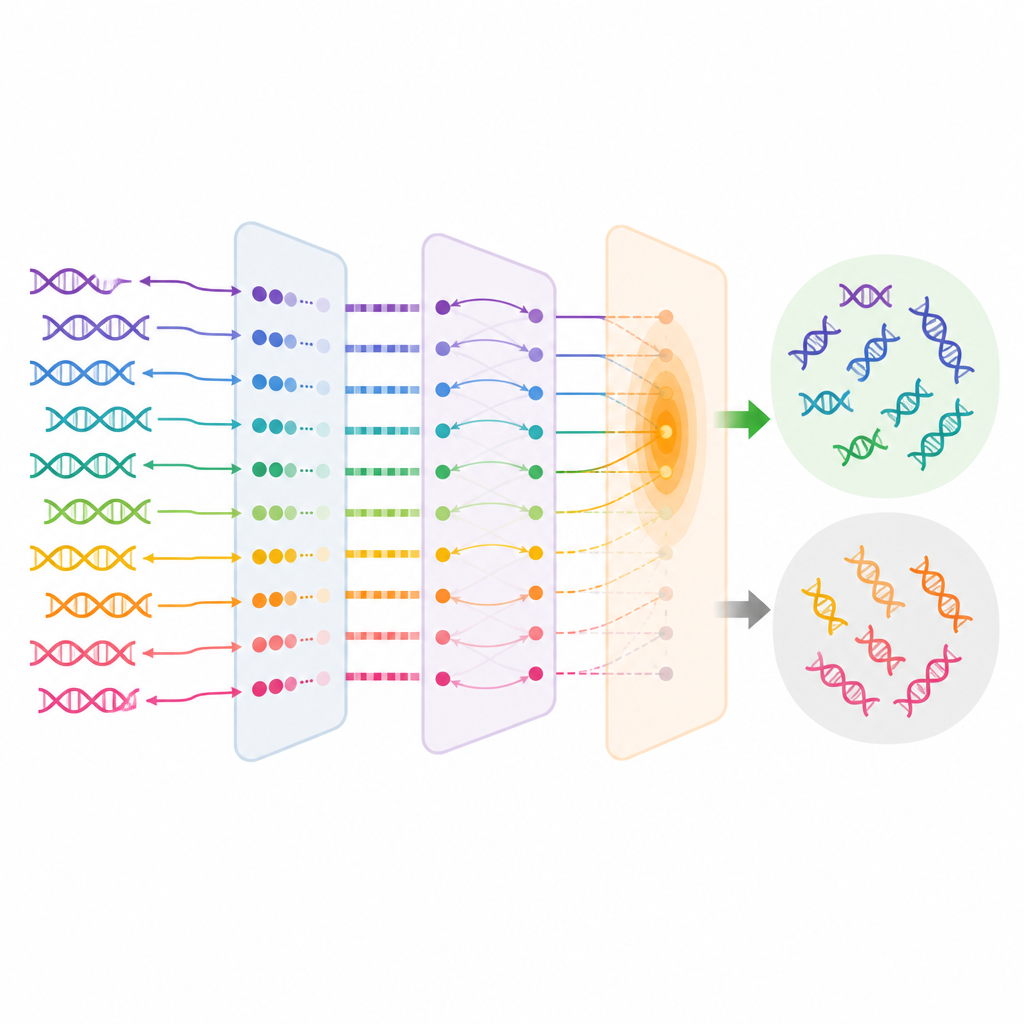
DeepWG proved highly accurate, correctly classifying test samples more than 97 percent of the time and outperforming simpler neural networks. The attention layer assigns a weight to each family of related genes, highlighting which ones matter most for distinguishing winged from wingless species. From nearly 28,000 gene families, the top 5 percent in weight yielded 3,872 candidate genes, including many already known to shape insect wings. Famous examples include genes that control wing growth, patterning, and size, as well as pathways that govern how cells divide and respond to signals. Network analysis of gene activity grouped many of these genes into modules closely tied to wing development in the fruit fly, adding confidence that DeepWG is pinpointing meaningful players rather than random noise.
Wings and gills sharing the same song
The most striking test came from comparing how these key genes behave across species and tissues. The team looked at the fruit fly, a mayfly with both wing pads and aquatic gills, and a shrimp-like crustacean with gills but no wings. They examined how strongly the candidate genes were switched on in wings, wing pads, gills, and other tissues. In all three species, the same core set of genes showed high activity in wings or wing pads and in gills, but not in unrelated tissues. This repeated pattern suggests that modern insect wings and crustacean gills draw on a shared genetic toolkit that predates the evolution of flight.
What this means for the story of flight
For non-specialists, the take-home message is that insect wings may not be a brand-new invention, but a clever reworking of ancestral gills guided by a conserved set of genes. By letting a neural network sift through vast amounts of sequence data, the study uncovers hundreds of genes that link wings and gills across distant branches of the arthropod family tree. While many pieces of the puzzle remain, the shared gene activity pattern strongly supports the idea that wings grew out of gill-like structures in ancient aquatic ancestors. DeepWG also offers a general tool for tracing how other important traits evolved by reading the language of genomes.
Citation: Liu, F., Cao, Y., Qian, S. et al. Deep learning and attention mechanisms to identify key genes and their implications for the origin of insect wings. Sci Rep 16, 15998 (2026). https://doi.org/10.1038/s41598-026-49441-y
Keywords: insect wings, wing evolution, deep learning, gene expression, arthropod gills