Clear Sky Science · en
Towards energy-efficient massive MIMO-NOMA systems with sigma–delta ADCs and group SIC detection
Why packing more signals into the air matters
Every year we ask our wireless networks to do more: connect more phones, cars, and sensors, deliver higher data rates, and yet consume less energy. Meeting these demands for 5G and 6G requires not only new radio spectrum but also smarter ways of using existing hardware. This paper explores how a cellular base station can listen to many users at once using a very large antenna array and extremely simple, low-power electronics, while still keeping connections fast and reliable.
Many ears listening to many voices
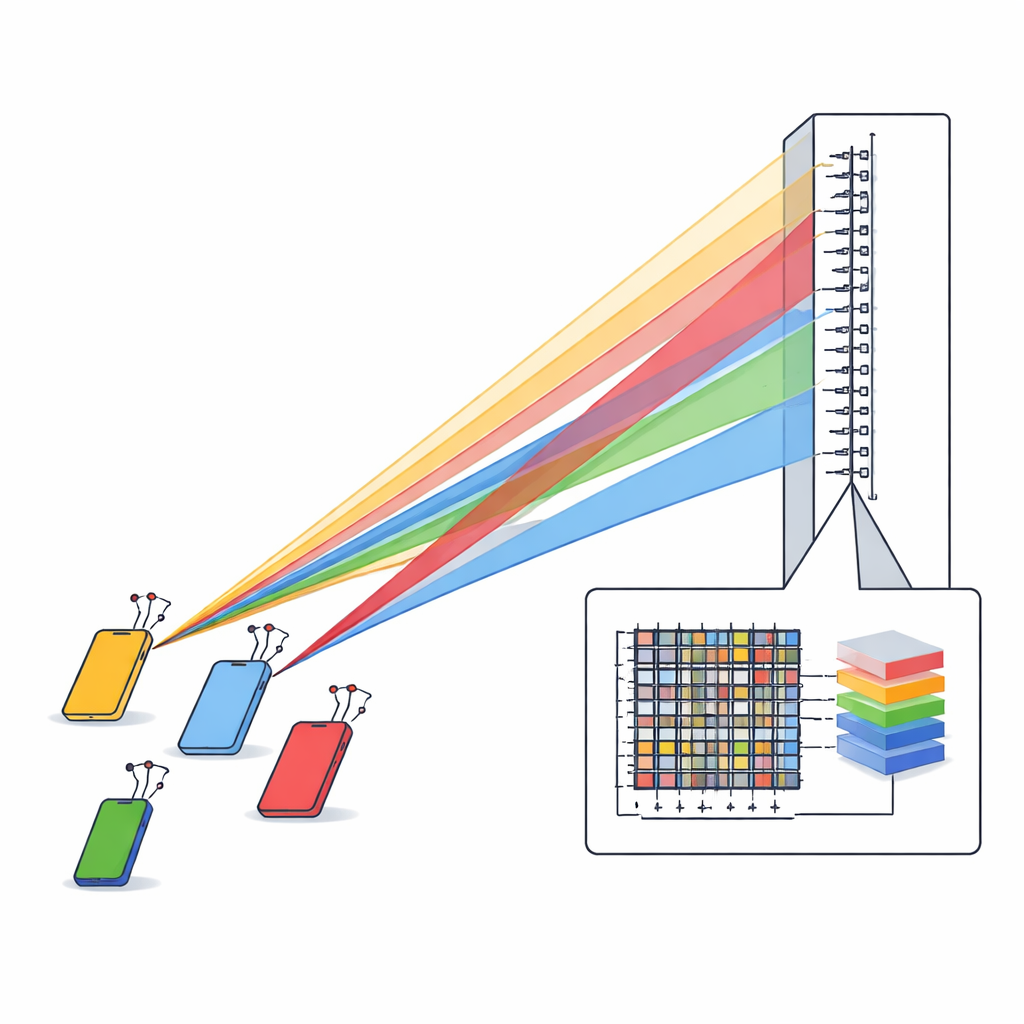
The study focuses on an uplink scenario, where many user devices send data to a single base station. The base station is equipped with a “massive” array of antennas, known as massive MIMO, and uses a signaling method called non-orthogonal multiple access (NOMA). Instead of giving each user its own time or frequency slice, NOMA lets several users share the same radio resources and separates them by differences in received power and smart signal processing. This approach greatly increases how much information can be carried per unit of spectrum, but it also makes the receiver’s job much harder, because signals from different users interfere with each other.
Simple converters with clever noise shaping
A key challenge in massive MIMO is energy consumption: each antenna needs an analog-to-digital converter (ADC) that turns incoming radio waves into digital samples. High-precision ADCs are power-hungry and expensive, especially when there are hundreds of antennas. The paper examines using extremely low-resolution ADCs—only one or two bits per sample—to cut power and cost. On their own, such coarse converters introduce strong distortion. To overcome this, the authors employ a spatial sigma–delta architecture: the quantization error from one antenna is fed, with a controlled phase shift, into the next. This feedback reshapes the distortion so that most of it is pushed into directions where no intended users are located, preserving signal quality in the directions of interest.
Making sense of many overlapping signals
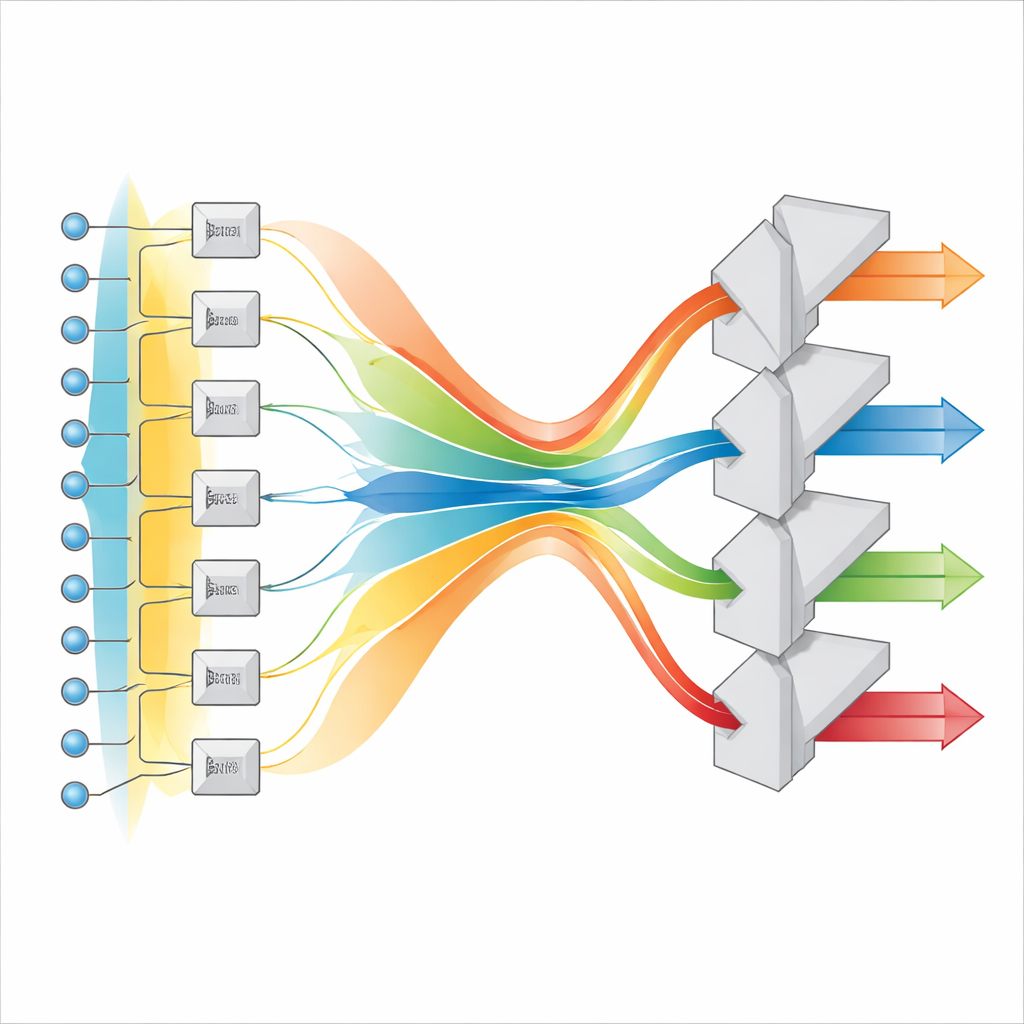
Even with noise-shaped low-resolution converters, the base station must separate many users transmitting at once. The paper studies several types of receivers: simple linear combining, traditional successive interference cancellation (SIC) that decodes users one by one, and a more flexible group SIC (GSIC) that processes small groups of users together. Within each group, a low-complexity combining method (maximum ratio combining or zero-forcing) enhances the desired signals and suppresses interference. The authors develop an analytical framework that uses a mathematical tool called Bussgang decomposition to approximate the behavior of the coarse ADCs as a linear system with extra noise. This lets them derive closed-form formulas for signal-to-interference-plus-noise ratio and spectral efficiency under different wireless channel conditions, including environments with and without a strong line-of-sight path.
How many antennas, how much power?
With these formulas in hand, the study explores how system performance scales with key design choices: the number of antennas at the base station, the resolution of the ADCs, the strength of the line-of-sight component, and the number of user groups used in GSIC. A central finding is a power-scaling law: as the number of antennas grows, the transmit power per user can be reduced roughly in proportion to the inverse of the antenna count, while maintaining the same data rate. This means that adding more antennas can both increase robustness and allow devices to transmit with much lower power. The analysis also shows that, for very large arrays, all receiver types tend to achieve similar spectral efficiency, but for practical, moderate array sizes, zero-forcing GSIC clearly outperforms simpler combining while still avoiding the full complexity of decoding every user separately.
Balancing efficiency, complexity, and reliability
Because base stations must meet quality-of-service requirements for many users at once, the authors design a low-complexity power allocation scheme that picks user transmit powers just high enough to hit target data rates. Using tools from random matrix theory, they provide approximate closed-form formulas for these powers, which reveal that receivers using SIC or GSIC need substantially less transmit power than basic linear schemes. Extensive simulations, covering different fading environments, dense multipath, spatial correlation, and even high-mobility vehicle-to-everything scenarios, confirm the analytical predictions. The results show that using 2-bit spatial sigma–delta ADCs, together with GSIC and a moderate number of user groups, can deliver spectral and energy efficiencies very close to those of ideal full-precision systems, but with much lower hardware power consumption and manageable processing complexity.
What this means for future wireless networks
In simple terms, the paper demonstrates that we can dramatically simplify and power down the “ears” of a massive MIMO base station without sacrificing much in terms of speed or reliability. By combining low-resolution, noise-shaping converters with smart grouping and interference cancellation, the system can serve many users at once, using less power in both the base station and the user devices. This makes the approach especially attractive for beyond-5G and 6G networks that must connect dense crowds of devices, support demanding applications, and still remain energy-efficient and affordable to deploy.
Citation: Farghaly, S.I., Khafaga, M.M. & Khamis, S. Towards energy-efficient massive MIMO-NOMA systems with sigma–delta ADCs and group SIC detection. Sci Rep 16, 14025 (2026). https://doi.org/10.1038/s41598-026-49425-y
Keywords: massive MIMO, NOMA, sigma-delta ADC, group interference cancellation, energy-efficient wireless