Clear Sky Science · en
A barrel theory-based optimization of stochastic PV-DG integration in radial distribution networks under load and solar uncertainties
Why rooftop solar needs smarter planning
As more homes and businesses add rooftop solar panels, our neighborhood power lines must quietly juggle sunshine that comes and goes and electricity demands that constantly change. If these systems are planned poorly, they can waste energy, strain equipment, and cause voltage problems that affect everyday customers. This study explores a new way to decide where and how big solar units should be on local power networks so that the grid stays efficient, reliable, and ready for a cleaner energy future. 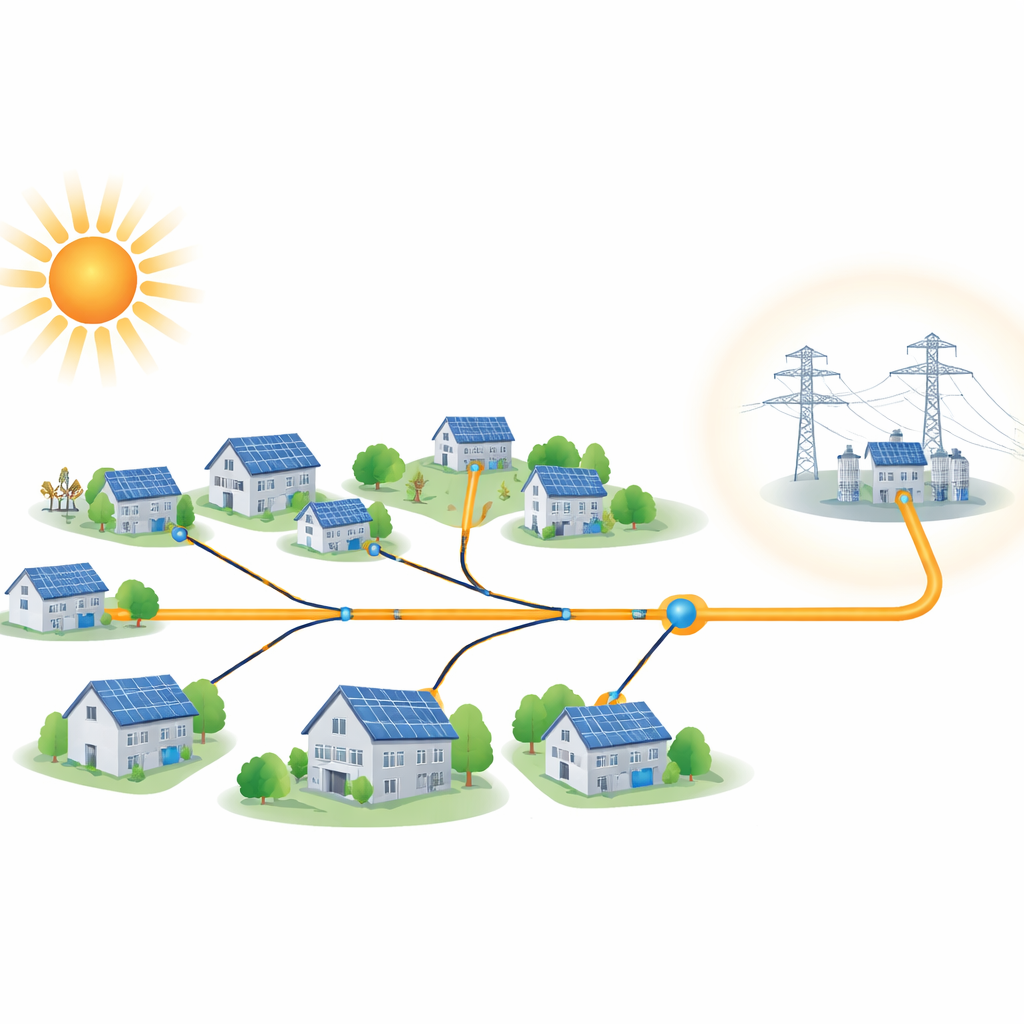
From one-way power flow to neighborhood power plants
Traditional power systems were built for electricity to flow in one direction: from large distant power stations to homes and factories. Today, small generators such as rooftop solar panels and community PV plants are increasingly connected directly to local distribution lines. This shift brings big benefits: it can cut energy losses in long wires, ease congestion on feeders, sharpen voltage quality, and improve resilience during outages. But it also brings new headaches. When many solar systems feed power back into the lines, voltages can rise above safe levels, currents can reverse direction, and equipment can be pushed outside its comfort zone. Making the most of solar power therefore requires careful planning of where to place these units and how large they should be.
Why uncertainty matters for the real world
Many earlier planning studies made a simplifying assumption: they treated sunshine levels and consumer demand as fixed, or used only a few hand-picked scenarios. In reality, clouds move, seasons change, and people switch appliances on and off in patterns that are anything but steady. Ignoring this variability can lead to choices that look good on paper but perform poorly in practice. Other approaches tried to handle uncertainty with heavy-duty simulations such as Monte Carlo trials, which are accurate but very time-consuming. This paper seeks a middle ground: a method that captures the most important randomness in solar production and load demand while keeping the number of required calculations manageable.
A barrel-inspired way to search for better solutions
To tackle this challenge, the authors combine two key ideas. First, they use a compact statistical tool called a point estimate method to represent the ups and downs of sunshine and demand with only a handful of carefully chosen scenarios. These scenarios stand in for thousands of possible daily conditions. Second, they apply a new search technique called the Barrel Theory-Based Optimizer. Inspired by the image of a wooden barrel whose capacity is limited by its shortest plank, this algorithm treats each possible plan for placing solar units as a barrel and each decision variable (such as size or location) as a plank. Instead of only polishing the best barrels, the method specifically looks for weak spots and improves them, while learning from the most promising solutions. This balance between exploration and refinement helps it navigate the complex landscape of choices in large power networks. 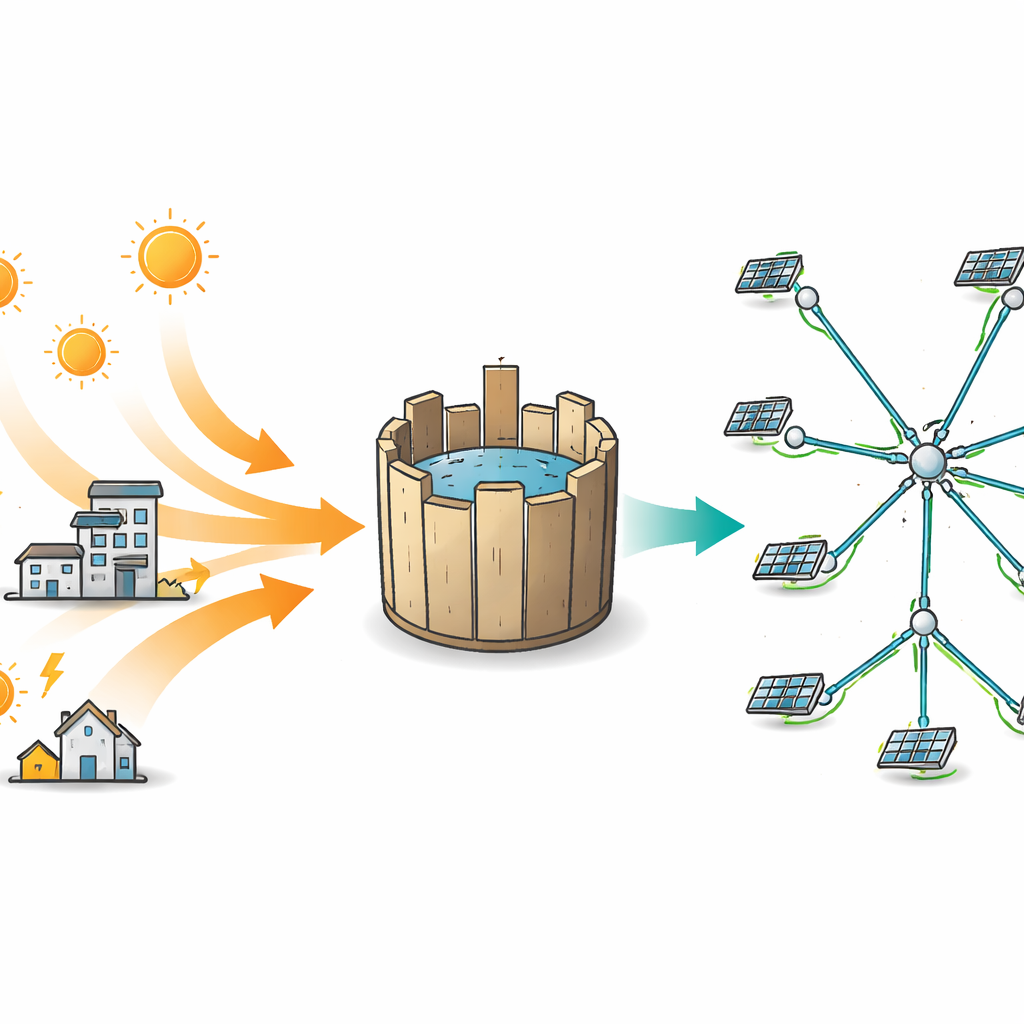
Testing on realistic power networks
The framework was tested on two benchmark distribution systems: a medium-size 85-bus network and a larger 118-bus network, each representing a realistic tangle of lines and customers. For the 85-bus case, the researchers studied scenarios with three, four, and five solar units. In each case, the goal was to choose locations, sizes, and operating conditions that minimize expected power losses and keep voltages within safe limits, across all uncertainty scenarios. They compared their barrel-based optimizer with several well-known search methods, including a classic differential evolution algorithm and two recent nature-inspired techniques. The new approach reached lower losses, converged faster, and produced more consistent results from run to run, especially as the number of solar units and system size increased.
What the results mean for cleaner local grids
Across both networks, the optimized solar layouts cut energy losses dramatically—by more than two-thirds compared with having no solar under heavy loading—and lifted the lowest voltages back into acceptable ranges everywhere on the system. The barrel-based optimizer not only found solutions with the smallest expected losses, but it did so with little variation between repeated runs, suggesting strong reliability. It also required less computation time and memory than some of its rivals, a key point for planners who need to study many future scenarios. In plain terms, the study shows that with a smart mix of streamlined uncertainty modeling and a carefully designed search strategy, utilities can place solar units in ways that squeeze far more value out of the same sunshine while keeping neighborhood grids stable and efficient.
Citation: Alqahtani, M.H., Aljumah, A.S., Shaheen, A.M. et al. A barrel theory-based optimization of stochastic PV-DG integration in radial distribution networks under load and solar uncertainties. Sci Rep 16, 14040 (2026). https://doi.org/10.1038/s41598-026-49415-0
Keywords: rooftop solar, power distribution networks, renewable integration, grid optimization, solar variability