Clear Sky Science · en
A blockchain-enabled framework for secure and efficient data transmission in underwater sensor networks using advanced cryptographic techniques
Why protecting underwater data matters
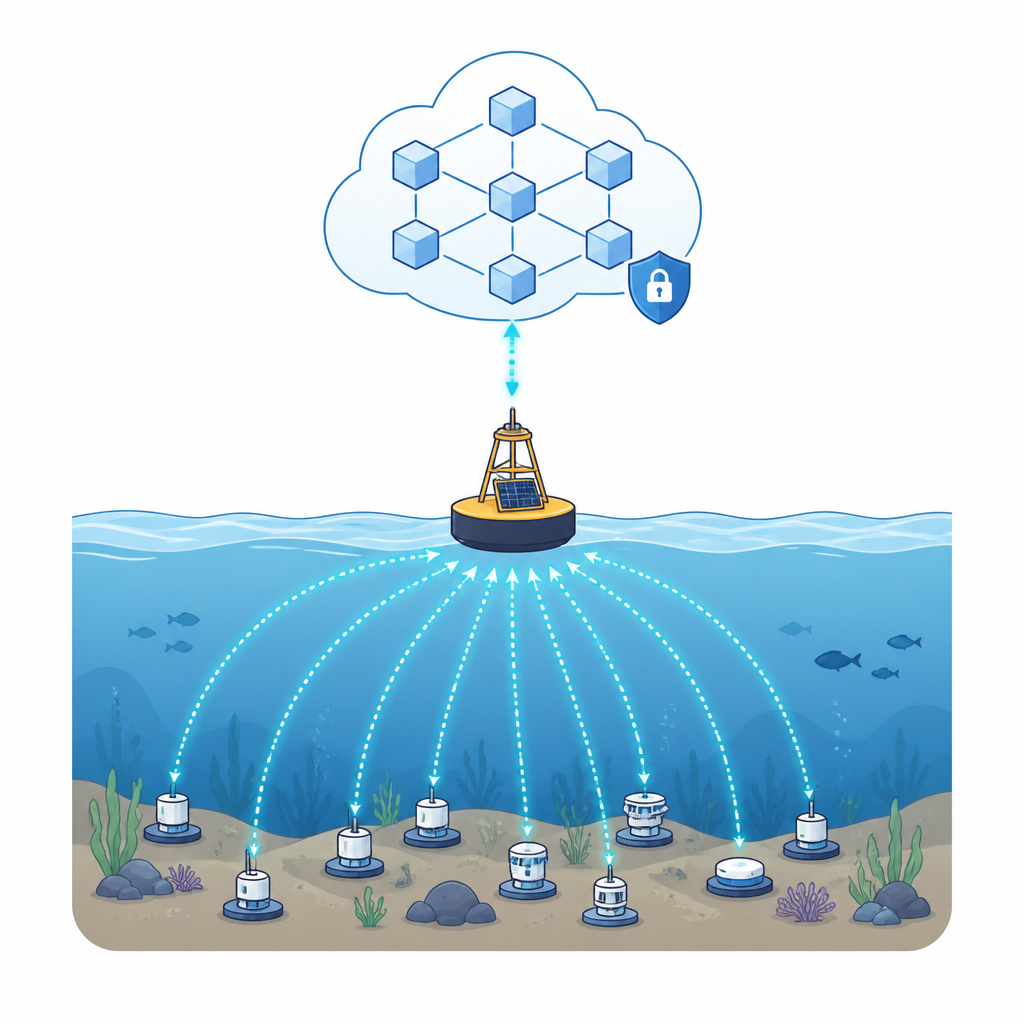
Oceans hide a vast network of sensors quietly tracking pollution, marine life, climate change and even hostile submarines. These devices sit on the seafloor or float beneath the waves, relaying sensitive information back to shore. But underwater links are slow, noisy and easy to disrupt, which makes it hard to ensure that the data is both trustworthy and kept out of the wrong hands. This paper explores a new way to lock down those underwater messages so they arrive intact, private and reliable, even when some devices misbehave.
The problem with talking through water
Unlike the fast radio links we rely on above water, underwater sensors usually communicate using sound. Sound travels slowly, the available bandwidth is tiny, and currents, temperature and salt levels constantly twist and distort the signal. Messages can be delayed, lost or garbled. At the same time, hostile parties can eavesdrop, forge data or take control of nodes. Earlier solutions tried to improve routing, save battery life or add basic encryption in isolation. Very few were designed specifically for these harsh conditions while also assuming that some nodes may actively try to cheat or attack the system.
Bringing shared ledgers below the surface
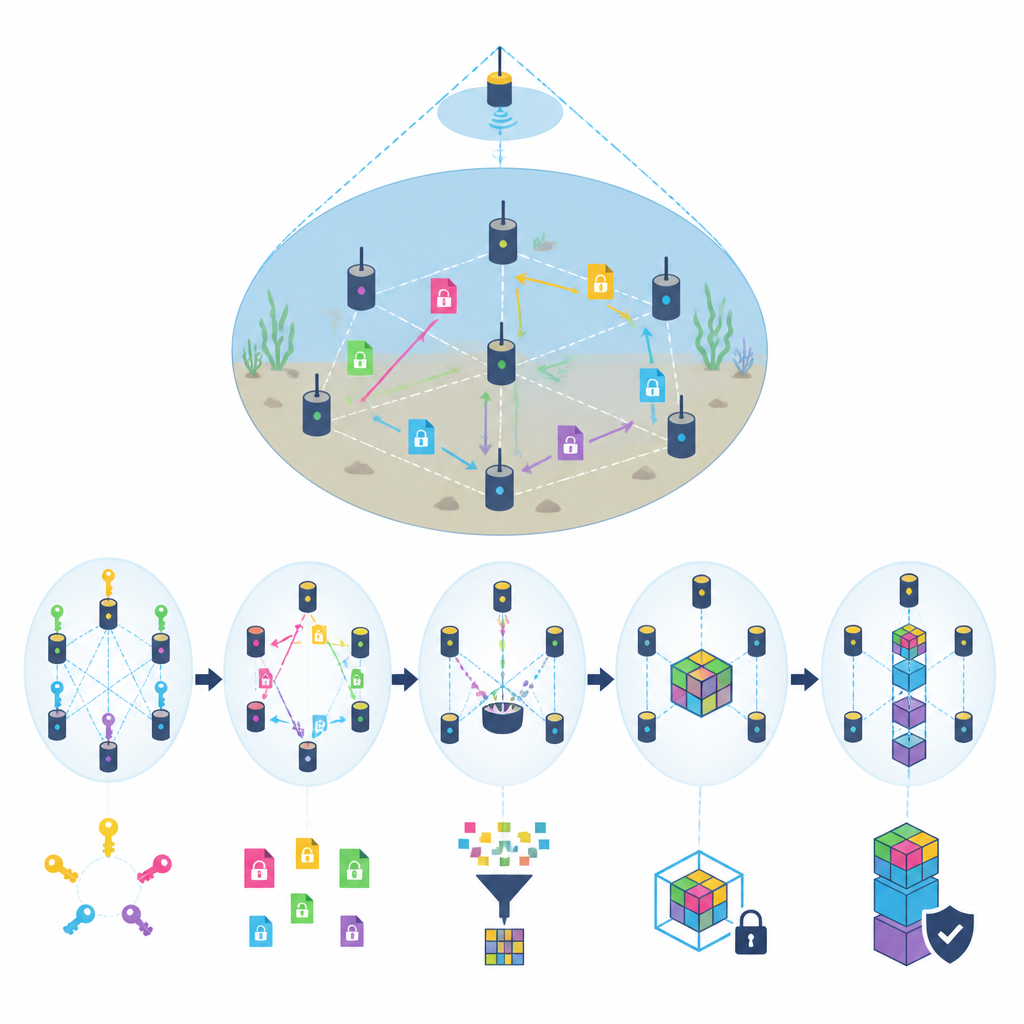
The authors propose a framework that uses blockchain ideas to keep an underwater network in step. Instead of trusting a central base station, many nodes jointly agree on which data blocks are valid and in what order they should be stored. They adapt an approach called asynchronous Byzantine fault tolerance, which lets the group reach agreement even if messages arrive late, arrive out of order, or are sent by a minority of malicious devices. The design is tuned for the ocean setting, where long delays and intermittent links are the norm rather than the exception.
Sharing secrets without revealing them
To protect the content of the data, the framework layers several advanced cryptographic tools. Nodes work together to generate keys so no single device holds too much power. Each secret is split into pieces and spread across many nodes, and only a large enough group can reconstruct it. Other methods allow the network to jointly compute useful summaries while keeping individual readings private. Combined, these tools mean an attacker who compromises a few sensors cannot unlock the data or forge convincing messages, and honest nodes can check that shared pieces are consistent without seeing the underlying secrets.
Testing the system in a virtual ocean
Because real underwater experiments are difficult, the team built a detailed simulation that mimics realistic sea conditions such as temperature, salinity, noise and signal loss. They compared several cryptographic building blocks inside the same blockchain framework and measured how many packets arrived correctly, how long decisions took, how hard the processors worked and how long the network could run before draining its batteries. The results suggest that the proposed setup can keep data private and tamper resistant while still achieving good throughput and acceptable delays, even when some nodes behave dishonestly or the channel becomes unreliable.
Balancing safety, speed and battery life
The study shows that there is no single best cryptographic choice for all underwater missions. Some options deliver higher data rates and lower delays but consume more energy, which may be acceptable for short, critical tasks. Others are gentler on batteries but slower, making them better suited to long-term monitoring deployments. By quantifying these trade-offs, the framework acts as a design guide: engineers can dial security strength and performance up or down to match the needs of a specific scientific, industrial or defense application.
What this means for ocean sensing
For a lay reader, the key message is that it is possible to make underwater sensor networks both safer and more dependable without crippling their performance. By blending a shared tamper resistant ledger with collaborative ways of creating and using secrets, the proposed approach helps ensure that data from the deep can be trusted, even when some devices fail or turn hostile. This paves the way for more confident use of underwater sensing in areas such as climate research, offshore energy and maritime security, where the cost of bad or leaked data can be very high.
Citation: Kumar, K.K., Pavani, M., Chandra, N.S. et al. A blockchain-enabled framework for secure and efficient data transmission in underwater sensor networks using advanced cryptographic techniques. Sci Rep 16, 15487 (2026). https://doi.org/10.1038/s41598-026-49371-9
Keywords: underwater sensor networks, blockchain security, data transmission, cryptography, network resilience