Clear Sky Science · en
Wavy collector design for high-efficiency solar chimney power plants
Turning Sunlight and Air into Gentle Power
Imagine making electricity from sunlight using nothing more than warm air rising up a tall tube. That is the basic idea behind solar chimney power plants, a low-tech concept that could deliver clean energy in sunny regions. This paper explores a simple twist on the design: reshaping the floor under the plant’s glass roof into gentle waves. The authors show that this subtle change can make the air move faster and carry more heat, which could help future solar chimneys generate more power without adding moving parts.
How a Solar Chimney Works
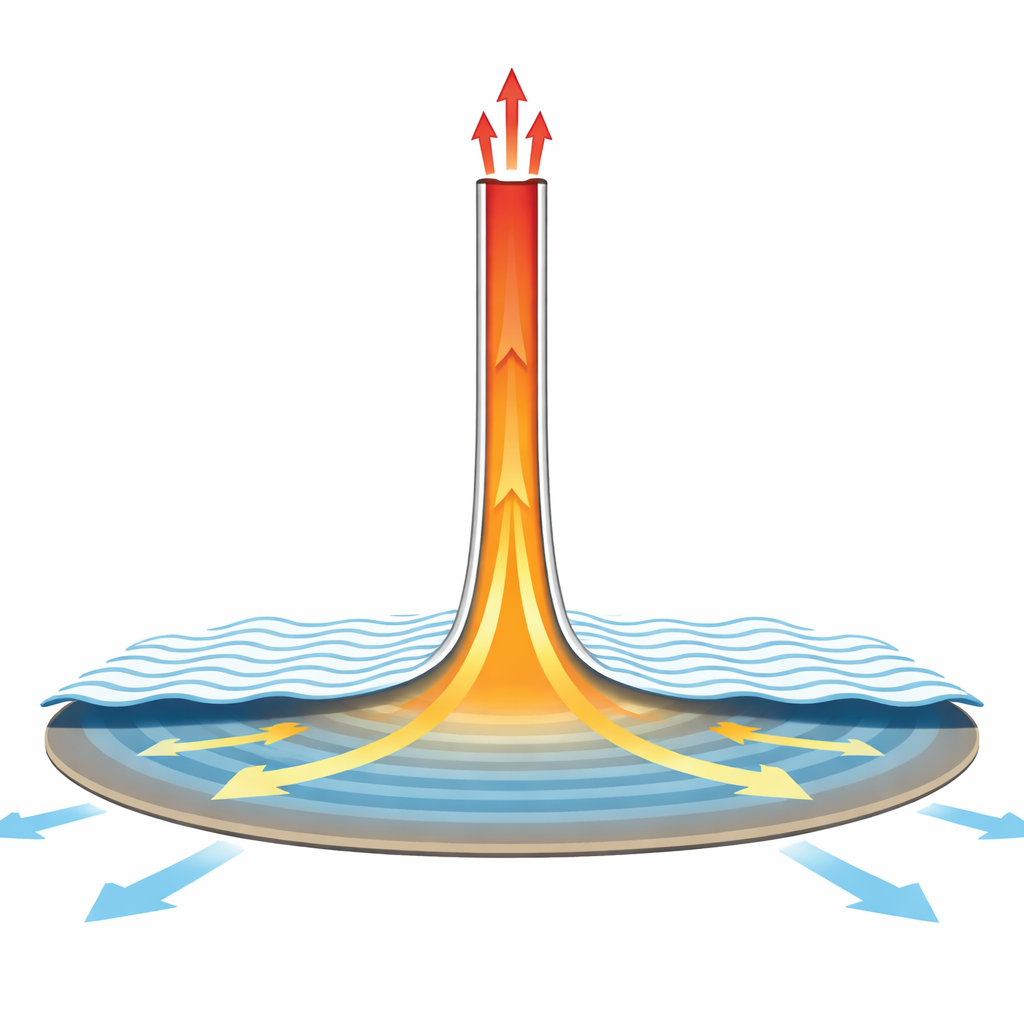
In a solar chimney power plant, a broad, low roof made of transparent material covers a dark ground surface. Sunlight passes through the roof, warms the ground, and in turn heats the air trapped underneath. This warm, light air flows toward a tall central tower and rises inside it like smoke in a flue. A turbine placed near the base of the tower can then harvest the energy of the moving air. The beauty of this setup is its simplicity: there are no fuels to burn and very few components to maintain, making it attractive for remote or dry regions where other power plants are harder to build.
Why the Shape of the Floor Matters
Although the concept is straightforward, real solar chimneys often fall short of their theoretical potential. A key bottleneck is how effectively the collector area under the roof can heat and move the air. In most designs, this surface is flat, which limits how much the air swirls and mixes as it warms. Drawing inspiration from heat exchangers and solar air heaters, where ridged or wavy surfaces are known to boost heat transfer, the authors asked: what if the collector floor in a solar chimney were gently rippled instead of flat? Their aim was to see whether such a passive, purely geometric change could strengthen the natural “pump” that drives air up the chimney.
Testing Wavy Designs on the Computer
Because building many full-size prototypes would be impractical, the researchers used detailed computer fluid dynamics simulations to test different shapes. They modeled a small-scale solar chimney with a circular wavy collector, describing the waves by their height (amplitude) and spacing (wavelength). By systematically varying these two parameters, they could see how the air’s speed, pressure, temperature, and density changed as it flowed from the outer edge toward the tower. The virtual model was checked against existing experimental data from a conventional flat collector, and the agreement in both temperature and air speed gave confidence that the simulations were realistic.
What the Waves Do to Airflow and Heat
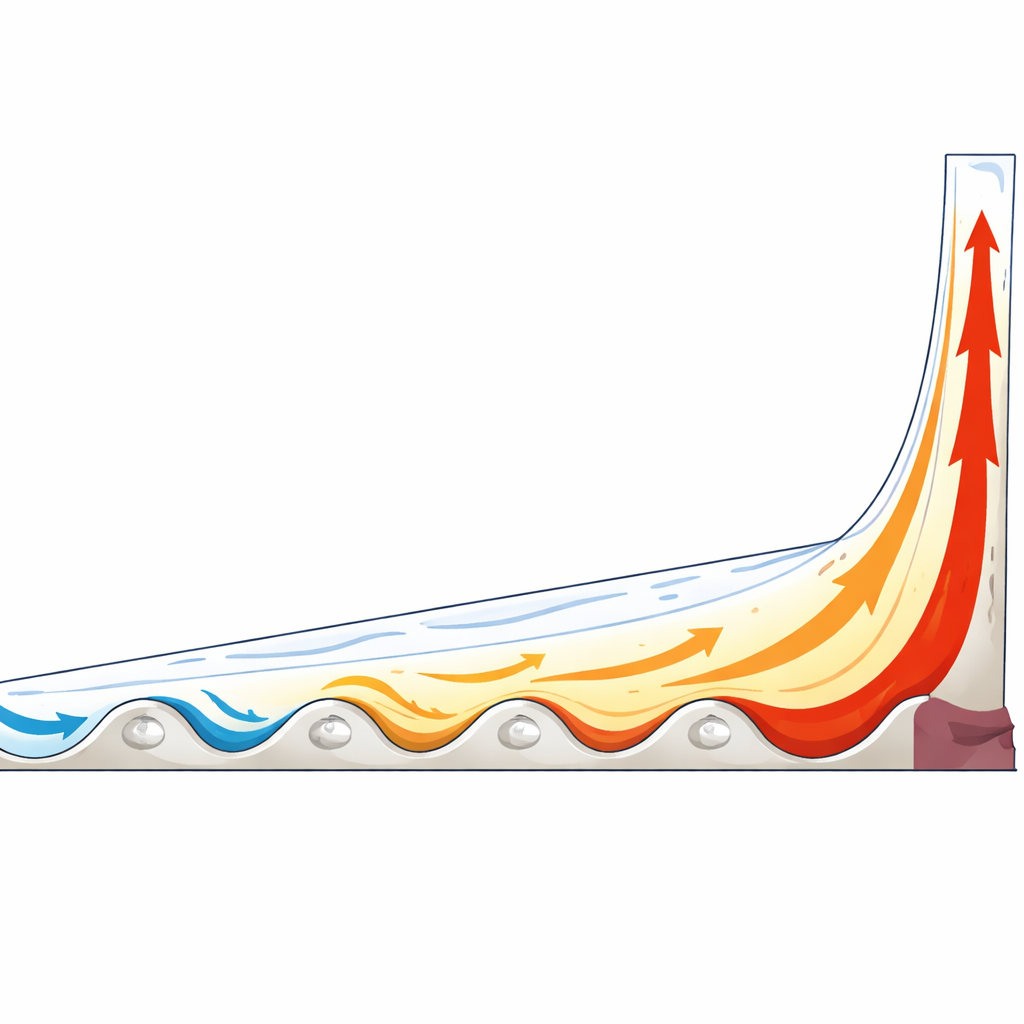
The simulations reveal that adding waves to the collector floor has two main effects. First, it increases the actual surface area being heated by the Sun, so more heat can be passed to the air for the same incoming sunlight. Second, the curved shape nudges the air into gentle swirling patterns, which mix warmer air near the ground with cooler air above. This mixing helps spread heat more evenly and encourages the air to accelerate as it approaches the chimney. Not all wave shapes are equally helpful, however: when the waves are too tight or too tall, they create small pockets of recirculating flow that act like brakes and reduce the net air intake.
Finding the Sweet Spot
By comparing many cases, the team identified a “sweet spot” where the waves are strong enough to enhance heating and mixing but gentle enough to avoid excessive resistance. In their study, the best performance occurred when the distance between wave peaks and their height followed a particular ratio, and when the wave height matched the radius scale used in the design. Under these conditions, the air entering the chimney moved nearly a third faster than in the flat-floor case, while the pressure at the chimney base dropped more, giving a stronger natural suction. These changes translated into noticeable gains in the plant’s calculated power output and overall efficiency, all without adding fans, pumps, or other active devices.
What This Means for Future Clean Energy
To a non-specialist, the message is that small geometric tweaks can make a simple solar technology work better. The study shows that carefully designed wavy patterns beneath a solar chimney’s roof can help the system pull in more warm air and push it upward more forcefully, slightly increasing the energy that can be extracted. While the work was done on a model system and under steady, idealized sunlight, it points toward a promising, low-cost way to refine solar chimney plants. With further testing at larger scales and under real weather conditions, such wavy collectors could become part of a new generation of silent, low-maintenance solar power systems.
Citation: Elsayed, A.M., Aziz, M.A. & Elshimy, H. Wavy collector design for high-efficiency solar chimney power plants. Sci Rep 16, 13624 (2026). https://doi.org/10.1038/s41598-026-49364-8
Keywords: solar chimney, renewable energy, solar collector design, passive heat transfer, computational fluid dynamics