Clear Sky Science · en
Effect of mineralogical composition on the compressive strength and microstructure of metakaolin geopolymer
Stronger, Greener Building Blocks
Concrete is everywhere, but making its key ingredient, Portland cement, pumps out huge amounts of carbon dioxide. Scientists are searching for cleaner binders that can still hold our buildings and bridges together. This study looks at "geopolymers" made from fired clay instead of cement, asking a deceptively simple question: does it matter whether the silica and alumina needed for strength come from the clay itself or from the liquid chemicals added during mixing? The answer could help engineers design tougher, more sustainable construction materials.
From Common Clay to High-Tech Binder
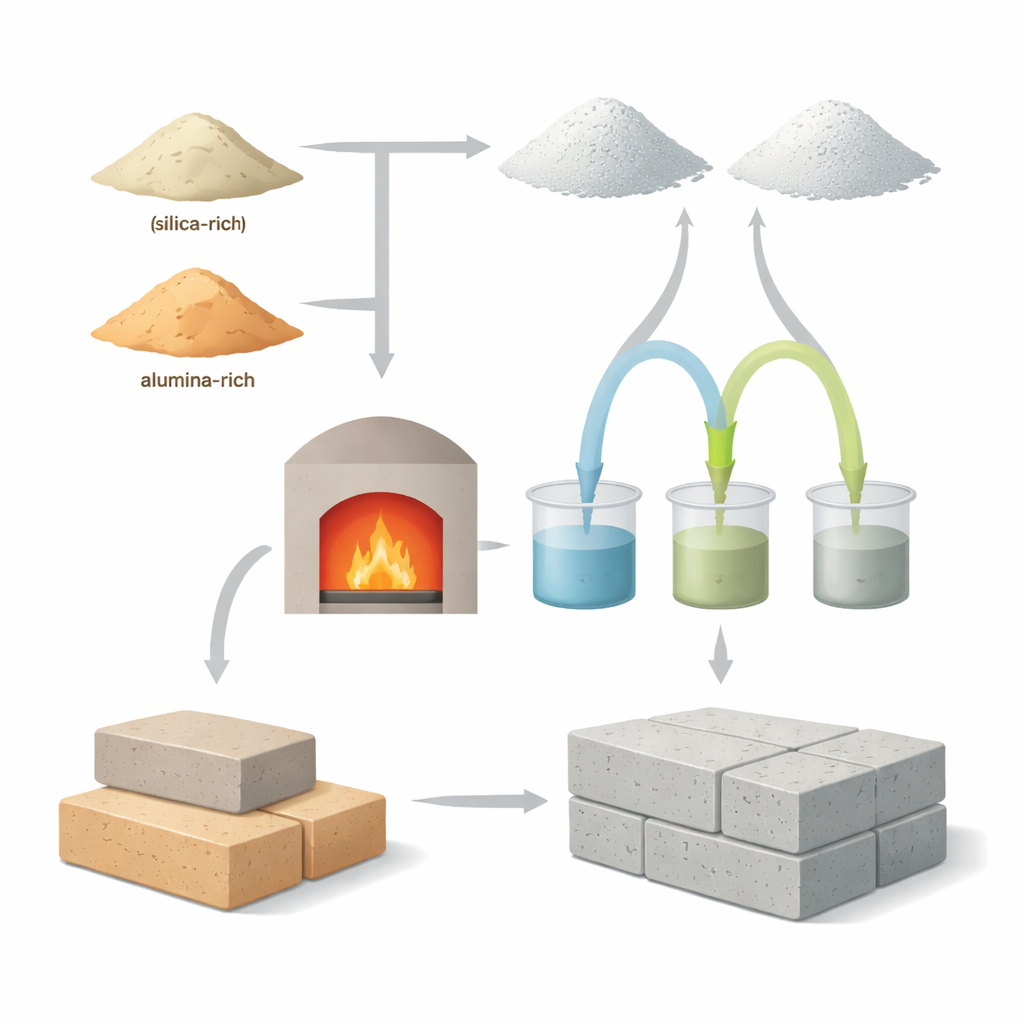
The researchers started with two natural kaolin clays from Egypt. After grinding, they fired both at 700 °C to turn them into metakaolin, a highly reactive powder. The key difference between the clays was their mineral makeup: one contained more alumina (aluminum oxide) and less silica, while the other had more silica and less alumina. To see how “ready to react” these powders were, the team used a standard lime-fixation test that measures how much calcium the metakaolin can bind. The alumina-rich sample proved markedly more reactive, confirming that not all metakaolins are created equal, even if their overall oxide contents look similar on paper.
Firing, Testing, and Peering Inside
To understand what firing does to the clay, the team combined thermal analysis, X-ray diffraction, and electron microscopy. Heating between about 450 and 600 °C drives off tightly bound water from the clay structure, converting ordered kaolinite crystals into a more disordered, glassy metakaolin. At 700 °C for one hour, this transformation was nearly complete, producing a largely amorphous material that is much easier to dissolve in alkaline solutions. Microscopy images showed that while the plate-like particle shapes remained, their edges rounded and the internal crystal order collapsed. This structural disorder is actually desirable here: the more disordered the metakaolin, the more reactive it becomes when mixed into a geopolymer.
Designing Mixes with the Same Ratios
Next, the researchers used the two metakaolins to make eight geopolymer mixes. They carefully controlled the overall chemical ratios of silica, alumina, sodium, and water so that pairs of mixes looked identical on paper. The only real difference was how much silica came from the solid metakaolin versus how much was supplied as dissolved silica in the sodium silicate solution. Because the alumina-rich metakaolin started with less silica in its structure, it needed more sodium silicate solution to reach the same target silica-to-alumina ratio as the silica-rich metakaolin. The team then measured how easy the fresh pastes were to handle, how quickly they set, and how strong they became after heat curing and 28 days of aging.
How Extra Dissolved Silica Boosts Strength
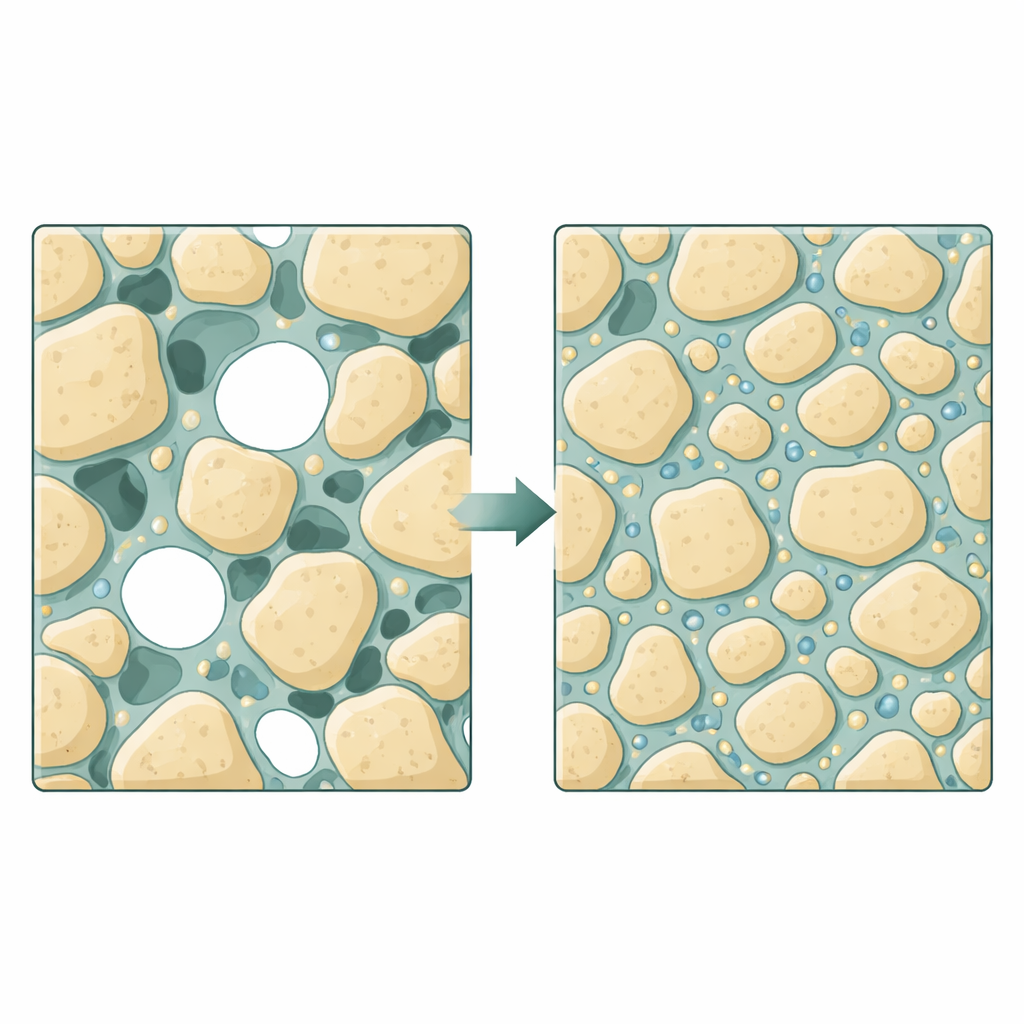
The strength tests told a clear story. For both metakaolins, compressive strength rose as the silica-to-alumina ratio increased, peaking at a value of about 3.5 before dropping off again. But the alumina-rich, more reactive metakaolin produced far stronger binders at every ratio—up to 64 MPa compared to only 18.6 MPa for its counterpart at the optimum composition. Microscopy and pore-structure measurements explained why. Mixes with more sodium silicate developed a denser, better-connected gel that filled in pores and reduced large defects, even when the total silica content was the same. In contrast, relying mainly on silica locked in the original mineral grains left more unreacted particles, larger voids, and a weaker, more brittle network.
What This Means for Future Buildings
For a non-specialist, the main takeaway is that it is not just how much silica a raw material contains that matters, but how much of that silica is actually available in dissolved form during mixing. This study shows that carefully choosing and firing the clay, then fine-tuning the sodium silicate dose, can dramatically improve the strength and compactness of metakaolin-based geopolymers while keeping their overall composition similar. In practical terms, using alumina-rich, highly reactive metakaolin and supplying enough soluble silica appears to be a more effective route to strong, low-carbon binders than simply starting with silica-rich clay. That insight brings geopolymers a step closer to serving as a robust, greener alternative to traditional cement in tomorrow’s infrastructure.
Citation: Abdeen, H., Mohsen, A., Soltan, A. et al. Effect of mineralogical composition on the compressive strength and microstructure of metakaolin geopolymer. Sci Rep 16, 14148 (2026). https://doi.org/10.1038/s41598-026-49264-x
Keywords: geopolymer, metakaolin, sustainable concrete, compressive strength, mineralogical composition