Clear Sky Science · en
Tensile performance modeling and process optimization of AA6061-T6/WC surface nanocomposites developed via friction stir processing
Stronger, Lighter Metals for Everyday Machines
From cars and airplanes to bicycles and ships, aluminum is prized because it is light and resistant to rust. But when metal parts rub, bend, and pull under heavy loads, the surface can become a weak link. This study explores a way to toughen the skin of a common aluminum alloy by mixing in ultra-hard ceramic nanoparticles, aiming to create lighter parts that still stand up to demanding real-world use in transport, defense, and marine systems.
How to Toughen a Metal Skin
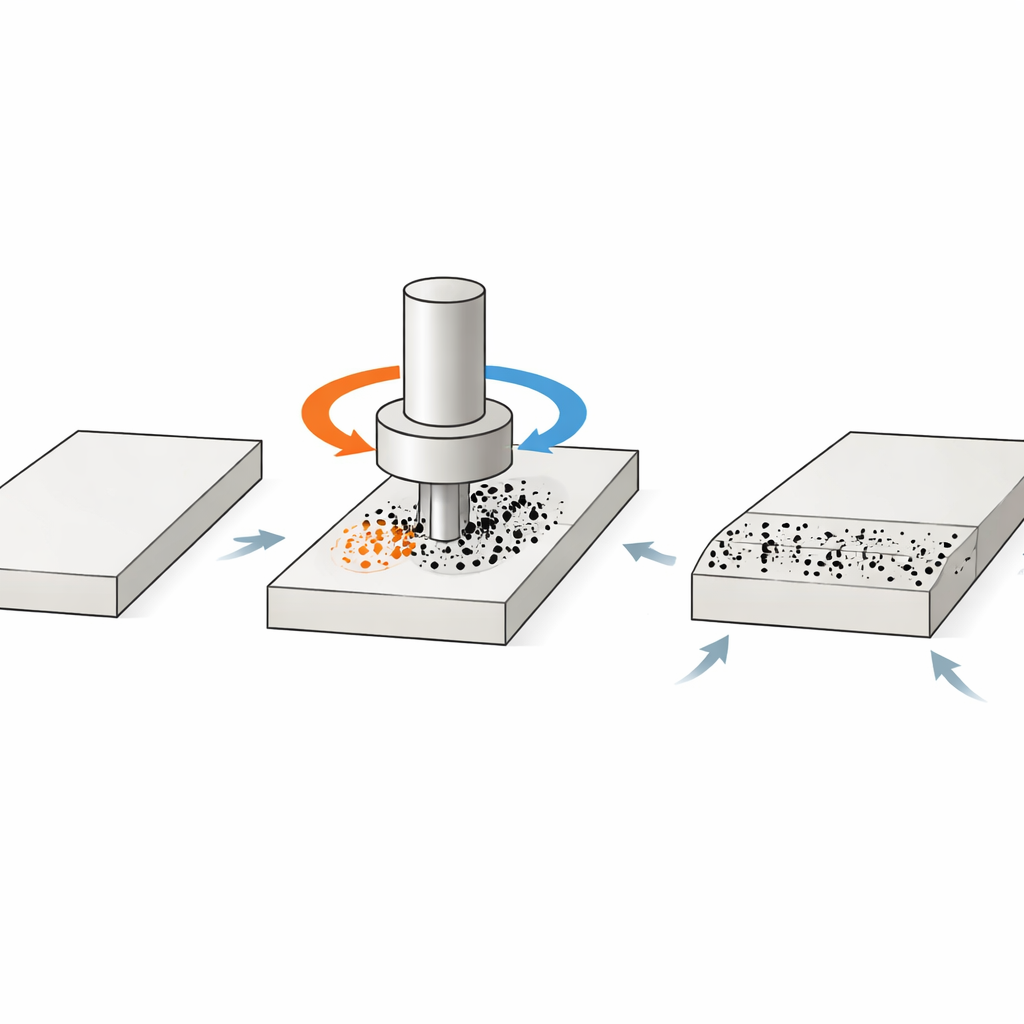
The researchers worked with AA6061-T6, a widely used aluminum alloy found in aircraft frames and automotive components. On its own, this alloy already balances strength, corrosion resistance, and ease of machining. To boost its performance further, the team added tiny particles of tungsten carbide, a ceramic material known for its exceptional hardness and wear resistance. Instead of melting the aluminum, they used a solid-state technique called friction stir processing, in which a rotating tool plunges into the surface, heats it through friction, and mechanically stirs the material without turning it into liquid. Grooves cut into the plate were filled with tungsten carbide nanoparticles, then sealed and stirred so that the hard particles became embedded in a thin surface layer of the aluminum.
Fine-Tuning the Stirring Recipe
Because friction stir processing involves many adjustable knobs, the team needed a smart way to choose which combinations to test. They varied four key factors: how much tungsten carbide was added, how many times the tool passed along the same track, how fast the tool rotated, and how quickly it moved forward. Using a statistical planning method known as Box–Behnken design, they mapped these settings to three important outcomes: tensile strength (how much pull the metal can withstand), yield strength (when permanent bending begins), and elongation (how much it can stretch before breaking). With only 27 carefully chosen experiments, they built mathematical models that predict the metal’s behavior for many possible processing conditions, and confirmed the models using analysis of variance to ensure the trends were reliable.
What Happens Inside the Metal
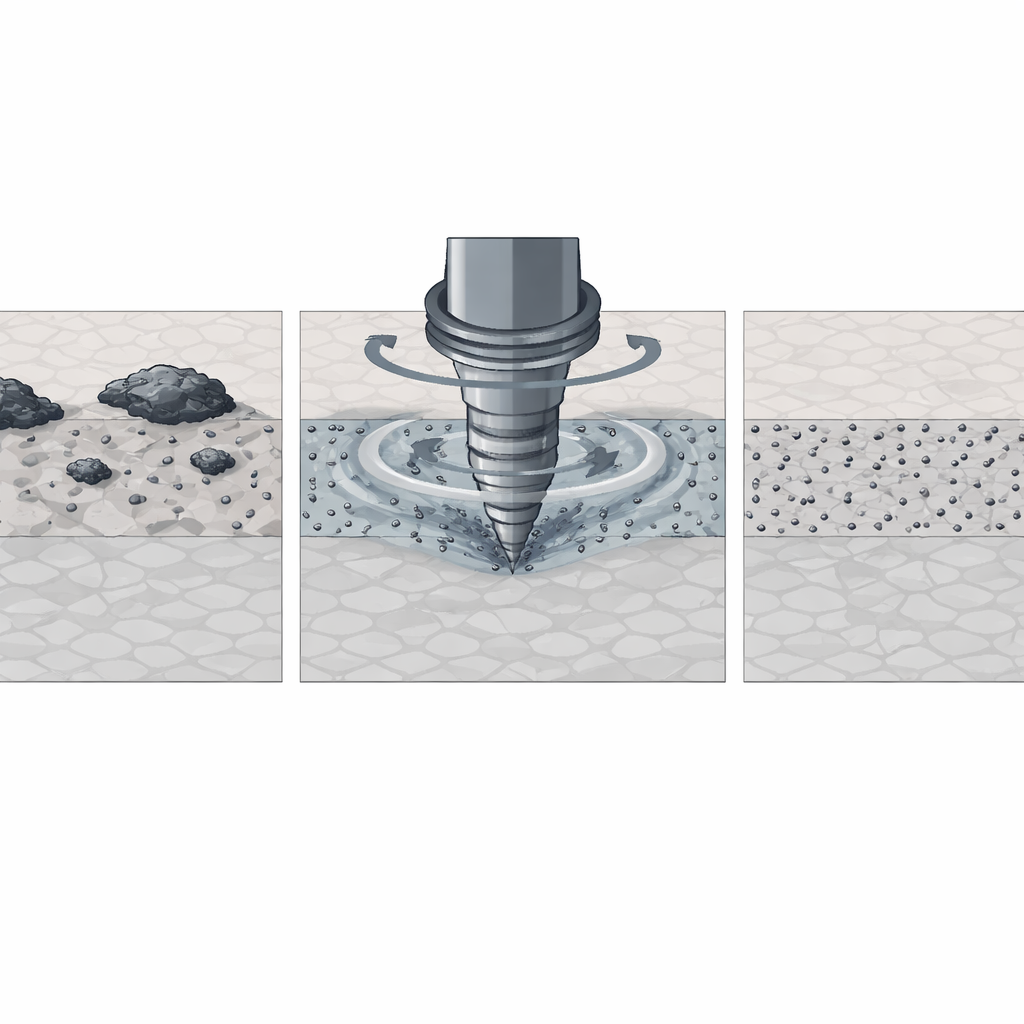
Looking inside the processed region with optical and electron microscopes, the researchers saw that the intense stirring broke up coarse features and transformed the structure near the surface. As the rotating tool swept over the material, it imposed severe plastic deformation and heat, which triggered dynamic recrystallization—essentially, the metal’s grains were chopped up and replaced by much finer, equiaxed grains. At the same time, the tungsten carbide nanoparticles were broken apart and spread more evenly with each additional pass of the tool. Under less-than-ideal settings, particles tended to clump together, and visible flow bands formed, which could become weak spots. Under optimized conditions, however, the particles were uniformly dispersed in a refined surface layer with clean, well-bonded interfaces between the hard ceramic and the softer aluminum.
Balancing Strength and Stretch
The statistical models revealed that tool rotation speed was the most influential factor, while the forward travel speed played a smaller role within the tested range. Increasing the number of passes almost always improved strength, as repeated stirring further refined the grains and removed defects like pores and tunnels. However, more tungsten carbide was not always better: strength and ductility improved as particle content rose to about 2% by volume, then declined when more particles caused clumping and stress concentration. The best combination the team found used 2% tungsten carbide, five passes, a rotation speed of 1000 revolutions per minute, and a slow traverse speed of 30 millimeters per minute. Under these conditions, the surface layer reached about 315 MPa in tensile strength, 221 MPa in yield strength, and nearly 10% elongation, a strong balance between toughness and stretch.
Why This Matters for Future Machines
In plain terms, the study shows that it is possible to “stir in” hard nanoparticles into the skin of a standard aluminum alloy and, by carefully tuning the processing recipe, create a surface that is both stronger and reasonably ductile. The optimized layer resists pulling forces better and deforms more gracefully before breaking, without sacrificing the light weight that makes aluminum so attractive. Because the process avoids melting, it also sidesteps many defects that plague traditional casting. As industries push for lighter vehicles and equipment that still last longer under harsh conditions, such tailored surface nanocomposites offer a promising path toward safer, more efficient designs.
Citation: Abdelhady, S.S., Elbadawi, R.E. Tensile performance modeling and process optimization of AA6061-T6/WC surface nanocomposites developed via friction stir processing. Sci Rep 16, 13887 (2026). https://doi.org/10.1038/s41598-026-49260-1
Keywords: aluminum nanocomposite, friction stir processing, tungsten carbide nanoparticles, tensile properties, lightweight structural materials