Clear Sky Science · en
Building energy retrofits in Canada under government fiscal constraints
Why warmer homes and lower bills matter
Many Canadians live in houses that leak heat and money. Heating these homes burns a lot of fuel, driving up both energy bills and greenhouse gas emissions. This study asks a practical question: how can Canada upgrade its homes so they are cleaner and cheaper to run, while governments face tight budgets and families struggle with rising energy costs?
How the study looks at homes and money together
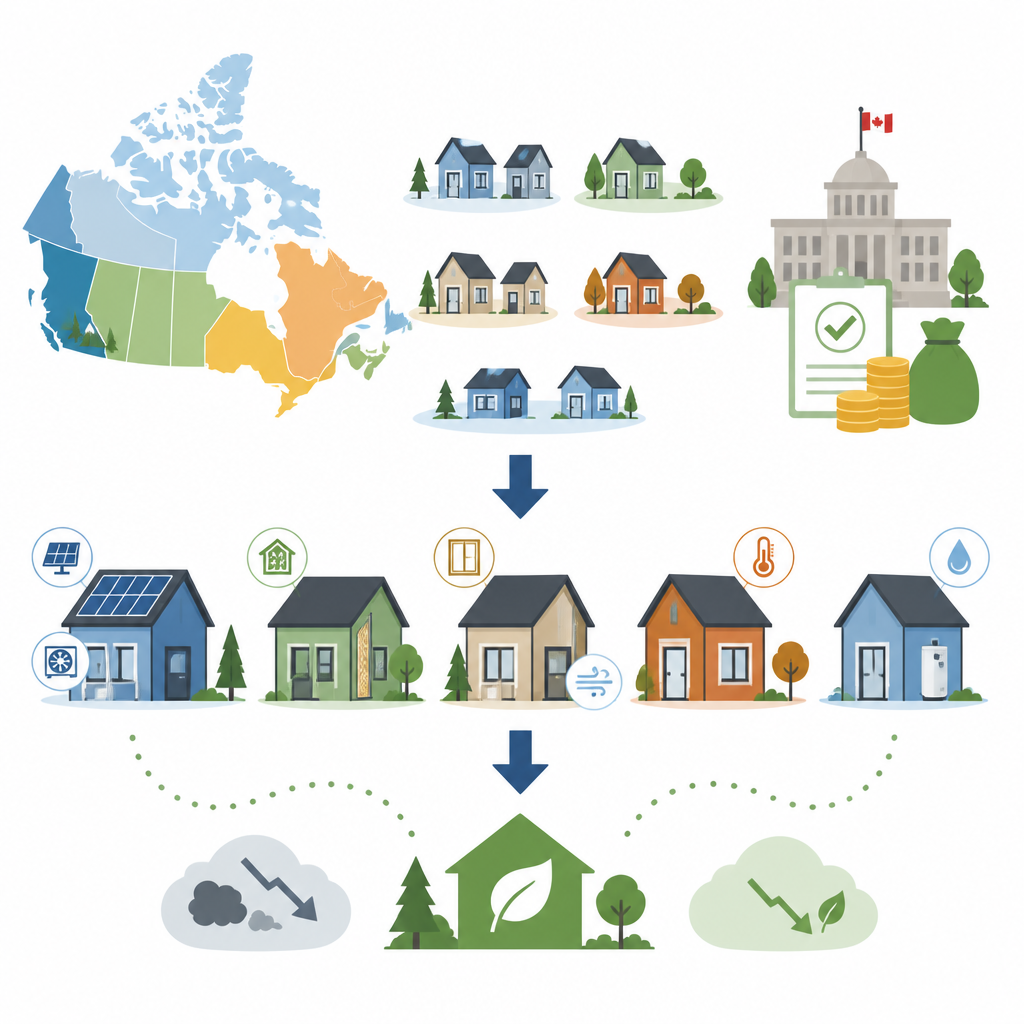
The researchers built a computer framework that treats a house and the policies around it as one connected system. They focused on a typical detached home and tested thousands of upgrade packages across ten cities, from mild Vancouver to very cold Yellowknife. For each city, a detailed building model estimated hourly energy use before and after retrofits such as better insulation, tighter air sealing, solar panels, heat pumps, solar hot water, and thermal energy storage. At the same time, the model varied rebates, low-interest loans, and energy taxes, then searched for combinations that would cut emissions, save homeowners money, and limit government spending over twenty years.
Which upgrades give the biggest payoff
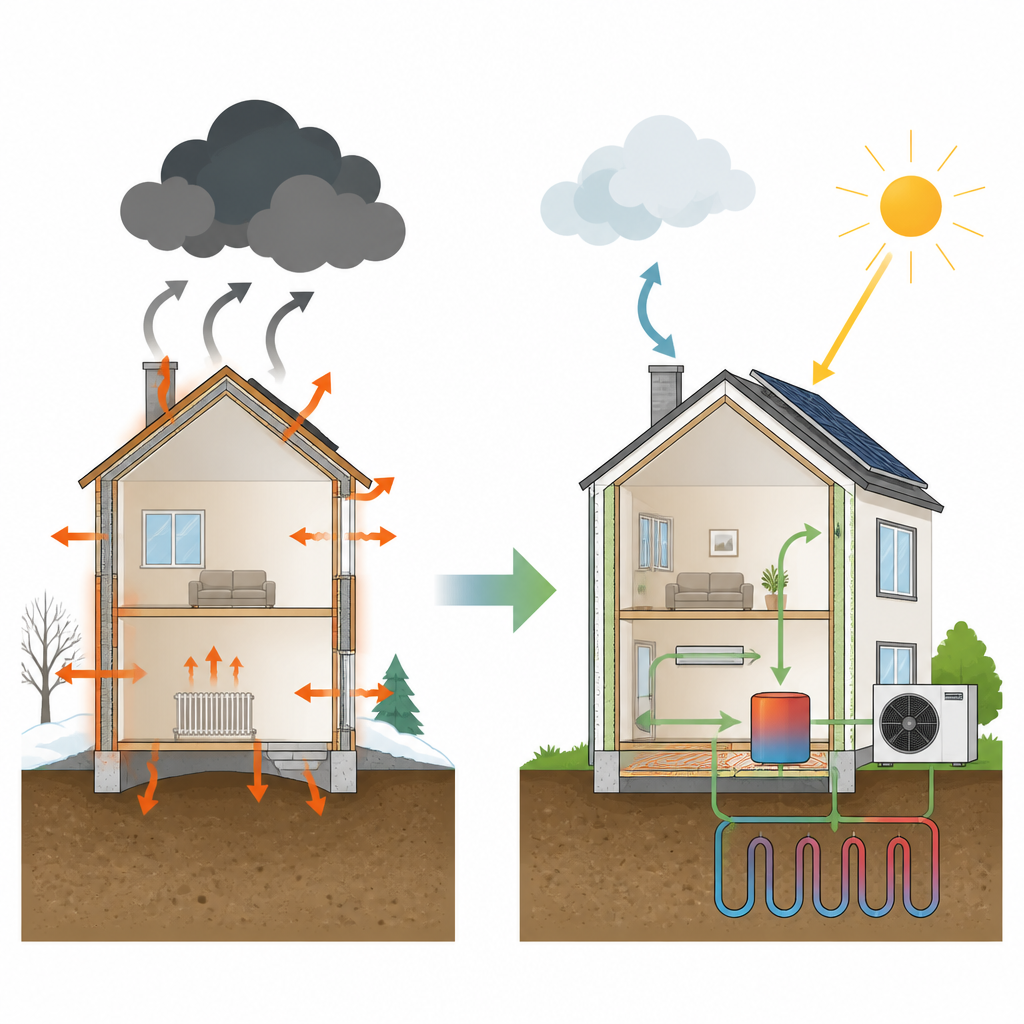
The results show that high-tech systems often beat simply adding more insulation. In almost every city, roof and wall insulation stayed near current building code levels, while improved air tightness was chosen again and again. Heat pumps, thermal energy storage, and solar thermal collectors proved valuable in most climates, because they cut fuel use for heating. Solar panels were especially attractive where the electricity grid is dirty or electricity prices are high, such as Toronto, Calgary, and Saskatoon. In places with clean and cheap power, like Montreal and Winnipeg, the model relied more on heat pumps and storage than on large solar arrays.
What it costs homeowners and governments
Across Canada, the optimized packages could save individual households up to about seven thousand dollars per year on energy bills while cutting more than one hundred tonnes of carbon dioxide over two decades. But these gains do not come for free. The study finds that governments almost always spend money overall, mainly through rebates in the range of twenty three to forty two thousand dollars per home, plus very low-interest loans and modest energy taxes. Governments do not make that back directly through higher taxes or lower program costs, yet the public still benefits from lower climate damage and healthier, more comfortable homes. Carefully tuned taxes on energy use provide a gentle push to save energy without putting an unfair burden on households.
Cutting energy poverty across regions
The study also looks at energy poverty, defined here as households that spend at least ten percent of their income on energy. Before retrofits, many cities showed high energy burdens, especially in colder provinces and the North. With the optimized upgrades and financial support, large urban areas such as Montreal, Toronto, Vancouver, Calgary, and Winnipeg see sharp drops in the share of families in energy poverty. In Montreal, for example, hundreds of thousands of households could fall below the ten percent threshold. However, Atlantic provinces and northern territories remain vulnerable even after upgrades, because of harsher climates, dependence on expensive fuels, and long heating seasons. In these regions, the authors argue that retrofits must be paired with deeper support, such as fuel switching to heat pumps and ongoing help with bills.
What this means for Canada’s path forward
For a general reader, the main message is clear: upgrading homes can strongly cut emissions and lower many families’ bills, but only if governments step in with smart, sustained support. The study suggests that the best use of public funds is not endlessly adding insulation, but combining solid basic building shells with modern equipment like heat pumps, solar systems, and thermal storage, tailored to each region’s climate and energy mix. Done well, such programs can ease energy poverty and move Canada toward its climate goals, even when public budgets are limited.
Citation: Madadizadeh, A., Siddiqui, K. & Aliabadi, A.A. Building energy retrofits in Canada under government fiscal constraints. Sci Rep 16, 14663 (2026). https://doi.org/10.1038/s41598-026-49147-1
Keywords: building retrofits, energy poverty, heat pumps, solar energy, climate policy