Clear Sky Science · en
Assessing the unconventional reservoirs of the Nukhul formation in the Rudeis-Sidri Field, Gulf of Suez: petrophysical characterization and flow unit discrimination
Hidden pockets under an ancient sea
Deep beneath the Gulf of Suez, rocks laid down in a warm shallow sea quietly hold oil that helps power modern Egypt. This study looks at one such rock layer, the Nukhul Formation, to answer a practical question: how much oil is really there, and how easily can it be brought to the surface?
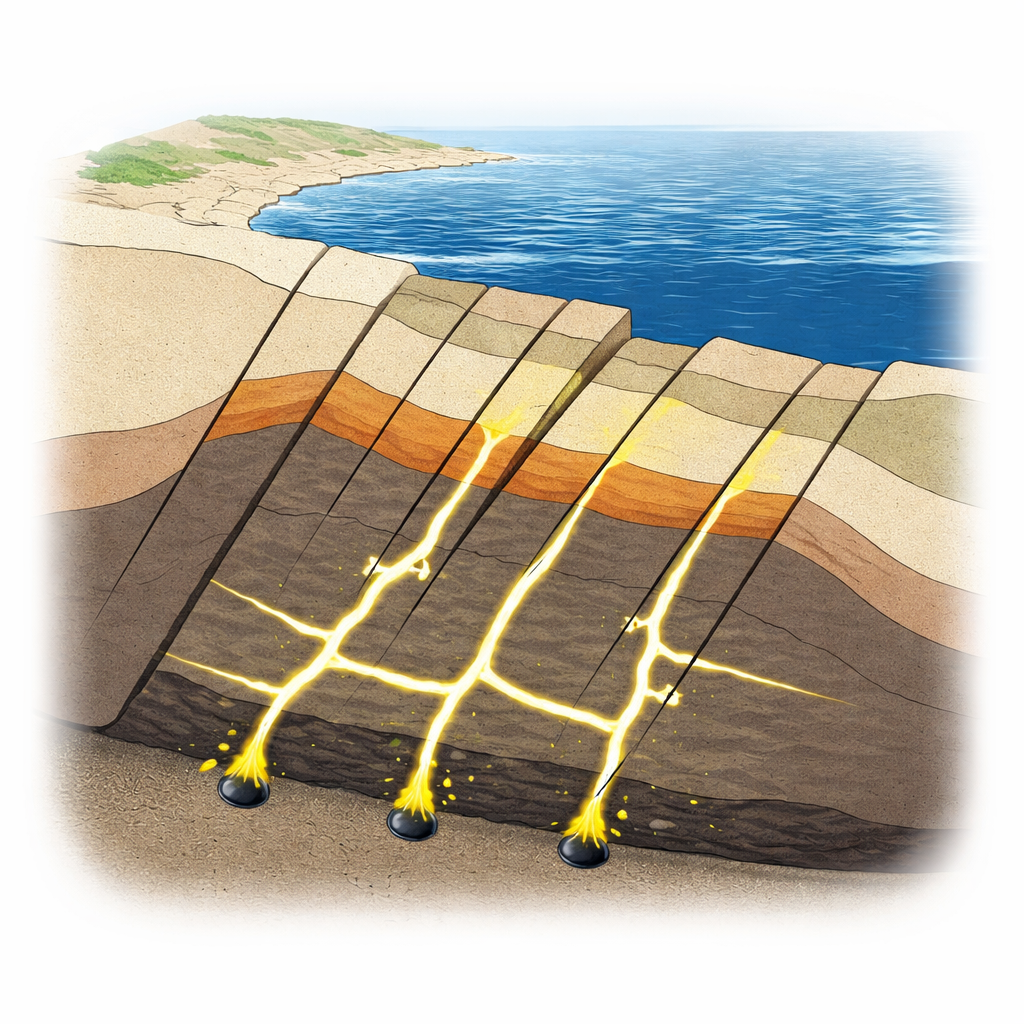
Where the rocks sit and why they matter
The Nukhul Formation lies within the Rudeis–Sidri Field, one of the Gulf of Suez region’s long‑producing oil areas. Over millions of years, stretching of the Earth’s crust created a rift basin, tilting blocks of rock and opening space for thick piles of sand, mud, and carbonates to build up. Within this stack, Nukhul sandstones act as the main oil‑bearing layer, while surrounding shales and other rocks act as seals and secondary reservoirs. Because the field is cut by many faults and contains a mix of rock types, oil does not sit evenly; instead, it collects in complex patterns that require detailed study before new wells are drilled.
How scientists read the rock record
To decode this hidden system, the authors combined measurements made directly on rock pieces brought up by drilling with readings from tools lowered down the well. These downhole tools record natural radioactivity, density, sound speed, and electrical resistivity, which together reveal how sandy or shaly the rock is, how much empty space it contains, and whether that space is filled mostly with water or hydrocarbons. In the Sidri‑14 well, this integrated approach allowed the team to divide the Nukhul into four main units, labeled A through D, and to estimate how much of each unit could realistically flow oil to a well.
Good spaces to store oil but poor pathways to move it
The measurements show that units A, B, and C are made mostly of sandstone mixed with thin shale and limestone layers, while unit D is dominated by tight limestone with almost no reservoir value. Even in the better units, the tiny spaces between grains are small and poorly connected. Porosity values are modest, and permeability, which controls how easily fluids move, is mostly very low. Water often fills more than half of the pore space, further limiting useful oil volume. By tracking how permeability changes with depth, the team found that the reservoir is highly uneven, with a wide spread of flow capacities over short vertical distances. In everyday terms, the rock is like a sponge where only a few streaks let liquid move freely, while most of it behaves almost like solid stone.
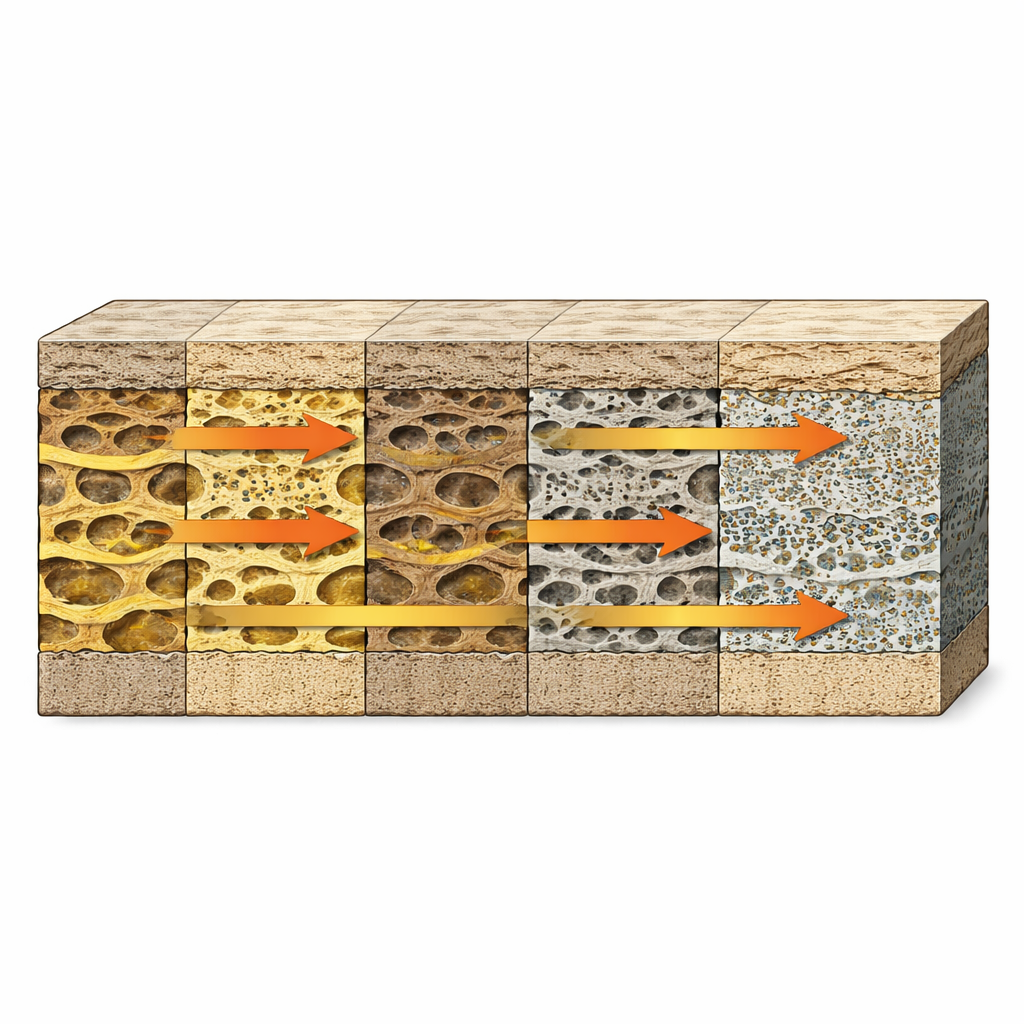
Picking out the few fast lanes
To separate the rare “fast lanes” from the surrounding slow rock, the researchers grouped samples into hydraulic flow units, or HFUs, based on how their pore spaces behave. They used several indices that combine porosity and permeability and relate them to the effective size of pore throats, the narrow necks linking adjacent pores. Eight distinct HFUs emerged. Two of them, linked to the best rock types, have relatively larger and better connected pores and account for the largest share of the formation’s flow capacity, even though they make up only part of the thickness. Most of the remaining flow units have tiny pore throats and carry fluid only sluggishly, while the worst unit contributes essentially nothing to flow.
What this means for future oil production
For a non‑specialist, the key message is that the Nukhul Formation is not a classic free‑flowing oil reservoir but a tight, patchy one. Useful oil is present, but it is locked inside rock that does not give it up easily. The study shows that only a few narrow zones within the formation act as effective pathways, and successful wells must be designed to target these sweet spots. Techniques such as horizontal drilling and hydraulic fracturing will be needed to connect more of these limited high‑quality flow units and to make production economical, while large portions of the rock will remain effectively sealed off from flow.
Citation: El-Sawy, M.Z., Nabawy, B.S., Shazly, T.F. et al. Assessing the unconventional reservoirs of the Nukhul formation in the Rudeis-Sidri Field, Gulf of Suez: petrophysical characterization and flow unit discrimination. Sci Rep 16, 14704 (2026). https://doi.org/10.1038/s41598-026-49085-y
Keywords: unconventional reservoir, tight sandstone, hydraulic flow units, Gulf of Suez, hydrocarbon potential