Clear Sky Science · en
Computational intelligence-based investigation of heat transfer enhancement and entropy optimization in tri-hybrid nanofluid flow over a paraboloid needle
Why cooling tiny devices matters
From smartphones to medical sensors, modern technology packs a lot of heat into very small spaces. Keeping these devices cool without wasting energy is a growing challenge. This study explores a new type of cooling liquid packed with different kinds of nanoparticles and uses artificial intelligence to predict how well it moves heat away from a slim heated needle. The results could guide better thermal management in electronics, biomedical tools, and energy systems.
Mixing special particles into smart liquids
Instead of using plain water or oil, the researchers examine nanofluids, which are liquids seeded with extremely small solid particles that conduct heat well. They focus on two mixtures: a "hybrid" nanofluid with two types of particles and a "ternary" or tri-hybrid nanofluid with three. The base liquid is a blend of water and ethylene glycol, a common coolant. Into this they mix titanium dioxide for chemical stability, multi-walled carbon nanotubes for very high thermal conductivity, and aluminum oxide to improve dispersion and cost effectiveness. Together, these ingredients aim to move heat more efficiently than ordinary coolants or simpler nanofluids.

Flow around a needle-shaped object
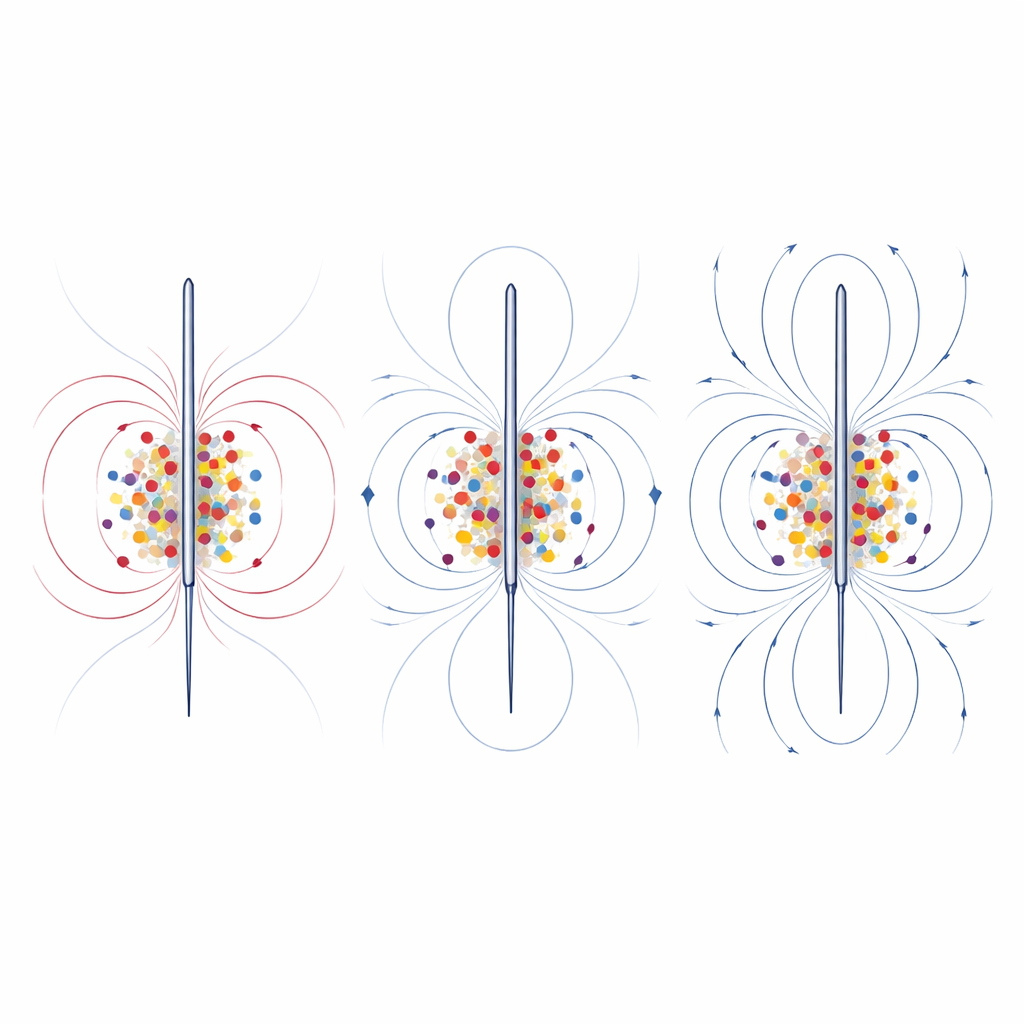
The team studies how these complex liquids flow past a heated needle with a curved, paraboloid shape. This geometry stands in for tiny components such as medical needles, fine wires, or micro-scale tubes where heat removal is critical. The fluid is also treated as a Casson fluid, a model usually used for materials like blood or thick pastes that only begin to flow once a certain stress threshold is exceeded. A magnetic field, thermal radiation, and particle migration effects are all included, creating a realistic picture of how heat, momentum, and matter interact in this small region around the needle.
Balancing heat transfer and energy losses
Beyond simple cooling power, the authors look at entropy generation, a measure of how much useful energy is irreversibly lost as heat spreads and friction resists motion. They find that the tri-hybrid nanofluid tends to increase wall shear stress, meaning stronger drag on the needle surface, and offers better momentum transfer than the two-particle hybrid fluid. However, the local heat transfer rate, characterized by a Nusselt number, is slightly lower for the ternary mixture, revealing a trade-off between pushing the fluid harder and extracting heat efficiently. Stronger magnetic fields and higher Casson behavior both thicken resistance to flow and reduce heat transfer, while stronger thermal radiation and certain particle motions make the fluid temperature rise and extend the thermal layer.
Teaching a neural network to predict cooling
Solving the governing equations for every combination of parameters can be time consuming, so the researchers pair a standard numerical solver with a feed-forward artificial neural network. They generate a broad set of sample solutions using a MATLAB boundary value solver and then train the neural network to learn the relationship between key inputs such as magnetic strength, radiation level, particle shape, and thermophoretic motion, and outputs such as skin friction and heat transfer rate. After training, the network reproduces the numerical results with very high accuracy, showing tight agreement in velocity and temperature profiles over many test cases. This means engineers can use the network as a fast surrogate model instead of repeatedly running heavy numerical simulations.
What this means for future cooling technologies
In simple terms, the study shows that adding three carefully chosen nanoparticle types to a coolant can improve how momentum and heat are handled near tiny heated objects, but it also increases drag and entropy production under some conditions. Magnetic fields and fluid rheology can either help or hinder cooling, depending on how they are tuned. By combining detailed physics-based modeling with neural network prediction, the authors offer both physical insight and a practical tool for quickly exploring design options. For designers of compact heat exchangers, biomedical devices, and advanced energy systems, these findings outline how to balance stronger cooling, manageable flow resistance, and acceptable energy losses when using advanced nanofluids.
Citation: Ahmad, J., Aljethi, R.A., Shah, S.A.A. et al. Computational intelligence-based investigation of heat transfer enhancement and entropy optimization in tri-hybrid nanofluid flow over a paraboloid needle. Sci Rep 16, 14159 (2026). https://doi.org/10.1038/s41598-026-49041-w
Keywords: nanofluid cooling, heat transfer, entropy generation, artificial neural network, magnetohydrodynamics