Clear Sky Science · en
Exploring the utilities of rice straw black liquor (part XVI): nano (zinc/lignin) hybrid for safe polyurethane films with enhanced antimicrobial, mechanical, and UV-protecting properties
Turning Farm Waste into Safer Food Wraps
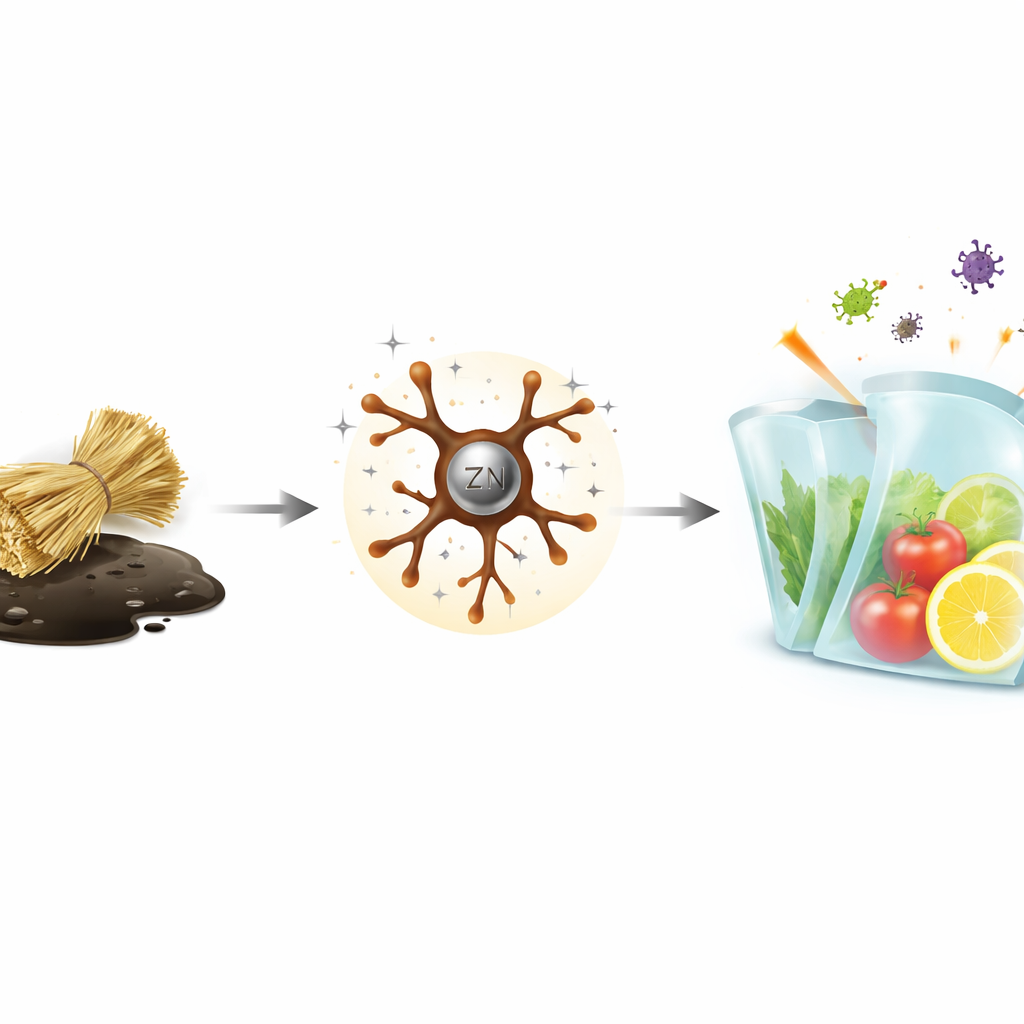
Every year, mountains of crop leftovers are burned or discarded, while supermarkets throw away fruits and vegetables spoiled by microbes, moisture, and sunlight. This study brings those two problems together in a surprising way: it transforms a waste product from rice straw processing into a tiny additive that, when mixed into a common plastic, creates food packaging films that are stronger, resist germs, and shield food from damaging ultraviolet (UV) light. The work points toward packaging that both protects our food better and relies less on fossil fuels.
Why Fresh Food Needs Smarter Packaging
Fresh produce is alive and breathing even after harvest. Inside sealed packs, water from fruits and vegetables evaporates and condenses on the inner surface, raising humidity and giving bacteria, yeast, and molds an ideal home. At the same time, sunlight—especially UV light—triggers chemical reactions that damage vitamins, proteins, and fats, shortening shelf life and wasting nutrition. Many current plastic films, often made from petroleum, either trap too much moisture, offer poor UV protection, or create long-lasting plastic waste. The authors focus on polyurethane, a versatile plastic that can be formulated to be biodegradable and to let gases pass at rates suitable for fresh produce, but they aim to upgrade it into a smarter, safer material.
Mining Rice Straw Waste for Useful Ingredients
When rice straw is chemically processed, it produces a dark liquid by-product rich in a natural polymer called lignin, along with silica and fatty substances. Instead of treating this “black liquor” as waste, the researchers previously learned how to capture lignin together with silica and fatty acids and combine them with zinc to form a hybrid nano-sized material. Lignin on its own can block UV light and has antioxidant and antimicrobial abilities. Zinc compounds are also known for their germ-fighting power. By letting lignin’s many reactive groups bind metals and other components, the team creates a compact hybrid particle that concentrates these useful traits and can be blended into plastics as a multifunctional filler.
Building and Testing the New Films
In this study, the hybrid zinc–lignin material was produced from rice straw black liquor and then ground into nanoparticles. These particles were melt-mixed into thermoplastic polyurethane at three loadings: 1, 5, and 10 percent by weight, with plain polyurethane as a reference. Using a suite of tools—X-ray techniques to confirm composition, infrared light to track chemical bonds, and electron microscopy to see the internal structure—the team verified that the particles were well incorporated into the plastic. Mechanical tests showed a clear trend: as more hybrid was added, the films became stronger and more stretchable, with tensile strength and elongation at break both rising, even after prolonged UV exposure. Measurements of gas and water transmission revealed that the nanoparticles made it harder for water vapor to pass through the film, an advantage for keeping moisture under control, while oxygen transmission increased, which can be useful in tuning packages for respiring produce.

Fighting Germs While Staying Gentle to People
The new films were challenged with common troublemakers in food spoilage and infection: the bacteria Staphylococcus aureus and Escherichia coli, and the fungus Candida albicans. Compared with untreated controls, the zinc–lignin hybrid sharply reduced the number of surviving microbes, with the strongest effect at the highest nanoparticle content. The authors attribute this to the combined action of lignin and zinc: the tiny particles can reach and disrupt microbial membranes, while reactive zinc ions and lignin’s antioxidant chemistry interfere with vital processes inside the cells. To ensure that this added protection does not come at the expense of human health, the team exposed normal human skin cells to different concentrations of the hybrid material. Only very high concentrations caused notable harm, indicating that the levels used in the films—between 1 and 10 percent—fall within a safe range.
Balancing Performance, Safety, and Cost
Putting all results together, the researchers identify about 5 percent of the zinc–lignin hybrid as a sweet spot: it delivers substantial gains in strength, stretchability, UV shielding, moisture control, and antimicrobial performance without excessive particle clumping, toxicity, or added cost. Because the hybrid is derived from agricultural waste and can be combined with biodegradable polyurethane, the resulting films promise both better protection for fruits and vegetables and a smaller environmental footprint. In everyday terms, the study shows how yesterday’s farm trash can become tomorrow’s cleaner, smarter food wrap—helping keep produce fresh for longer while easing our reliance on conventional plastics.
Citation: Nawwar, G.A.M., Youssef, A.M. & Othman, H.S. Exploring the utilities of rice straw black liquor (part XVI): nano (zinc/lignin) hybrid for safe polyurethane films with enhanced antimicrobial, mechanical, and UV-protecting properties. Sci Rep 16, 13891 (2026). https://doi.org/10.1038/s41598-026-48917-1
Keywords: bio-based food packaging, antimicrobial films, rice straw lignin, polyurethane nanocomposites, UV-protective materials