Clear Sky Science · en
Modeling and experimental confirmation of a new start method utilizing mechanical resonance for the linear range extender
Why a gentle push matters for future car engines
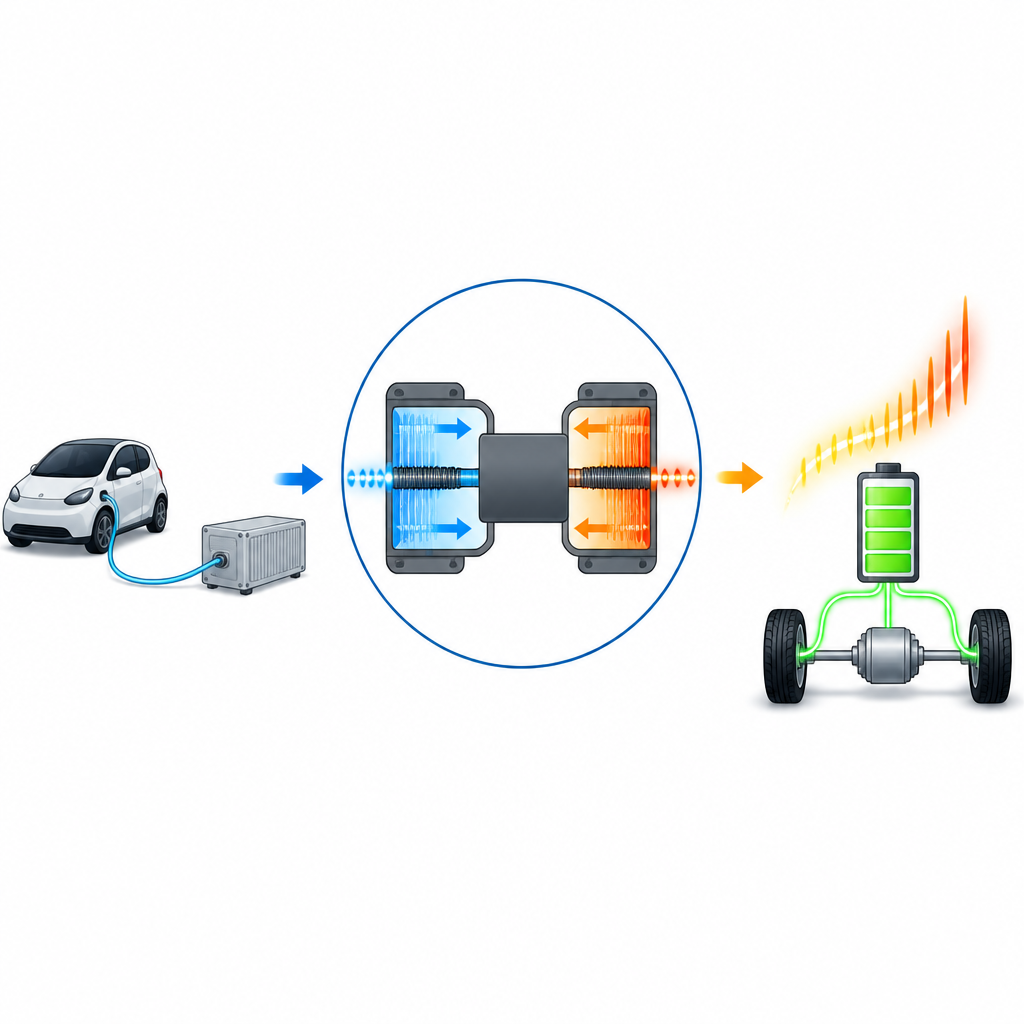
Modern electric cars often rely on small onboard engines to recharge their batteries on long trips. These “range extenders” must start quickly and reliably, but a new type called a linear range extender has no traditional crankshaft or flywheel to help it spin up. This study shows how engineers can start such an engine by using a clever form of mechanical resonance, where many small electrical nudges add up to strong motion and high pressure, making compact and efficient range extenders more practical for future vehicles.
A straight-line engine with a special challenge
Instead of a rotating crank, a linear range extender moves its pistons back and forth in a straight line and combines them directly with a linear electric motor. This simple layout can cut friction, emissions, and fuel limits while feeding electricity straight to a car’s battery. But without a heavy flywheel to store spinning energy, the engine struggles at the very first moments of operation, when the pistons must squeeze cold air to a high pressure before any fuel can ignite. Existing start methods rely on extra hardware such as compressed air, hydraulic systems, or very powerful motors, which makes the system heavier, more complex, and more expensive.
Turning small pushes into big squeezes
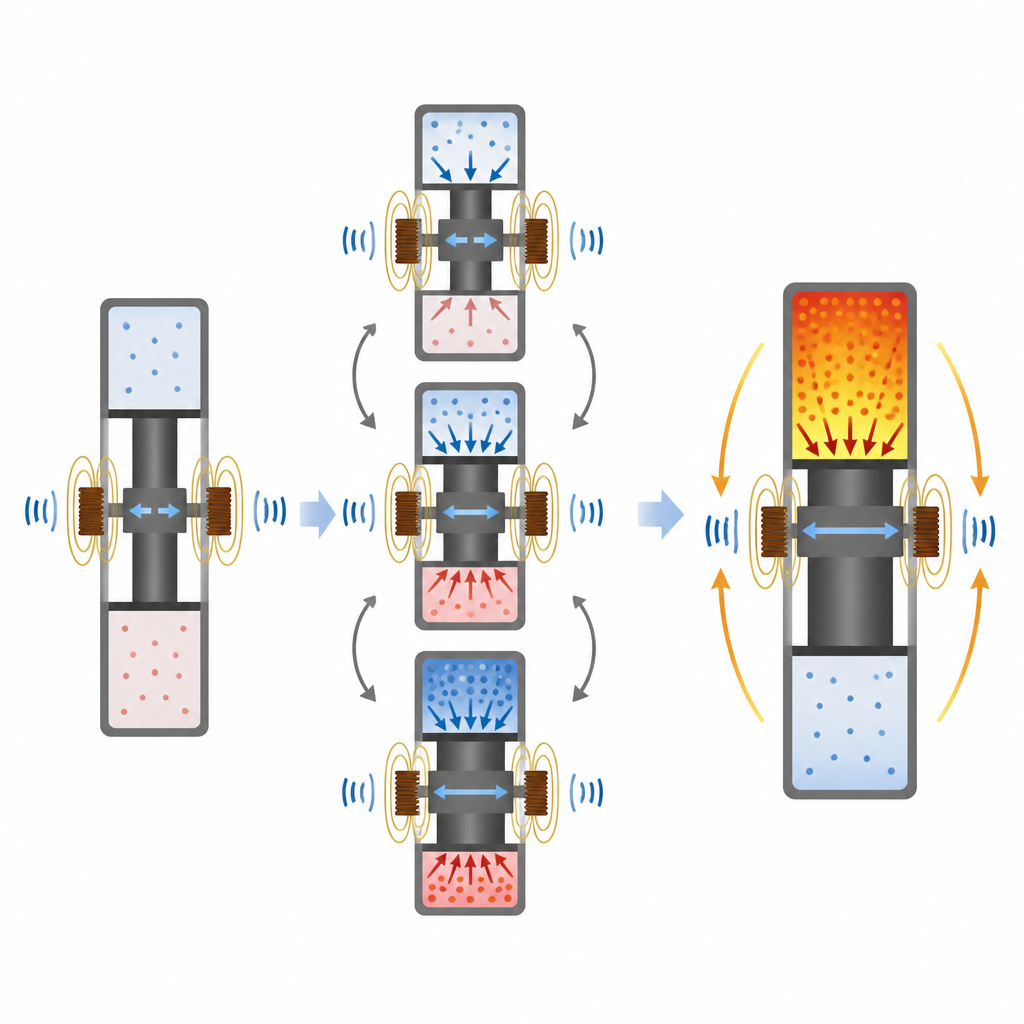
The authors propose a different idea: make the piston and gas behave like a resonating mass and spring. During start up, the linear motor gives timed pushes that are carefully matched to the piston’s back and forth motion, much like pushing a child on a swing at just the right moment. When the electrical force stays in step with the piston speed, each cycle adds a bit more energy than is lost to friction and heat. Over several strokes, the piston travels farther, moves faster, and compresses the gas inside the cylinder to higher and higher pressures, even though the motor itself delivers only modest force. A detailed mathematical model links the piston motion, gas compression and heating, friction, heat loss to the walls, and gas leaking past the rings into one coupled picture of the resonance process.
Building a realistic model of the hidden physics
To test whether this idea holds up in practice, the team built a simulation that treats the gas in the cylinders as an ideal working fluid whose pressure and temperature change as the volume shrinks and expands. The model includes how quickly heat flows to the cool metal walls, how much gas might leak through the tiny gaps at the piston rings, and how friction in the rings and motor resists motion. It also represents a smart control system that continuously adjusts the motor current so that the driving force always points in the same direction as piston motion, sustaining resonance. The model predicts that under the right timing and force, piston stroke and cylinder pressure grow quickly with each cycle until they reach the levels needed for fuel to ignite, then settle into a steady vibration where added energy balances losses.
Putting resonance starting to the test
The researchers then built and instrumented a twin cylinder experimental prototype. Using pressure sensors and a position encoder, they measured how cylinder pressure and piston motion evolved when the motor applied a constant, phase controlled starting thrust. Without injecting any fuel, they focused purely on the compression behavior. The experiments showed the piston stroke increasing from small oscillations to a stable, larger motion, while the peak cylinder pressure climbed from around atmospheric levels to more than four megapascals within a fraction of a second. These measured curves closely matched the model’s predictions, confirming that the simulation captures the key physics of resonance starting in this type of engine.
How much push is enough, and how much is too much
By varying the motor force in both simulations and analysis, the study mapped out safe and effective operating ranges. Stronger electrical pushes led to larger piston travel, higher compression ratios, faster pressure build up, and shorter start times. However, if the force is too low, the piston never reaches the pressure needed for ignition, no matter how many cycles are used. If the force is too high, the piston risks striking the cylinder ends and subjecting parts to excessive stress. Using energy balance and simple formulas, the authors derived expressions for the minimum force needed to overcome friction, heat loss, and leakage, and the maximum force that keeps motion within safe limits. These guidelines help designers choose a suitably sized linear motor without overspecifying it.
What this means for cleaner, simpler range extenders
Overall, the work shows that a linear range extender can start reliably by harnessing resonance, using its own built in motor to store and amplify energy over repeated strokes instead of relying on bulky helpers. With careful control, a relatively small electromagnetic force can compress gas strongly enough to ignite fuel while keeping mechanical loads within safe bounds. For a lay reader, the key message is that by timing small pushes in just the right way, engineers can start a straight line engine efficiently and simplify the hardware needed to support future electric vehicles.
Citation: Gao, G., Tian, X., Qin, Z. et al. Modeling and experimental confirmation of a new start method utilizing mechanical resonance for the linear range extender. Sci Rep 16, 15754 (2026). https://doi.org/10.1038/s41598-026-48914-4
Keywords: linear range extender, mechanical resonance, engine starting, hybrid vehicles, electromechanical energy