Clear Sky Science · en
Dynamical behavior of analytic solutions of the generalized derivative nonlinear Schrödinger equation under stochastic perturbations in fiber communication systems
Why tiny light pulses in fibers matter
Every time we make a phone call, watch a movie online, or send an email, streams of light pulses rush through hair‑thin glass fibers beneath our feet and across oceans. These pulses need to keep their shape over long distances to carry information reliably. In reality, however, they travel through an imperfect world filled with random disturbances and complex material effects. This paper explores how such randomness and subtle "memory" effects in the fiber change the behavior of special, self‑stabilizing light pulses known as solitons, and what that means for the future of high‑speed communication.

Light pulses that fight back
In optical fibers, powerful light pulses do not simply spread out and fade the way a flashlight beam does. Instead, the material of the fiber bends and slows the light in a way that can counteract this spreading. When these two tendencies perfectly balance, a soliton forms: a compact pulse that travels long distances without changing shape. Solitons have become an important tool in long‑haul fiber links because they can carry information with remarkably little distortion. To describe them, physicists use a key mathematical model called the nonlinear Schrödinger equation, which captures how dispersion (the tendency of different colors of light to separate) and nonlinearity (the intensity‑dependent response of the fiber) work together.
Adding real‑world randomness
Real fibers are never perfectly quiet. They are affected by temperature changes, manufacturing imperfections, amplifier noise, and other sources of randomness that jostle the light as it travels. The authors incorporate this kind of unpredictability into the soliton model by adding a "white noise" term, a standard way to represent rapid, random fluctuations, and by letting some of the derivatives be of fractional order, which mimics materials that have memory rather than responding instantly. This produces an extended version of the nonlinear Schrödinger equation that is better aligned with what actually happens in working communication systems, where both noise and complex material behavior can subtly erode signal quality.
Finding new families of wave shapes
Instead of relying only on computer simulations, the authors seek exact analytic solutions of this noisy, generalized equation. Using a technique called the unified method, they convert the original equation into a simpler one and systematically build explicit formulas for the pulse shapes. They uncover a rich zoo of solutions: kink‑type solitons that connect two different constant levels, localized wave solitons, and more exotic singular solitons whose intensity grows sharply at specific points. For each family, they derive conditions on physical parameters such as dispersion strength, nonlinearity, and noise intensity, and then use three‑dimensional surfaces, two‑dimensional slices, and contour plots to visualize how these pulses evolve in space and time.
How noise and memory reshape the signal
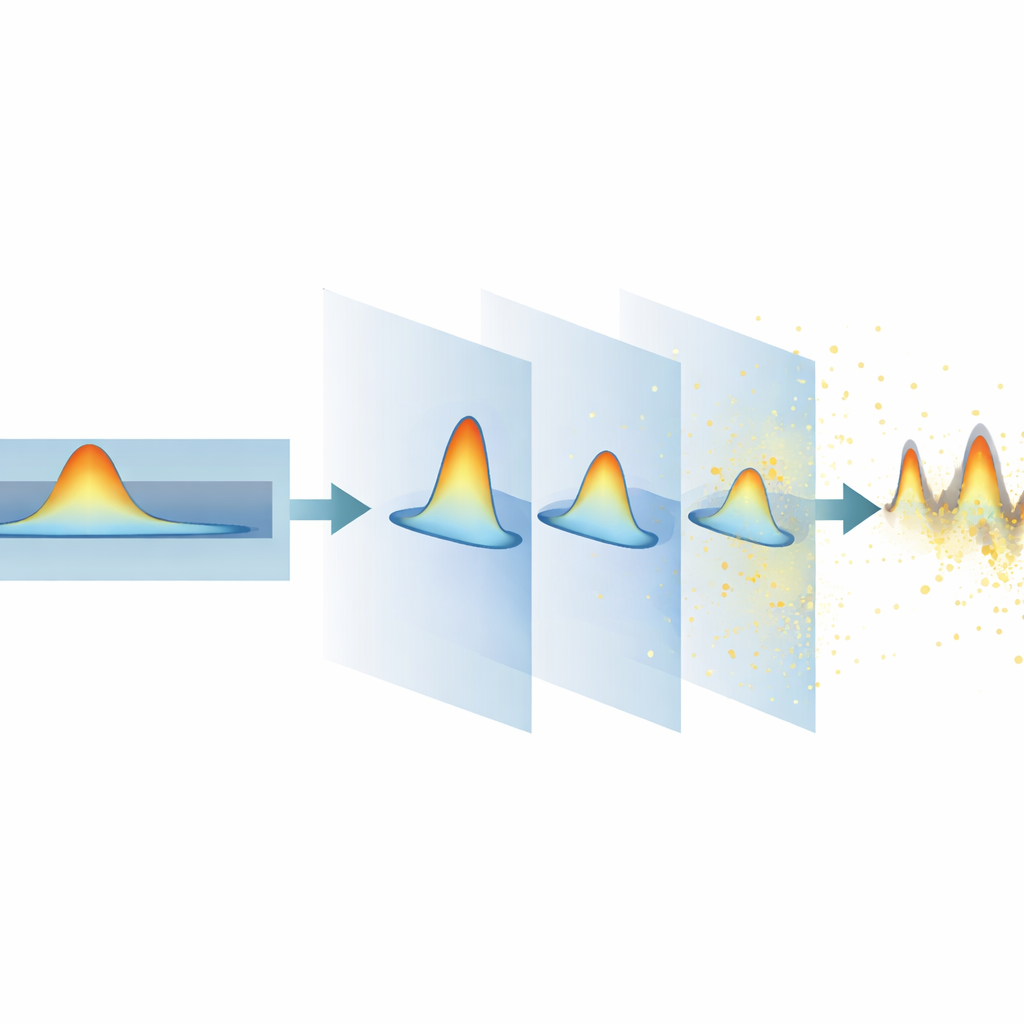
The graphical results show in detail how rising noise intensity gradually degrades soliton integrity. When noise is absent, the pulses display smooth, sharply localized profiles and propagate stably. As noise increases, contours of constant intensity spread out, the wave surfaces become rougher, and localized peaks flatten, signaling energy loss and loss of coherence. The study also varies the fractional‑order parameter that encodes memory effects. When this parameter is reduced, the once crisp kink‑shaped pulses become irregular and less steep, and their peaks diminish. Taken together, these patterns reveal how randomness and fractional behavior interact to push the system from orderly, robust soliton transmission toward more chaotic, dispersed waveforms over longer distances.
What this means for future data links
For a general reader, the main message is that the elegant soliton pulses used in optical fibers are not invincible: random disturbances and subtle material memory can slowly wear them down. By providing exact mathematical descriptions of how different types of solitons respond to noise and fractional effects, this work offers a sharper picture of when light pulses remain stable and when they break apart. These insights can guide engineers in designing fibers, choosing operating conditions, and developing noise‑management and error‑correction strategies that keep information flowing cleanly, even in the presence of unavoidable randomness in real‑world communication networks.
Citation: Murad, M.A.S., Abdullah, A.R., Mustafa, M.A. et al. Dynamical behavior of analytic solutions of the generalized derivative nonlinear Schrödinger equation under stochastic perturbations in fiber communication systems. Sci Rep 16, 13628 (2026). https://doi.org/10.1038/s41598-026-48889-2
Keywords: optical solitons, fiber communications, stochastic noise, nonlinear waves, fractional dynamics