Clear Sky Science · en
Adaptive frequency-domain CFAR for robust spectrum sensing under jamming and administrator-controlled counter-access
Why smarter sharing of the airwaves matters
Every wireless gadget you use—from phones to emergency radios—competes for limited space in the invisible radio spectrum. Much of this spectrum is licensed to critical services like police, firefighters, and military units, yet large slices sit idle at any given time. Cognitive radio promises to let ordinary devices temporarily borrow those quiet slices without disturbing the owners. This paper explores how to make that sharing reliable even when the air is noisy or under attack, and how network administrators can still pull the plug on untrusted users when safety demands it.
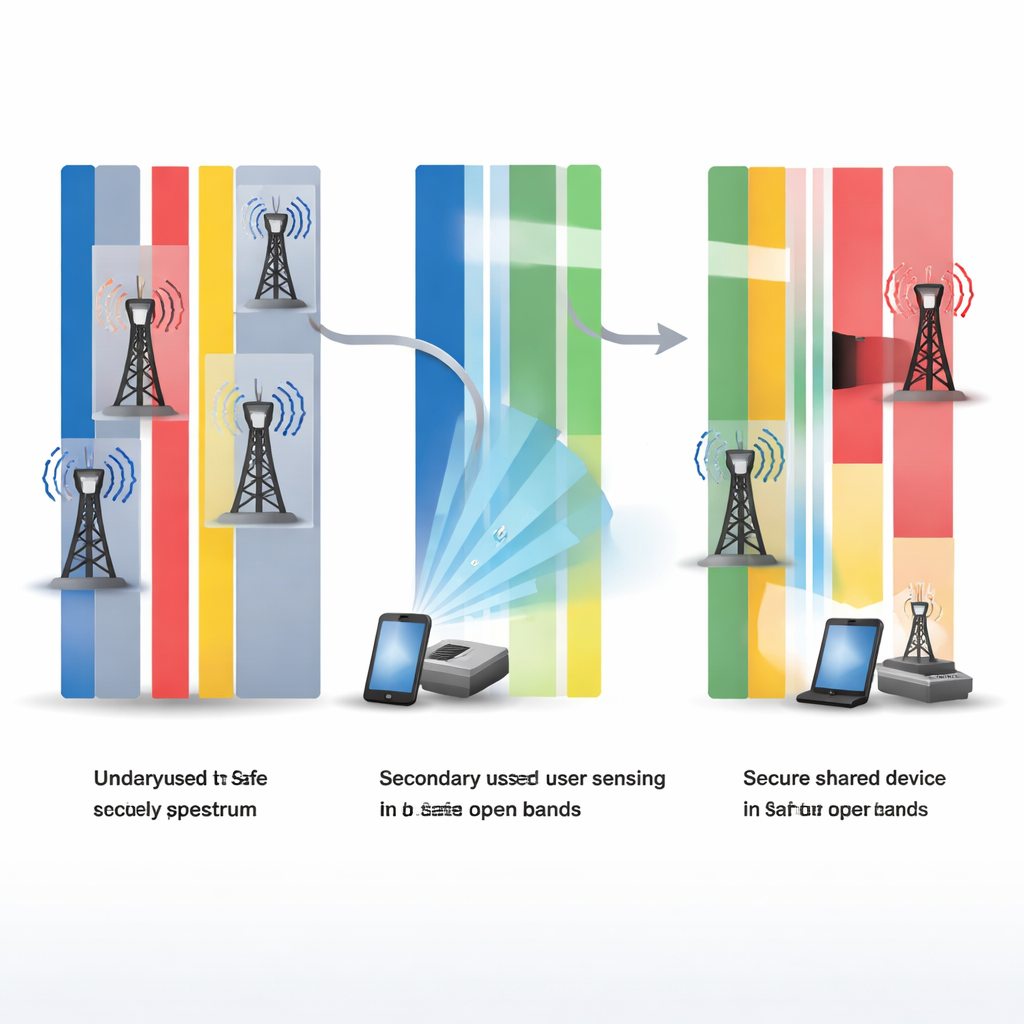
Finding empty channels in a crowded world
Before a device can safely talk, it must first listen and decide: is a licensed user active here or not? The simplest test, called energy detection, just measures how strong the signal is in a channel and compares it to a fixed cutoff. That works only if the background noise is well behaved. In real life, noise levels drift with hardware temperature, nearby electronics, and natural interference. Small misjudgments cause either constant false alarms (blocking harmless transmissions) or missed detections (risking interference with police or rescue teams). More sophisticated listening methods can work better but often need detailed knowledge of the licensed signal or heavy computing power—conditions that are rarely met in fast, fielded systems.
Teaching radios to adapt on the fly
The authors adapt a family of techniques known as CFAR—short for constant false alarm rate—from radar into the frequency domain for spectrum sensing. Instead of using one fixed cutoff for all situations, an adaptive window slides across the spectrum. For each small slice, or “cell,” the radio compares its energy not to a global standard but to its neighbors. A few nearby cells are set aside as a buffer, and the surrounding ones are used to estimate the local noise and interference level. Different CFAR flavors average, rank, or selectively ignore the strongest neighbors to avoid being fooled by spikes. The cutoff is then set as a scaled version of this local estimate, so the radio keeps its false alarm rate roughly constant even when background conditions change.
How CFAR stands up to hostile interference
Using realistic public-safety waveforms from the APCO Project 25 standard, the team runs large-scale simulations across several types of interference, from broad “barrage” noise to narrow, sweeping jammers. They compare five CFAR variants with a traditional fixed-threshold detector. Under wideband noise, the fixed detector quickly becomes unusable: its false alarms shoot toward 100%, locking secondary users out of the spectrum even though primary links keep working. In contrast, CFAR detectors automatically raise their threshold as the noise rises, holding the false alarm rate near the target value while still spotting real signals. Order-statistics and censored CFAR, which are designed to ignore outliers, prove especially robust when the interference is uneven across frequencies.
When protection becomes a loophole
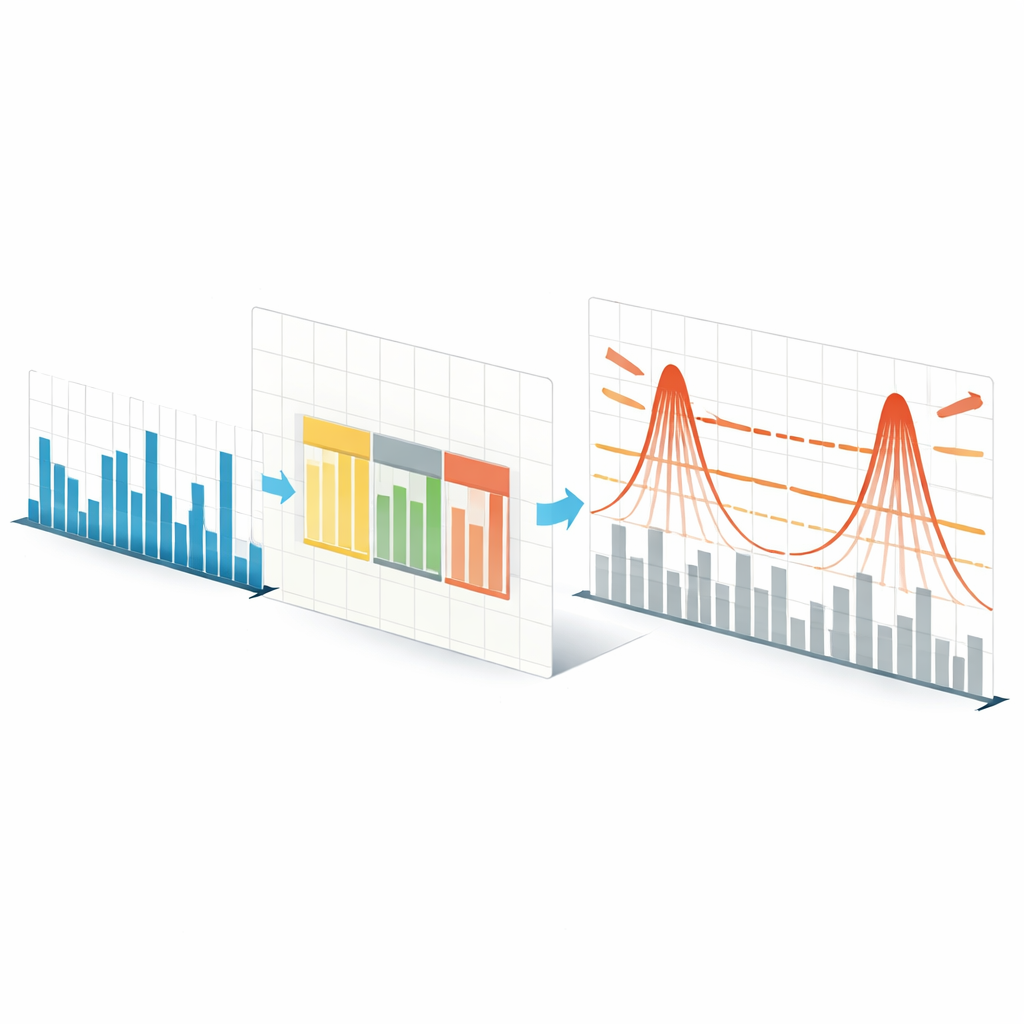
This very robustness leads to a security twist. A clever but untrusted secondary user can equip its radio with CFAR and continue to sense and exploit spectrum opportunities even while an administrator tries to jam the band for safety or operational reasons. Because CFAR “rides” on top of whatever interference is present, conventional jamming simply makes the detector work harder, not fail. To restore control, the authors design an administrator-controlled “comb-sweep” jammer. Instead of flooding the band, it sends a few narrow tones that rapidly sweep through the unused channels, carefully timed to land inside the detector’s reference cells. This selectively poisons the noise estimates so that the adaptive cutoff is inflated almost everywhere. The result: from the untrusted user’s viewpoint, nearly all channels appear busy all the time, while genuine primary signals still poke clearly above the raised cutoff.
Balancing access, control, and safety
Through detailed performance maps, the study shows that with the right power balance, the comb-sweep jammer can force false alarms to unity for all common CFAR types while keeping detection of licensed users high. This effect holds across a wide range of CFAR settings, meaning an attacker cannot dodge enforcement simply by tuning internal parameters. The cost is that administrators must reserve most of the monitored band for this control signal, leaving only about one quarter for real primary traffic during lockdown. To a lay observer, the main message is clear: smarter radios need equally smart oversight. Adaptive sensing can make wireless sharing safer and more efficient, but it also arms malicious users with powerful tools. By understanding and deliberately shaping the statistical assumptions those tools rely on, network operators can both unlock unused spectrum and reliably shut the door when security and public safety require it.
Citation: Shams, M.S., Abouelfadl, A.A., Mansour, A. et al. Adaptive frequency-domain CFAR for robust spectrum sensing under jamming and administrator-controlled counter-access. Sci Rep 16, 13517 (2026). https://doi.org/10.1038/s41598-026-48876-7
Keywords: cognitive radio, spectrum sensing, wireless jamming, adaptive detection, secure communications