Clear Sky Science · en
Experimental evaluation of a cost-effective tesla turbine for waste air energy recovery in transportation systems
Turning wasted air into useful power
Every time a heavy truck or train hits the brakes, it quietly throws away energy stored in compressed air. This study asks a simple question with big practical appeal: can we capture some of that lost air pressure and turn it into electricity using a small, low cost device called a Tesla turbine? If so, fleets and railways could gain an extra trickle of clean power without burning more fuel or adding complicated new machinery.
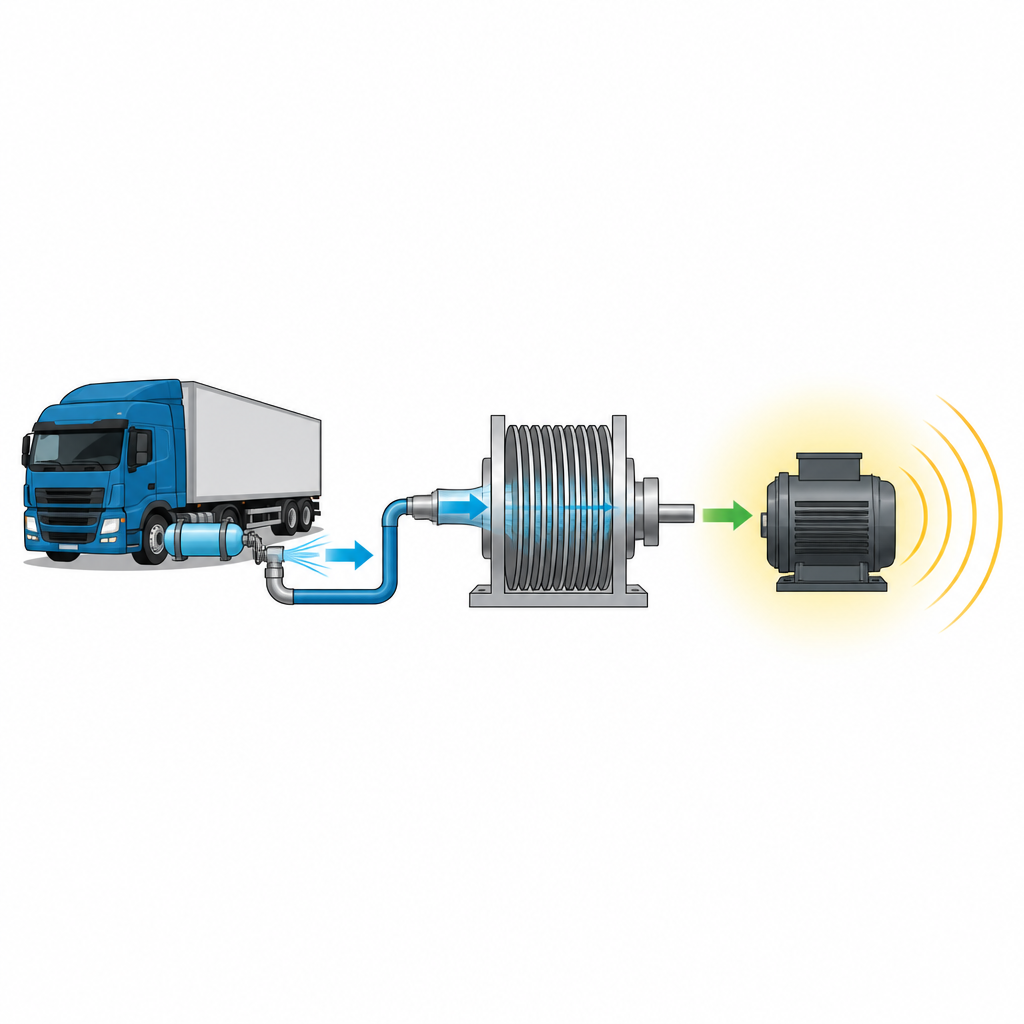
Why compressed air is left unused
Air brake systems on large vehicles rely on a mechanical compressor that keeps a storage tank filled with compressed air. Once the tank reaches its target pressure, valves open to release the excess and protect the system, while the compressor itself often keeps spinning with no useful load. That means both the spare air and the spinning motion are usually wasted. The authors propose adding a secondary path that sends this otherwise vented air through a small turbine connected to a generator, so that part of the lost pressure is turned into electrical power for lights, battery charging, or on board electronics.
A simple disc based turbine
The heart of the setup is a compact Tesla turbine, a type of turbine that replaces blades with a stack of smooth discs. Compressed air enters tangentially at the rim, then spirals inward between the discs. As it slides along the disc surfaces, friction gently pulls on them, making the whole stack spin. In this project, the team built a ten disc turbine using computer controlled machining, keeping the overall design deliberately simple so parts could be made and maintained easily in standard workshops. They tested two otherwise identical versions: one with aluminum discs and one with steel discs, to see how disc material affects performance in the low pressure range typical of vehicle brake systems.
How the tests were carried out
The researchers connected the turbine to a standard mechanical compressor, control valves, and measurement instruments that recorded air pressure, rotational speed, voltage, current, and electrical power. They ran experiments at inlet pressures from 2 to 10 bar, first with the turbine spinning freely and then with an electrical generator attached as a load. Each operating point was measured several times to check repeatability, and the team compared their results against earlier experiments from the literature to ensure that trends in speed and power followed known behavior for similar turbines.
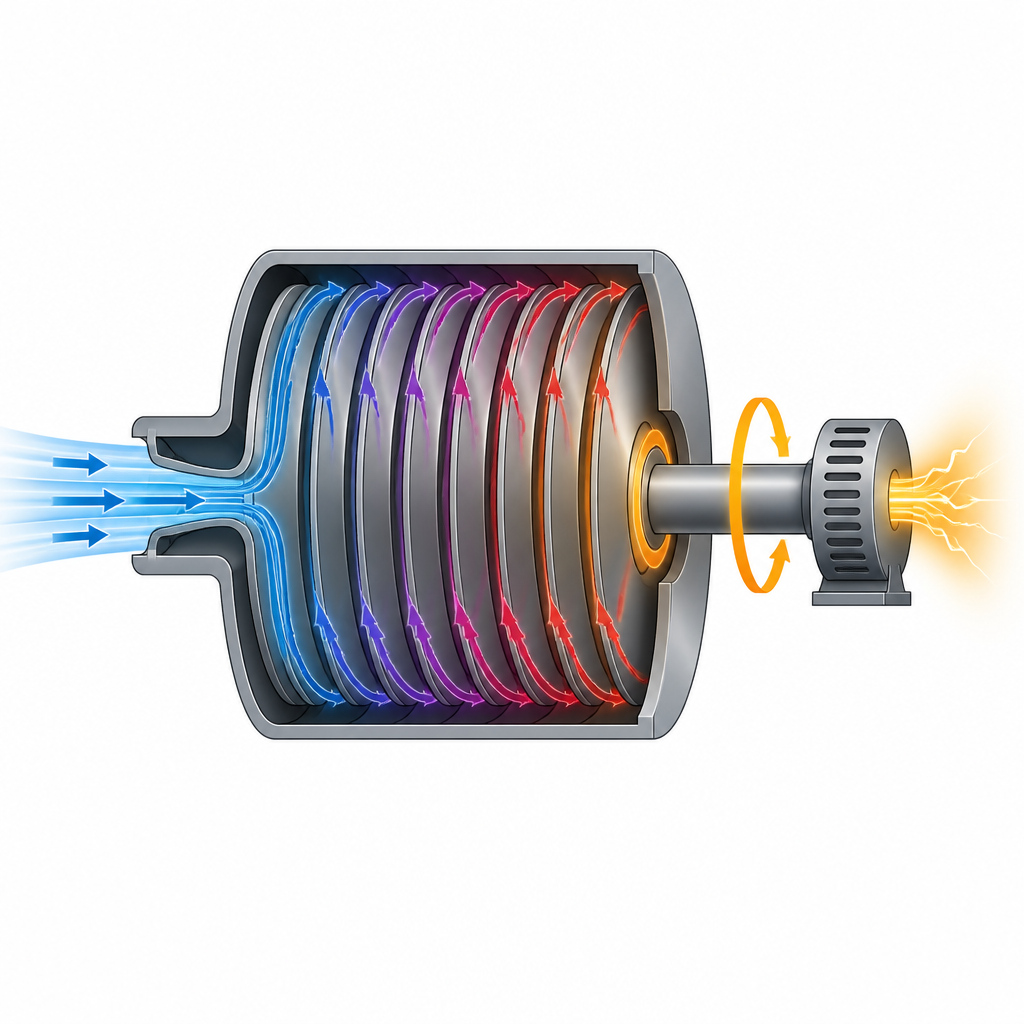
What the turbine delivered
As pressure increased, both turbine versions spun faster and produced more electrical power, matching the expected picture of faster air flow transferring more momentum to the discs. Under no load, the steel disc turbine reached over 7000 revolutions per minute at the highest pressure, while the aluminum version ran notably slower. When the generator was engaged, speeds dropped, but still rose steadily with pressure. The steel discs clearly outperformed the aluminum ones in loaded tests: at 10 bar, steel produced roughly twice the electrical power of aluminum, about 22 watts versus 11 watts over a 10 second run. At the lowest pressures, the aluminum turbine sometimes failed to generate measurable electricity at all, while the steel turbine continued to operate reliably.
What this means for real vehicles
Although the prototype generates modest power on its own, it proves that a small, low cost Tesla turbine can harvest energy from air that trucks and trains currently throw away. By choosing sturdy steel discs and integrating several such turbines or scaling up their size, operators could reclaim more of this lost resource for auxiliary uses without redesigning the core brake system. For everyday readers, the key takeaway is that even the hiss of air from a stopping train carries useful energy, and simple disc based turbines offer a practical way to catch some of it and feed it back into the transportation system.
Citation: Farghaly, M.B., Almohammadi, B.A., Alsharif, A.M. et al. Experimental evaluation of a cost-effective tesla turbine for waste air energy recovery in transportation systems. Sci Rep 16, 15177 (2026). https://doi.org/10.1038/s41598-026-48846-z
Keywords: Tesla turbine, waste energy recovery, compressed air, air brake systems, transportation energy