Clear Sky Science · en
Colossal emergent inductance in a molecular memristor
Why a tiny crystal that remembers electricity matters
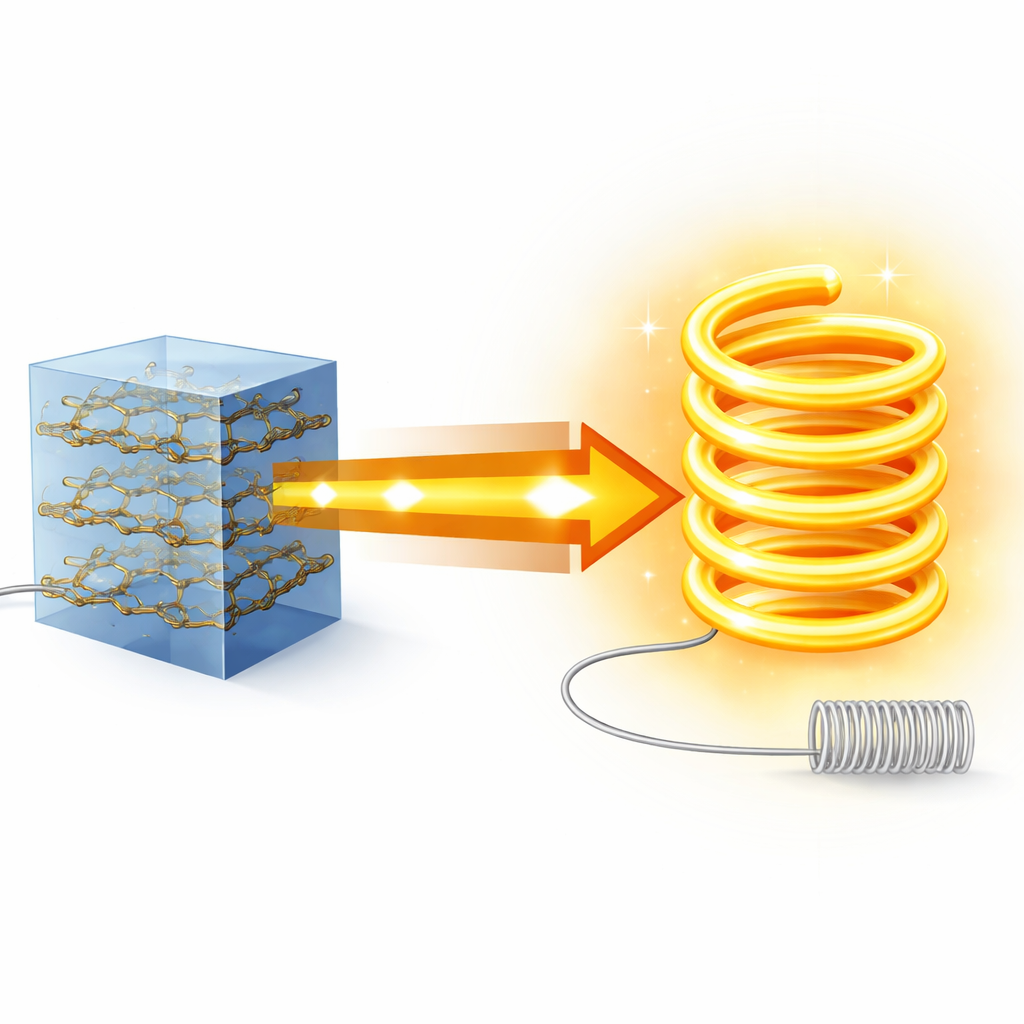
Everyday electronics rely on three basic building blocks: resistors, capacitors and coils (inductors). Coils are bulky and hard to shrink, especially for low-frequency circuits used in sensing, timing and brain-inspired computing. This study shows that a millimeter-sized crystal of a molecular material can act not only as a special kind of resistor that “remembers” past currents—a memristor—but can also generate an enormous built-in coil effect without any wire winding at all. That discovery points to a future where key circuit functions come directly from the quantum behavior of materials rather than from separate components.
A material that behaves like an electronic memory element
The researchers focus on a chain-like nickel–bromine compound known as [Ni(chxn)2Br]Br2, a so‑called Mott insulator in which electrons are strongly interacting and normally locked in place. When they drive an alternating current through a tiny crystal and measure how voltage responds, the current–voltage curve forms a distinctive “pinched” loop that passes through zero. This loop, whose shape depends on how the material was driven a moment before, is the fingerprint of a memristor: a device whose resistance keeps track of its own history. At low frequencies and low temperatures the loop is wide and shows negative differential resistance, meaning the voltage can drop even as current rises. At higher frequencies or warmer temperatures, the loop shrinks and the response becomes more ordinary and linear.
A hidden coil appears only when pushed
A looping response like this hints that the material may store and release energy in a way we usually associate with coils and capacitors. To probe this, the team performs impedance spectroscopy, a technique that tracks how the material reacts to alternating signals over a wide range of frequencies. Plotting the data in a standard way reveals two distinct arcs: one from capacitive behavior and, strikingly, another from inductive behavior—the kind created by a coil. Crucially, the inductive arc appears only when a steady bias voltage is applied; at zero bias it vanishes. This rules out mundane sources such as stray inductance in the wiring, which would always be present. By fitting the data to a simple equivalent circuit, the authors extract an effective inductance that climbs with applied bias, reaching tens of thousands of henries—far beyond what any conventional coil could provide in such a small volume.
Slow internal changes amplify the effect
The team then explores how this emergent coil-like behavior depends on temperature. As the crystal is cooled, its resistance rises steeply and the internal electronic state responds more sluggishly to changes in current. Under a fixed bias, the extracted inductance grows and peaks around 145,000 henries at 90 kelvin. The capacitance, by contrast, stays nearly constant and tiny. This pattern shows that the giant inductance is not a fixed hardware property but an outgrowth of slow, hysteretic changes in the material’s internal state: the electrons rearrange over long times, making current respond as if it had inertia. In effect, the memristive “memory” of past current manifests as an enormous, bias-dependent inductance.
Oscillations without a coil
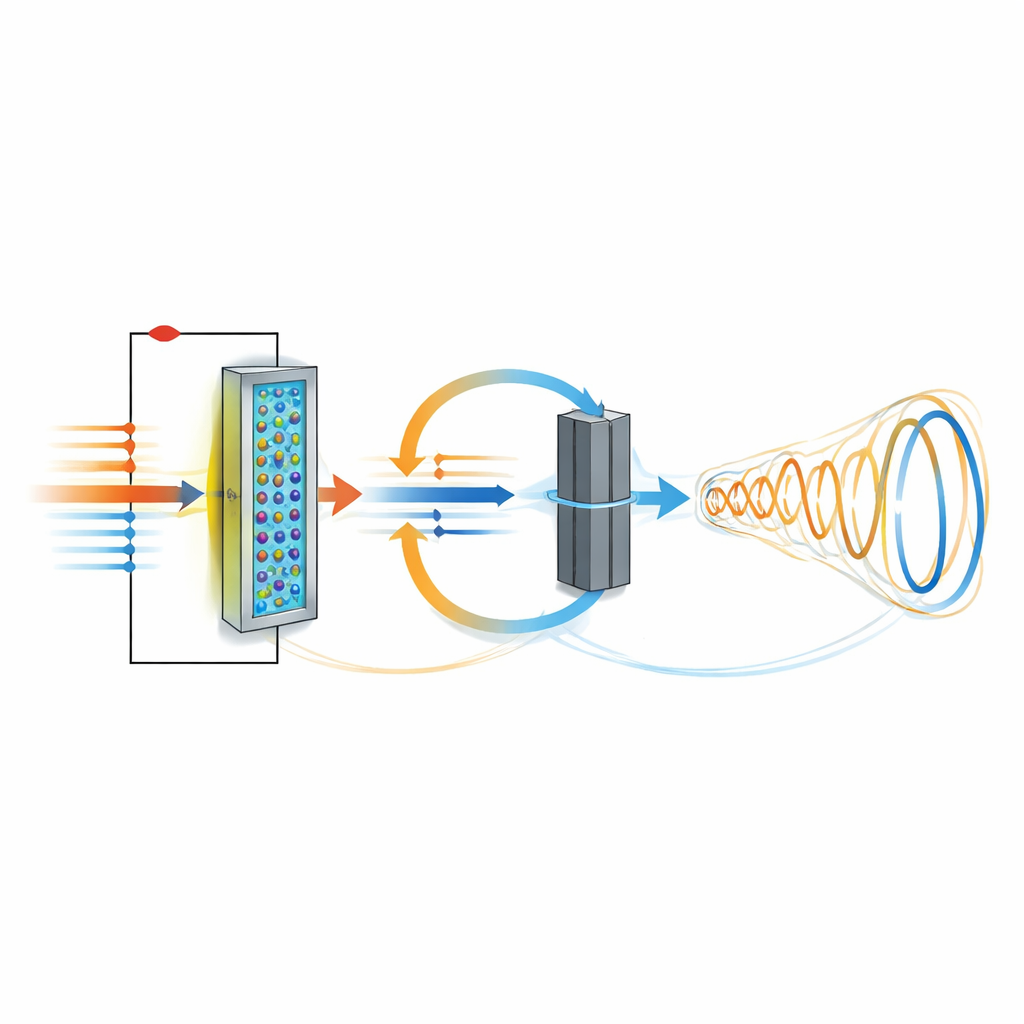
To test this picture in a completely different way, the researchers wire the crystal in parallel with a simple external capacitor and drive it with a steady current. Above a threshold current—matching the onset of the negative-resistance part of the loop—the voltage across the device begins to oscillate on its own. The frequency of these oscillations depends on temperature and on the value of the connected capacitor, just as expected for a circuit where a large inductance exchanges energy with a capacitor. Using the standard formula for an LC resonator, the team infers inductance values from the observed frequencies and again finds tens to more than a hundred kilohenries, in close agreement with the spectroscopy results. This cross-check confirms that the huge inductance is a real, intrinsic effect of the memristive dynamics, not a quirk of any one measurement method.
What this means for future electronics
Taken together, these findings redefine how we think about memristors. In this molecular crystal, the same physics that makes the resistance depend on past currents also gives rise to a colossal, tunable inductance that appears only when the device is driven. That emergent coil-like behavior can power self-sustained oscillations with nothing more than a capacitor and a steady current source. For a general reader, the key message is that advanced materials can fold multiple circuit functions—memory, timing and signal shaping—into a single tiny piece of matter. Harnessing such effects could one day enable compact, coil-free circuits for low-frequency filtering, precise timing and neuromorphic hardware that mimics the rhythms of the brain.
Citation: Oshima, Y., Usami, R., Moriya, T. et al. Colossal emergent inductance in a molecular memristor. Sci Rep 16, 13023 (2026). https://doi.org/10.1038/s41598-026-48808-5
Keywords: memristor, emergent inductance, Mott insulator, neuromorphic electronics, nonlinear circuits