Clear Sky Science · en
Cement floor tiles based on waste ceramic and waste tires for EMI shielding
Turning Trash into Protective Tiles
Modern life depends on electronics, from cell phone towers to home Wi‑Fi, yet the signals they emit can interfere with sensitive equipment and raise concerns about long‑term exposure. At the same time, cities are drowning in broken ceramic tiles, worn‑out car tires, and dusty leftovers from metal workshops. This study explores a way to tackle both problems at once: transforming these common wastes into durable cement floor and roof tiles that not only save resources, but also help block unwanted electromagnetic waves. 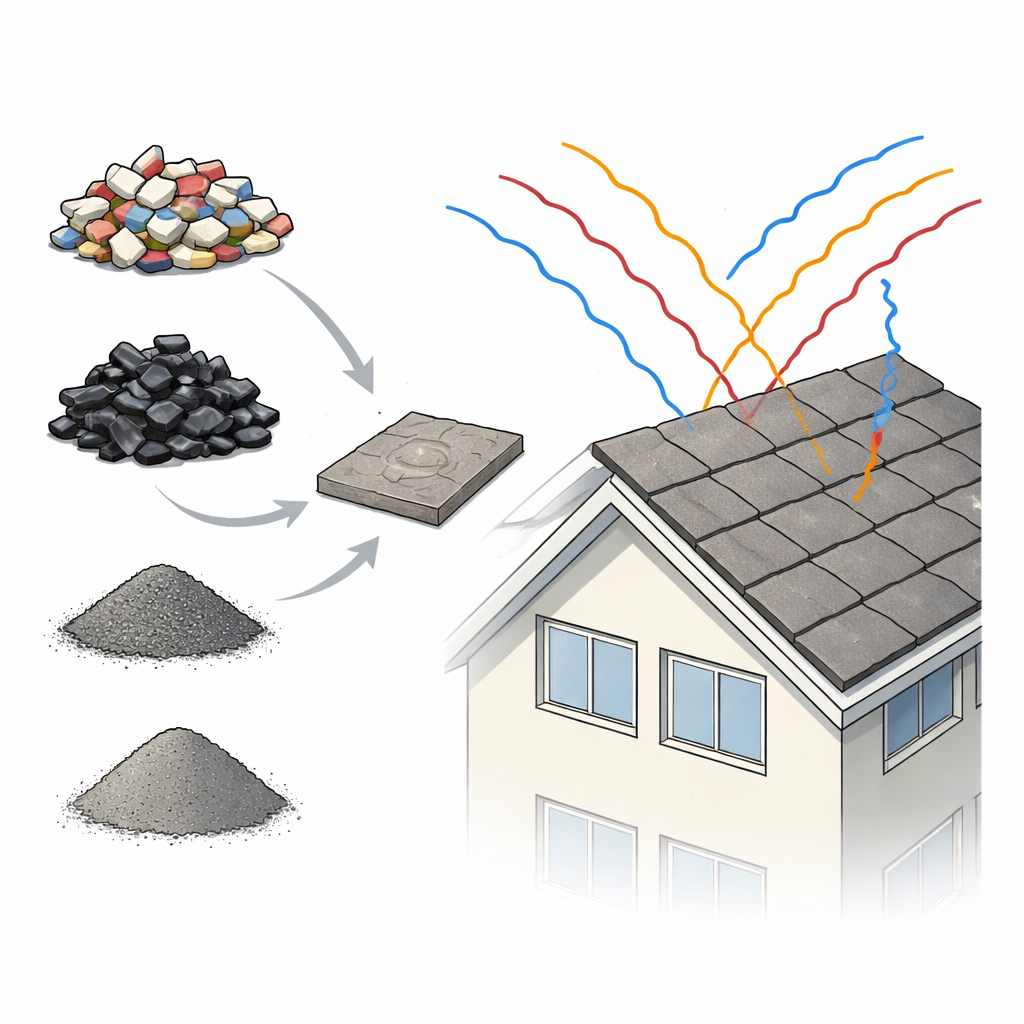
Why Waste from Buildings and Cars Matters
Construction and demolition sites generate mountains of ceramic wall and floor tiles that do not rot, cannot be easily reused on site, and usually end up in landfills. Old tires are another headache: about 1.5 billion reach the end of their lives every year, occupying land and posing fire and pollution risks. At the same time, industry produces fine iron shavings and powders as by‑products of cutting and grinding metal. Each of these waste streams on its own is a challenge; taken together, they represent a huge untapped resource. Researchers in Egypt set out to blend all three into new cement‑based tiles designed for outdoor use, particularly on roofs in areas exposed to strong electromagnetic emissions.
How the New Tiles Are Made and Tested
The team collected ceramic rubble from bathroom and kitchen renovations, ground it into fine powders from wall and floor tiles, and mixed these with crumb rubber from waste tires and locally sourced waste iron powder. These ingredients replaced part of the natural sand normally used in cement mortar. Small cubes and beams were cast and cured for up to 28 days, then tested for key properties that determine whether a tile can perform in real buildings: density, water absorption, and resistance to bending and crushing. Microscopes and X‑ray techniques were used to study the internal structure and mineral content, while highly sensitive instruments measured electrical conductivity and how well the samples blocked microwaves in the X‑band, a frequency range relevant to radar and communication systems.
Balancing Strength, Lightness, and Water Uptake
The results showed that simply adding ceramic and rubber waste makes the cement lighter but also more porous. As more of these wastes were used, density dropped and water absorption rose, a sign that extra voids had formed in the material. This can be useful for making lighter tiles, but too much porosity weakens them. The game‑changer was the waste iron powder. When small amounts of this ultra‑fine metal powder were introduced, it filled the tiny gaps between cement grains and waste particles, creating a denser and more uniform internal structure. Tiles with about 10 percent iron waste achieved higher compressive and flexural (bending) strengths than standard cement mixes, while water absorption fell back to acceptable levels. Microscopic images confirmed a smoother, more tightly packed matrix in the iron‑enhanced samples.
From Simple Tiles to Invisible Shields
Beyond basic strength, the study focused on turning these tiles into functional shields against stray electromagnetic waves. Ordinary cement behaves like an electrical insulator, but the addition of iron powder nudged the material into a slightly conductive, “antistatic” range, suitable for floors where static charge must be safely dissipated. To further boost shielding, the researchers embedded a thin metal mesh inside the tiles. Tests at 10 GHz showed that mesh alone could block about 99 percent of incoming radiation. When combined with waste iron particles dispersed throughout the cement, the shielding performance soared: some formulations reached around 48 dB of attenuation, corresponding to blocking 99.99 percent or more of incident electromagnetic energy. 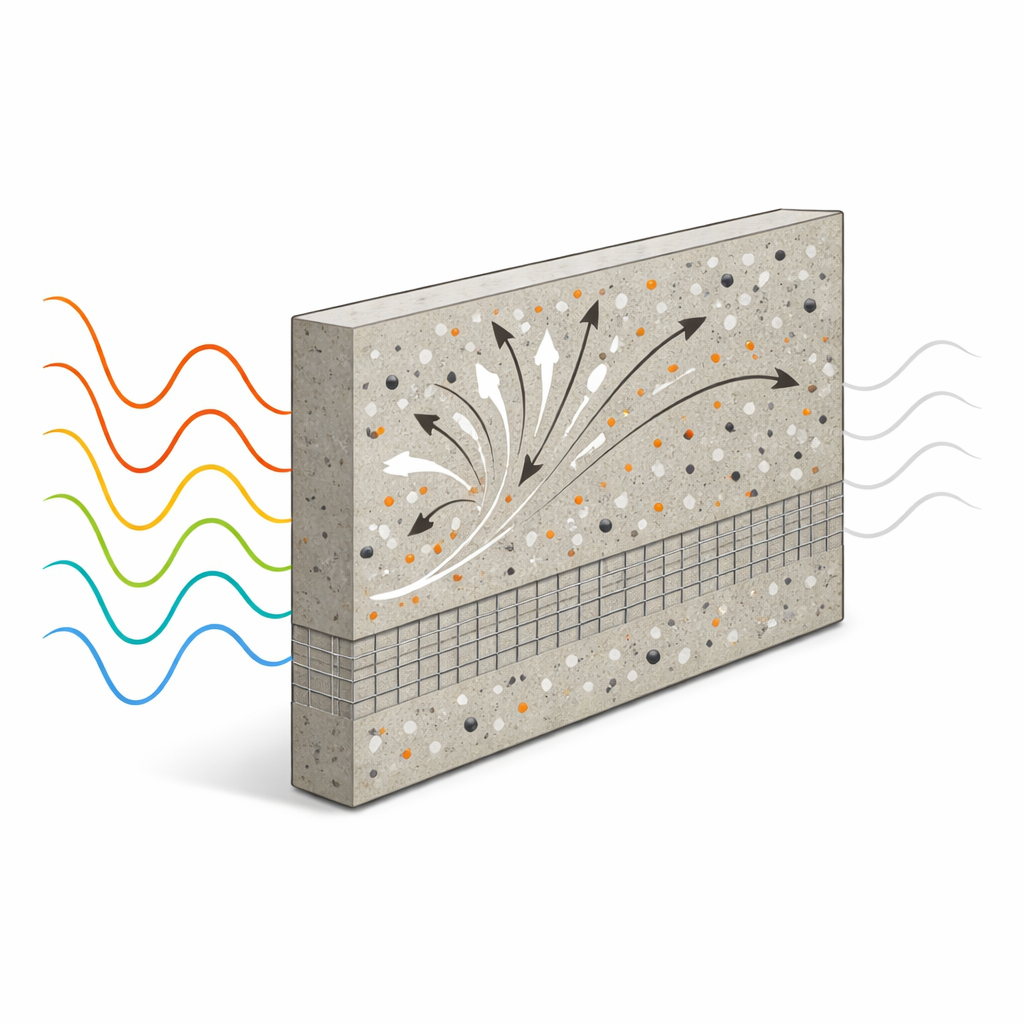
What This Means for Buildings and the Planet
In practical terms, the study demonstrates that roof and floor tiles made from recycled ceramic, tire rubber, and iron waste can match or surpass standard mechanical performance while providing built‑in protection against electromagnetic interference. The best mixtures comply with Egyptian and European standards for external cement tiles, making them realistic candidates for use on buildings near cell towers, industrial plants, or sensitive electronics. By replacing part of the natural sand with demolition and industrial scraps, the approach cuts raw material demand, lowers carbon emissions associated with quarrying, and diverts persistent wastes from landfills. For a layperson, the takeaway is straightforward: the researchers have shown how everyday trash can be engineered into smart building materials that quietly protect both equipment and occupants from invisible electronic noise.
Citation: Ramadan, R.M., Shafik, E.S., Youssef, N.F. et al. Cement floor tiles based on waste ceramic and waste tires for EMI shielding. Sci Rep 16, 13904 (2026). https://doi.org/10.1038/s41598-026-48682-1
Keywords: EMI shielding, recycled construction materials, waste tire rubber, ceramic tile waste, cement composites