Clear Sky Science · en
Experimental and machine learning-based comparison of swirling and conventional conical fluidized bed reactors for enhanced thermal performance
Hotter, Cleaner Energy from Swirling Sand
Turning agricultural waste and other leftovers into useful energy is one way to cut our dependence on fossil fuels. A popular device for doing this is the fluidized bed reactor, where hot air blows through a bed of sand-like particles to heat and transform biomass. This study asks a simple but powerful question: can we reshape the reactor and make the air swirl so that we get more heat out while using less energy to push the air through? By combining careful experiments with modern machine learning, the authors show that the answer is yes.
A New Twist on a Familiar Reactor
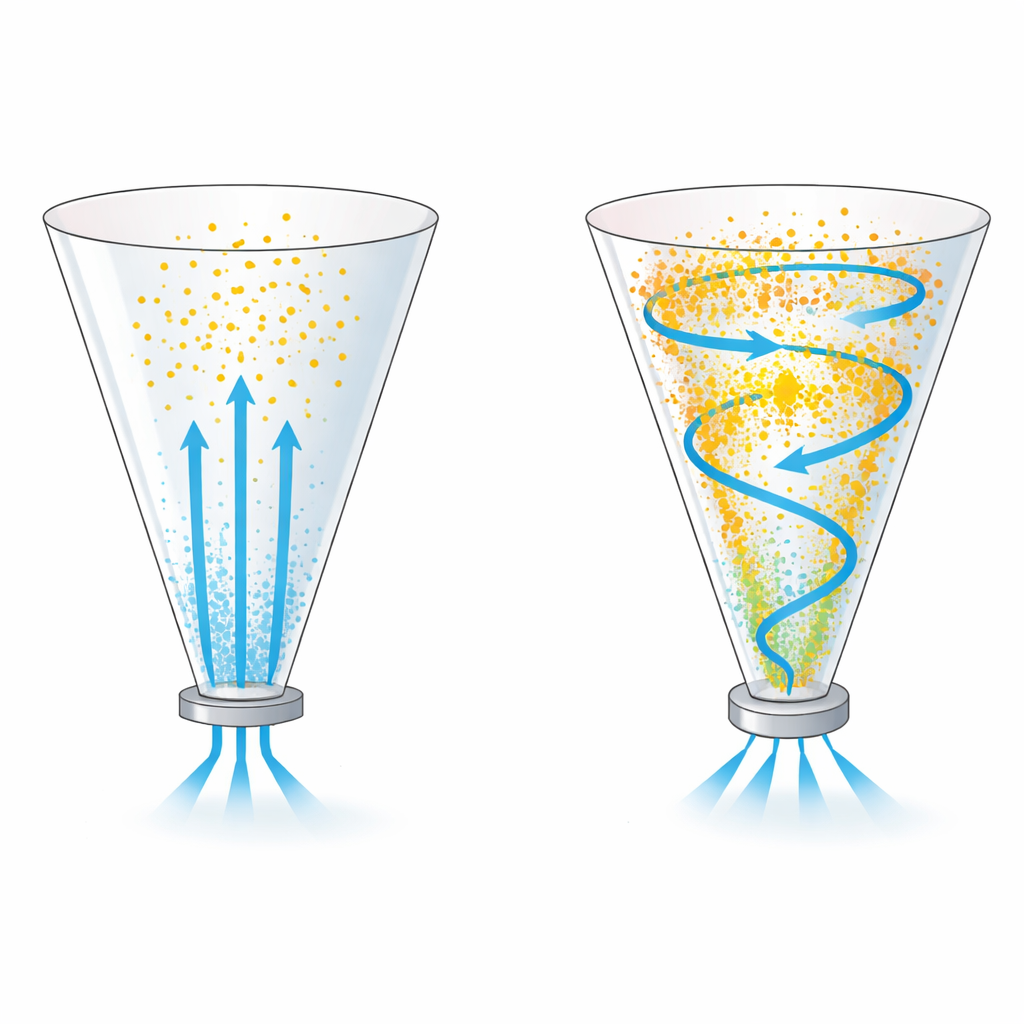
Traditional fluidized bed reactors are usually straight cylinders that push air upward through a flat screen. The researchers redesigned this setup in two ways. First, they used a conical lower section that is wide at the top and narrow at the bottom, which naturally guides particles and gas into smoother patterns. Second, they replaced the flat screen with a ring of angled blades that makes the incoming air spin, creating a swirling bed of moving particles. They then compared this “swirling conical” design to a more conventional conical reactor that kept the same shape but used the simple mesh screen without blades.
Watching Heat and Motion Inside the Bed
To see how well each reactor moved heat, the team used heated air and beds of sand particles while varying the air speed. They measured how hard it was to push air through the reactor (the pressure drop) and how effectively heat moved from the hot bed to the reactor walls (the heat transfer coefficient). Tiny thermocouples recorded temperatures at different heights and radial positions, while an infrared camera looked through a clear window to capture detailed thermal images of the particle surfaces without disturbing the flow. This allowed the researchers to map out hot and cold regions and judge how evenly heat was spread through the bed.
Swirling Flow Boosts Heat and Saves Energy
The spinning air in the swirling conical reactor changed the behavior of the bed in important ways. It took slightly more air speed to start the swirl than to start ordinary fluidization, but once swirling began, the reactor needed less pressure to keep the particles moving. Both the pressure drop across the distributor and across the bed were consistently lower than in the conventional reactor, meaning less blower power would be required in real plants. At the same time, the swirling design improved heat transfer by up to about 40 percent, especially in the lower and middle regions where most reactions occur. Infrared images showed that temperatures in the swirling bed were more uniform both vertically and across the cross-section, with fewer cold spots near the walls and fewer overheated regions in the center.
Teaching Machines to Predict Reactor Behavior
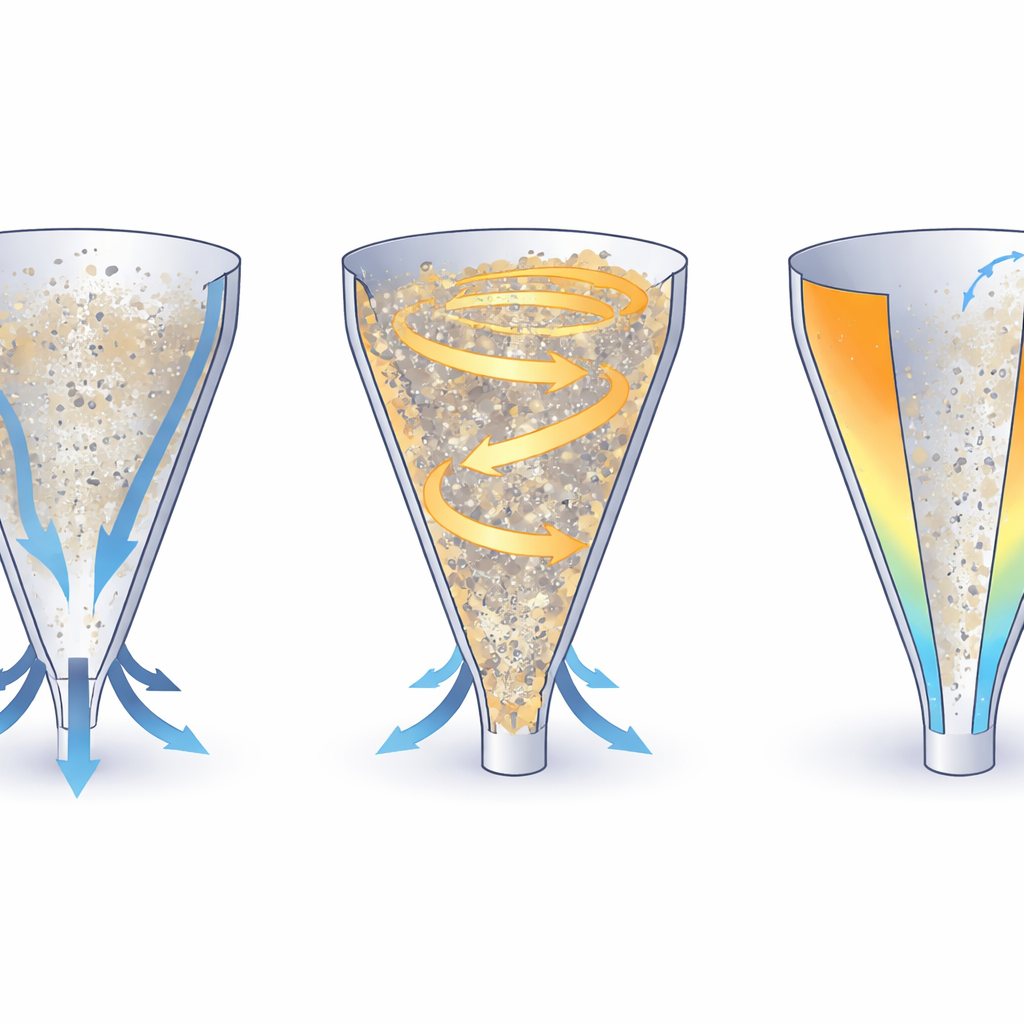
Because running many experiments is costly and time-consuming, the authors turned to machine learning to build fast predictive tools. They trained three different models using measured air speed, bed and wall temperatures, bed height, and position in the reactor as inputs, asking the models to predict heat transfer and pressure drop. An ensemble method called Extra Trees performed best: it captured nearly all of the variation in the data for both heat transfer and pressure drop with relatively small errors. Further analysis showed that air speed is the single most influential factor for both quantities, while temperatures and geometric position play secondary roles. This kind of digital model can help engineers explore operating conditions and designs that were never tested directly in the lab.
What This Means for Cleaner Energy Systems
For non-specialists, the bottom line is clear: by reshaping the reactor and adding a simple swirling motion, engineers can move more heat through the system while spending less energy pushing air. A swirling conical fluidized bed produces a more evenly heated, better mixed bed of particles, which is good news for processes such as biomass combustion, gasification, and waste treatment. The study also shows how pairing advanced measurements, like infrared thermography, with machine learning models can guide the design of more efficient reactors. If scaled up and adapted to real fuels, this approach could help future energy and chemical plants convert waste materials into useful products more efficiently and with lower environmental impact.
Citation: Abdelmotalib, H.M., Samee, A.A.A. & Tawfik, M.H.M. Experimental and machine learning-based comparison of swirling and conventional conical fluidized bed reactors for enhanced thermal performance. Sci Rep 16, 13384 (2026). https://doi.org/10.1038/s41598-026-48623-y
Keywords: fluidized bed reactors, swirling flow, heat transfer, biomass energy, machine learning in energy systems