Clear Sky Science · en
An enhanced adaptive elephant herding optimization based on hybrid cuckoo search algorithm and elite opposition-based learning
Smarter Search for Tough Problems
Many modern challenges, from tuning machine learning models to designing cheaper bridges, boil down to searching for the best choice among countless possibilities. This paper introduces a smarter search method that combines ideas from elephant herds, wandering birds, and a clever way of looking at “opposite” guesses. The result is a computer tool that finds good answers faster and more reliably on a wide range of test problems and practical engineering tasks.
Why Finding the Best Answer Is So Hard
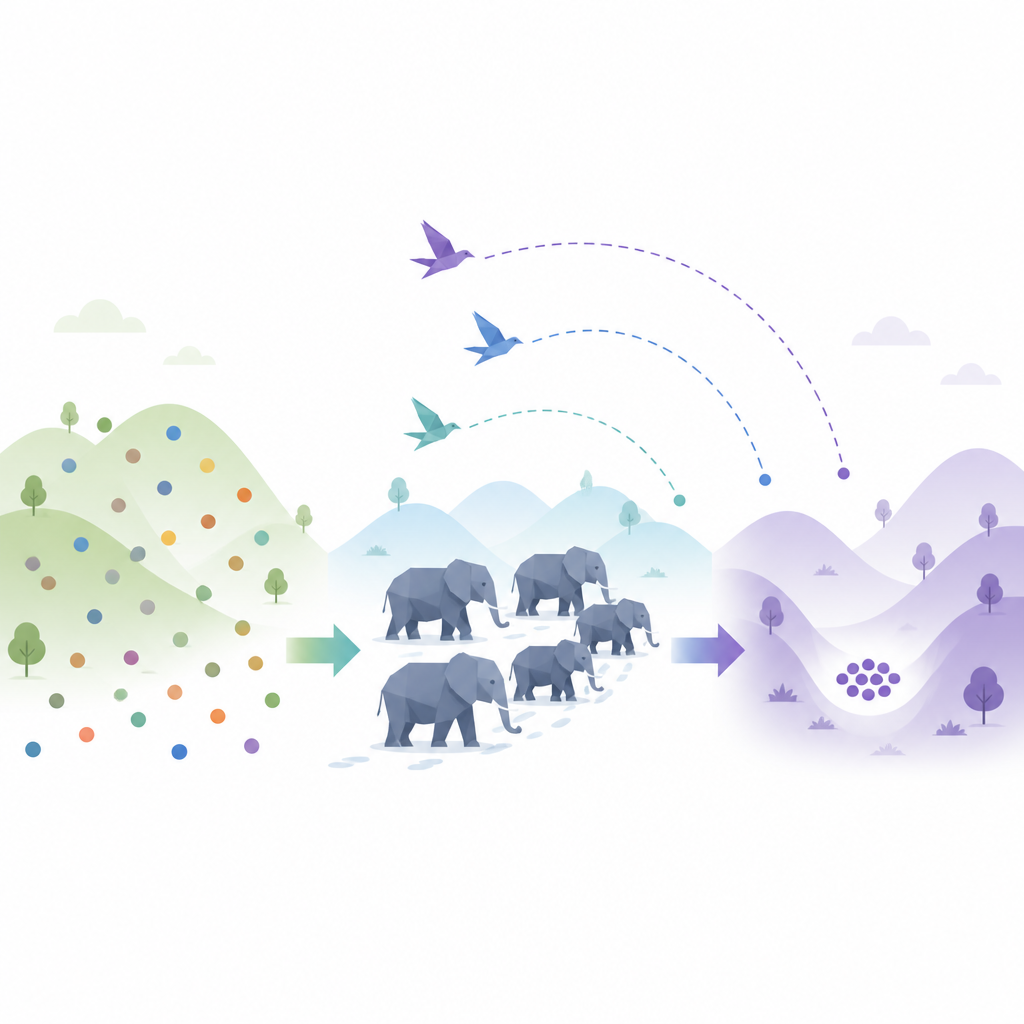
When engineers or scientists try to optimize a design, they often face a landscape filled with hills and valleys, where each point represents a different possible solution. Standard search methods can easily slip into a nearby valley and get stuck, missing the deepest valley that represents the truly best answer. Earlier nature-inspired methods, such as Elephant Herding Optimization, did a decent job by imitating how elephants follow clan leaders while keeping some variety in the herd. However, this earlier method had three main weaknesses: it could settle too early on a so-so solution, it did not smoothly shift from wide exploration to fine tuning, and it slowed down in the later stages of the search.
Blending Three Simple Ideas
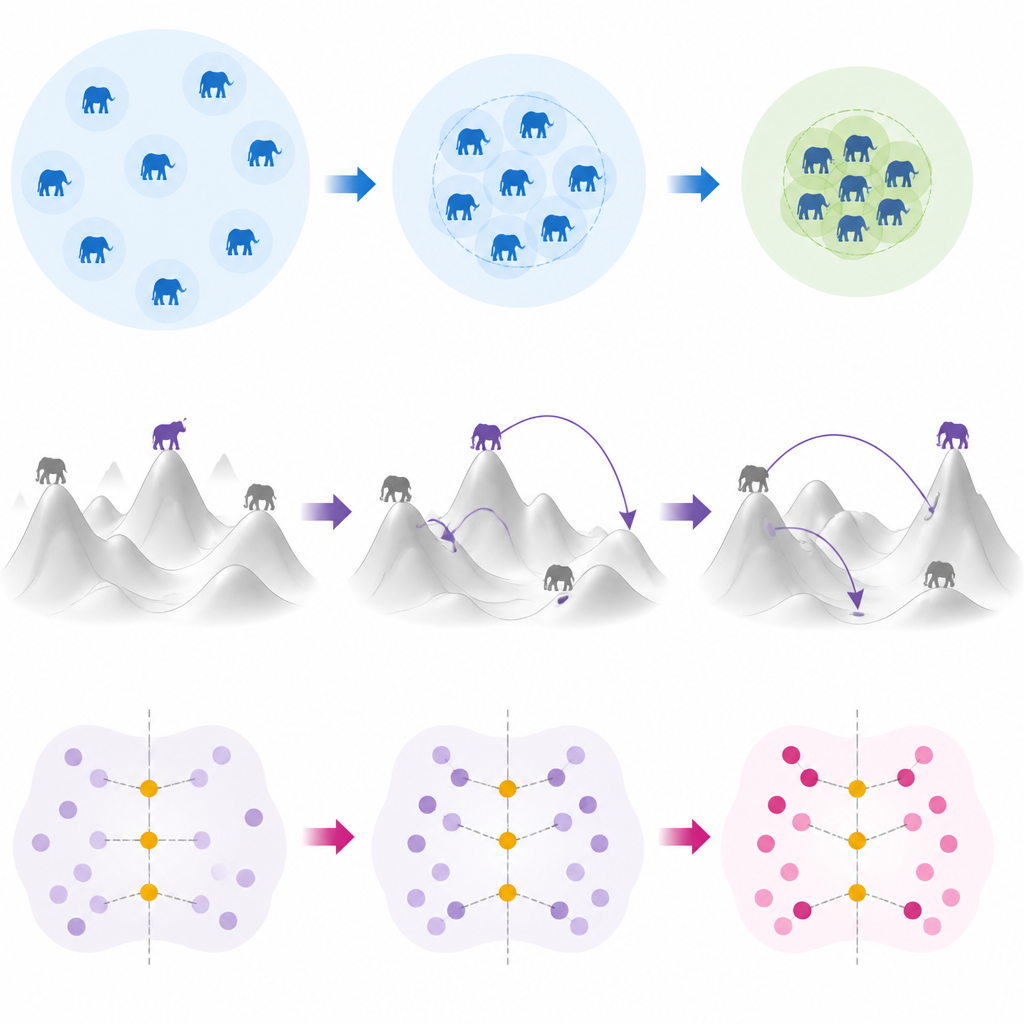
The authors propose a new algorithm called AEHOCSEOBL that tackles these issues by blending three ideas. First, they adjust how strongly each elephant follows its clan leader over time using an adaptive schedule. Early on, the elephants roam widely so the algorithm can scan broad regions; later, the herd tightens around the most promising spots to polish the final answer. Second, they borrow a behavior from the Cuckoo Search method: occasional long jumps, inspired by the erratic paths of birds, are applied only to the clan leaders. These big steps let the leaders escape bad regions and carry their followers toward better valleys without causing chaos in the whole herd.
Adding “Opposite” Guesses to Stay Curious
The third idea is called elite opposition-based learning, but its core is intuitive. Whenever the algorithm discovers especially good candidate solutions, it also generates new guesses that are their controlled “opposites” within the allowed range. By checking both the elite guesses and their opposites, the method keeps its options open around the most promising areas instead of crowding into a narrow corner. This extra curiosity helps the search avoid getting stuck in small local valleys while still homing in on high-quality regions of the landscape.
Testing on Math Puzzles and Real Designs
To see how well this combined strategy works, the authors tested it on ten standard mathematical puzzles that are widely used to judge optimization methods. Some of these tests check how quickly a method can slide down a single smooth valley, while others are full of many peaks and pits that can trap a careless search. Across all of these, the new approach consistently reached lower errors and did so with more stable behavior than well-known competitors such as Particle Swarm Optimization, the Sine Cosine Algorithm, and several earlier elephant-based hybrids. In some cases it reached the exact known best value or did so with much smaller average error.
From Theory to Practical Engineering
Beyond synthetic tests, the researchers applied their method to two real engineering problems. One is the design of a specialized signal-processing filter, where the goal is to adjust many interconnected settings so that noisy signals are cleaned up without distortion. The other is a classic welded beam design problem, in which material cost must be minimized while respecting safety limits on stresses, bending, and deflection. In both cases, the new algorithm found cheaper or more accurate designs while keeping results consistent across repeated runs, showing that the method is not just clever mathematics but also useful in practice.
What This Means for Non-Specialists
In plain terms, this work offers a more reliable “treasure map” for anyone who needs to search huge spaces of possibilities. By starting broad, allowing leaders to make bold leaps, and constantly checking smartly chosen opposite guesses, the method avoids many of the traps that slow or mislead older tools. The authors do not claim it is perfect for every situation, and they point out that very high-dimensional or highly restricted problems still pose challenges. Even so, AEHOCSEOBL provides a flexible and general recipe that can be adapted to tasks in energy systems, machine learning, manufacturing, and beyond, helping computers discover better solutions with less trial and error.
Citation: Mohamed, Z.E., Dabour, W. An enhanced adaptive elephant herding optimization based on hybrid cuckoo search algorithm and elite opposition-based learning. Sci Rep 16, 15221 (2026). https://doi.org/10.1038/s41598-026-48615-y
Keywords: metaheuristic optimization, elephant herding algorithm, cuckoo search, opposition-based learning, engineering design