Clear Sky Science · en
A novel strategy for secretory leukocyte protease inhibitor (SLPI) immobilization on alkaline-etched titanium via a plasma-polymerized interlayer and covalent coupling to enhance osteoblast activity
Stronger Implants for Everyday Lives
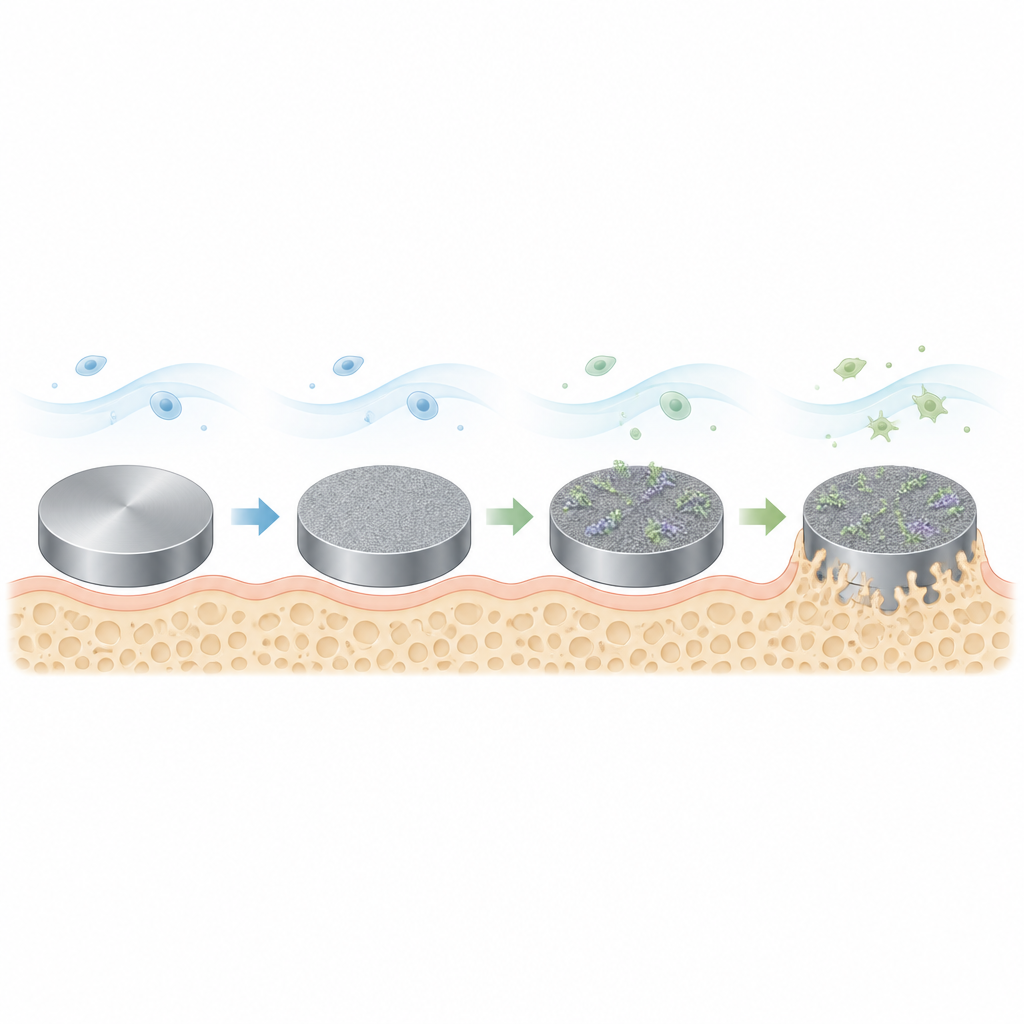
Titanium screws and plates help people chew, walk, and move after injury, but their metal surfaces are not naturally friendly to new bone. This study explores a way to give titanium a more welcoming skin so bone cells can grab on, grow, and harden more quickly. By adding a thin layer of a natural protective protein to a carefully prepared metal surface, the researchers aim to create implants that heal faster and bond more firmly to the skeleton.
Why Bone Needs More Than Bare Metal
Although titanium is widely used in dental and orthopedic implants, its bare surface is mostly passive in the body. It does not actively encourage bone cells to attach and build new tissue, which can slow healing or lead to unstable implants, especially in people with weaker bones. Doctors and engineers have long tried to turn these quiet surfaces into helpful partners by roughening them or adding helpful molecules. This work combines both ideas: first shaping the metal so it resembles natural bone surroundings, then adding a protein that can support bone cells.
A Gentle Protein with More to Offer
The protein at the heart of this work is secretory leukocyte protease inhibitor, or SLPI, normally known for calming inflammation and fighting germs. Earlier studies hinted that SLPI can also nudge bone-forming cells to stick, multiply, and mature. Simple coatings, however, tend to wash away or lose their structure once inside the body. The team set out to fasten a human-made form of this protein, called recombinant human SLPI, firmly onto titanium so it would stay in place long enough to help bone cells do their job.
Building a Friendlier Titanium Surface
To prepare the metal, the researchers first soaked titanium discs in a strong alkaline solution, which etched the surface into a forest of tiny pillars resembling the natural scaffold around bone cells. Next they used a low-temperature plasma process to lay down an ultra-thin intermediate film rich in active chemical hooks. On top of this, they grew a thin layer rich in carboxyl groups and then used standard coupling chemistry to form stable bonds between the surface and SLPI. Tests that detect specific proteins and surface elements confirmed that SLPI was securely attached, especially on the etched titanium. Microscopy showed that etched samples had the desired pillar-like structure, while the protein layer smoothed the surface slightly but preserved its overall texture and made it much more water-loving, a trait that generally helps cells settle and spread.
How Bone Cells Responded to the New Surface
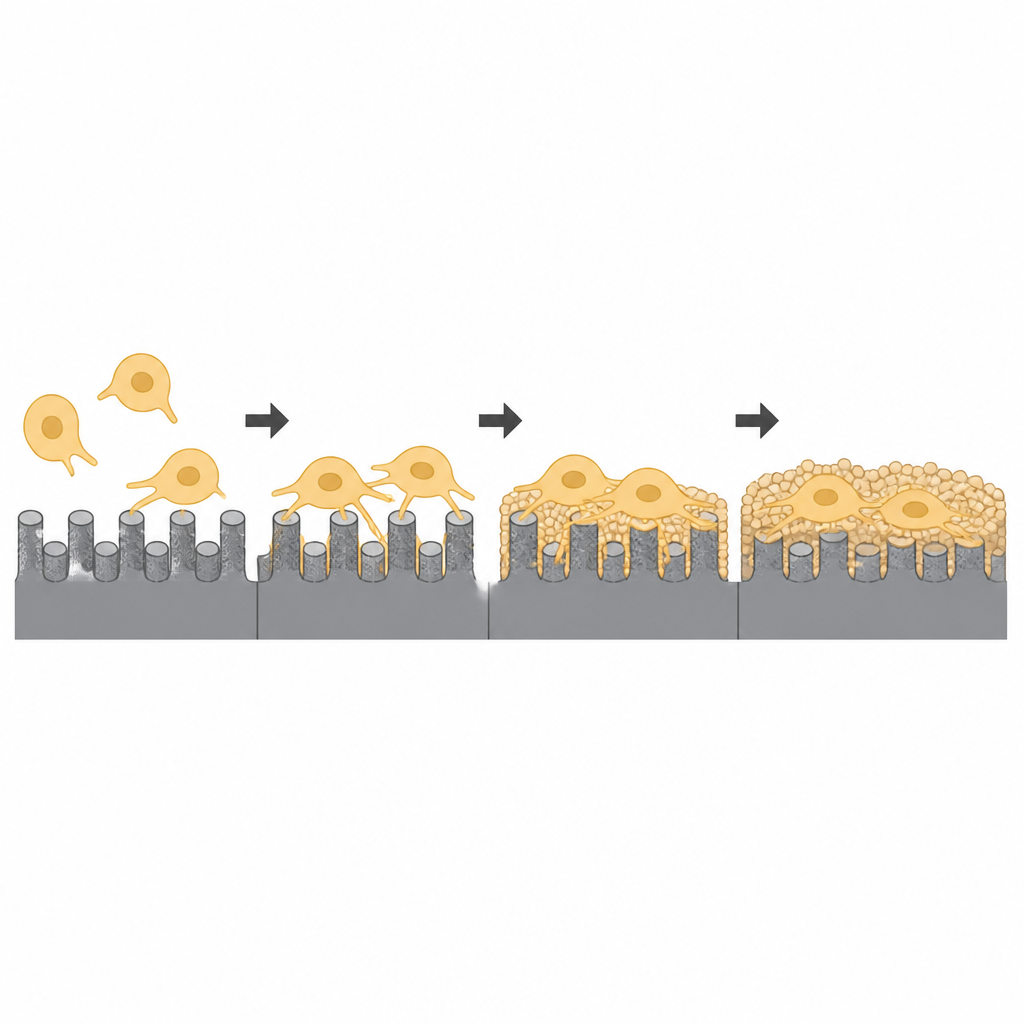
The team then grew human bone-forming cells on four types of samples: plain titanium, etched titanium, titanium with SLPI, and etched titanium with SLPI. All samples were safe for the cells. Etched metal and SLPI-bearing surfaces both attracted more cells in the early stages, and the combination of etching plus SLPI produced the highest level of early attachment and cell spreading. When the researchers tracked growth over a week, the smooth titanium with SLPI supported the fastest cell multiplication, while the rough etched surfaces favored a shift toward bone-like behavior rather than simple expansion in number.
From Soft Cells to Hard Mineral
To see whether these surfaces helped cells move into a more mature bone state, the scientists placed them in conditions that encourage mineral formation and waited three weeks. They then stained the hardened deposits that form as bone cells lay down their mineral-rich matrix. Etched titanium alone led to more mineral than plain metal, and titanium with SLPI showed a smaller but clear gain. The greatest mineral buildup appeared on the etched titanium that also carried SLPI, suggesting that the rough, wettable landscape and the protein cues worked together to guide cells toward full bone formation.
What This Could Mean for Patients
In simple terms, this work shows that fastening a helpful natural protein onto a carefully textured titanium surface can make bone cells stick better and mature into mineral-producing cells. The approach remains at the lab stage and has not yet faced the complex environment of a living body, with its immune defenses and constant mechanical forces. Still, the results offer a clear proof of concept that this layered treatment can turn plain titanium into a more active partner in healing, laying the groundwork for future implants that bond more quickly and securely with bone.
Citation: Chouyratchakarn, W., Chen, WY., Atthi, N. et al. A novel strategy for secretory leukocyte protease inhibitor (SLPI) immobilization on alkaline-etched titanium via a plasma-polymerized interlayer and covalent coupling to enhance osteoblast activity. Sci Rep 16, 16111 (2026). https://doi.org/10.1038/s41598-026-48469-4
Keywords: titanium implants, bone healing, surface modification, osteoblasts, protein coating