Clear Sky Science · en
Peristaltic flow of sutterby nanofluid in a stenosed artery with ciliated endothelium and wall roughness under hall and ion slip effects
Why this study matters for blood flow and health
When arteries narrow, blood flow becomes more complicated than a simple stream. Tiny surface hairs, rough patches, suspended particles, and magnetic effects can all change how blood moves, how heat is carried, and how drugs or microbes spread. This paper builds a detailed picture of how all these ingredients interact inside a narrowed artery, offering insights that could guide safer medical devices, better drug delivery, and improved understanding of cardiovascular disease.
Blood as a smart, particle filled fluid
Instead of treating blood as a simple liquid, the authors model it as a special “nanofluid” that contains tiny solid particles and motile microorganisms. They use a Sutterby model, which captures how such a fluid can become thinner or thicker depending on how fast it is stirred or squeezed. The artery is not a straight, smooth tube: it tapers, contains a stenosis region where the diameter shrinks, and has a porous wall that allows some fluid exchange with surrounding tissue. Into this environment the study adds the influence of an external magnetic field, electric currents, chemical reactions, and heat generation inside the fluid, all of which can matter for real blood flow in diseased vessels or engineered microchannels.
Rough walls and living brushes in the artery
The inner surface of the modeled artery is both rough and covered with cilia, tiny hair like structures that beat in a coordinated way. Wall roughness is allowed to change not only along the length of the vessel but also in time, mimicking deforming plaque or shifting tissue. The cilia follow elliptical beating paths that act like a moving brush on the fluid, enhancing mixing near the wall and altering the pressure and velocity patterns. The authors show that longer cilia dig deeper into the flowing blood, increasing drag and hydraulic resistance, which slows the average forward speed. At the same time, if the cilia beat more off center, they can boost net forward transport and help the fluid overcome the obstacles posed by narrowing and roughness. 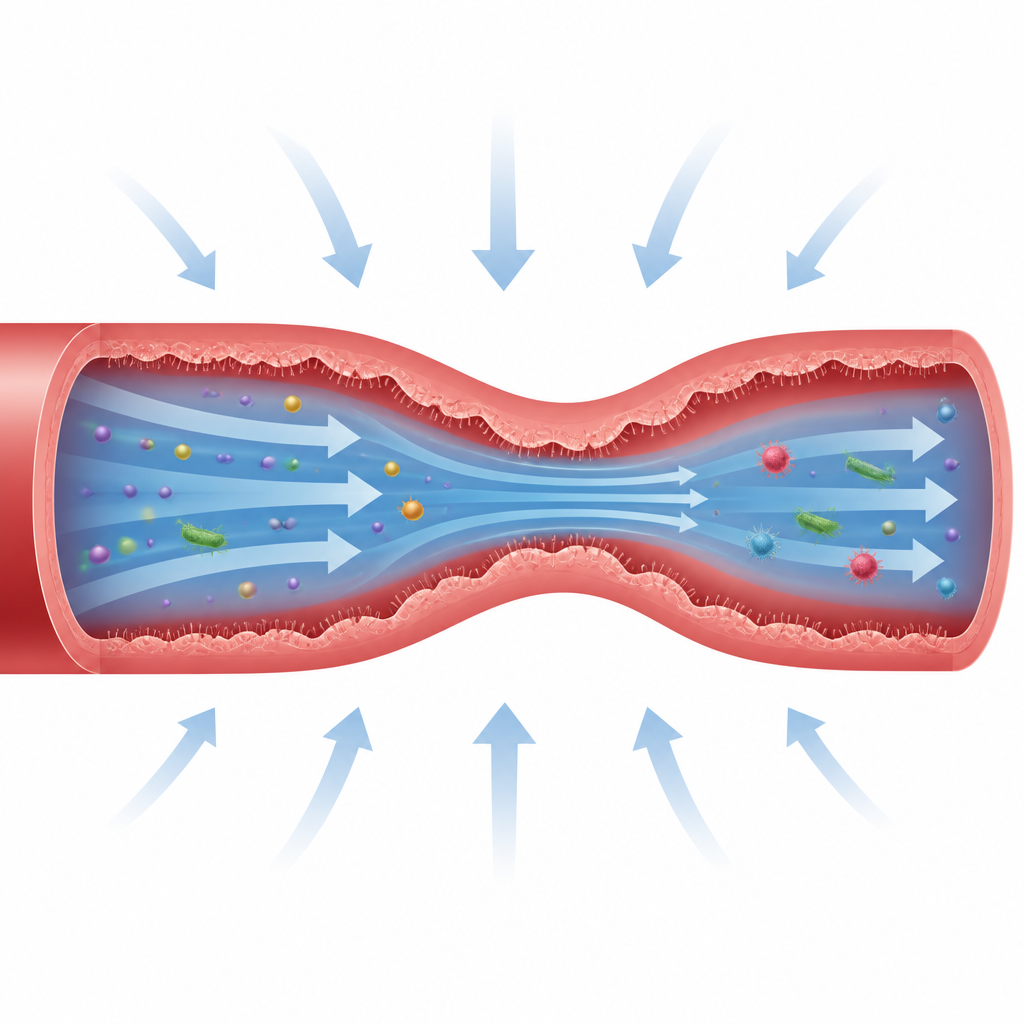
Heat, chemicals, and tiny swimmers in motion
Beyond flow speed, the study tracks how temperature, dissolved substances, and motile microbes behave. Heat is generated inside the fluid by friction, electrical currents, and radiation; this heat can change viscosity and drive buoyancy forces. Chemical reactions are treated with an activation energy concept, showing that higher energy barriers cut down how much solute is transported. Microscopic organisms respond to both the flow and chemical gradients, tending to swim and cluster in certain regions. A key finding is that cilia and roughness together create zones of trapping and recirculation, where fluid and microbes swirl instead of moving straight ahead. Depending on where along the artery one looks, longer cilia can either spread organisms out and lower local density or focus them downstream into zones of accumulation.
Magnetic forces and electrical slips in the bloodstream
Because the nanofluid is electrically conducting, the applied magnetic field interacts with electric currents in the blood. Two subtle effects, Hall currents and ion slip, describe how charged particles drift differently from the bulk fluid. These processes modify the effective drag on the flow and the way heat is produced by electrical resistance. The authors combine these magnetohydrodynamic effects with a refined porous flow model that extends the classic Darcy law, better capturing how oscillating blood pushes through a deformable, partially permeable arterial wall. Using an analytical approach called the Homotopy Perturbation Method, they derive approximate formulas for velocity, temperature, concentration, and microorganism distributions, then explore how each control parameter reshapes the flow.
Patterns of pressure, friction, and trapped pockets
The model reveals how pumping efficiency and mechanical stress depend on cilia and surface texture. As wall roughness grows in height or becomes more closely spaced, both resistance and skin friction on the wall rise, especially near the stenosed segment. This tends to lower the critical pumping velocity that the peristaltic wave can sustain. Pressure rise over a wave cycle changes almost linearly with the imposed flow rate, and cilia shift the balance between forward pumping and backward leakage. Streamline plots show increasingly distorted paths and closed recirculation bubbles as cilia length and roughness amplitude increase, highlighting where nutrients, drugs, or microbes might linger longer than expected. 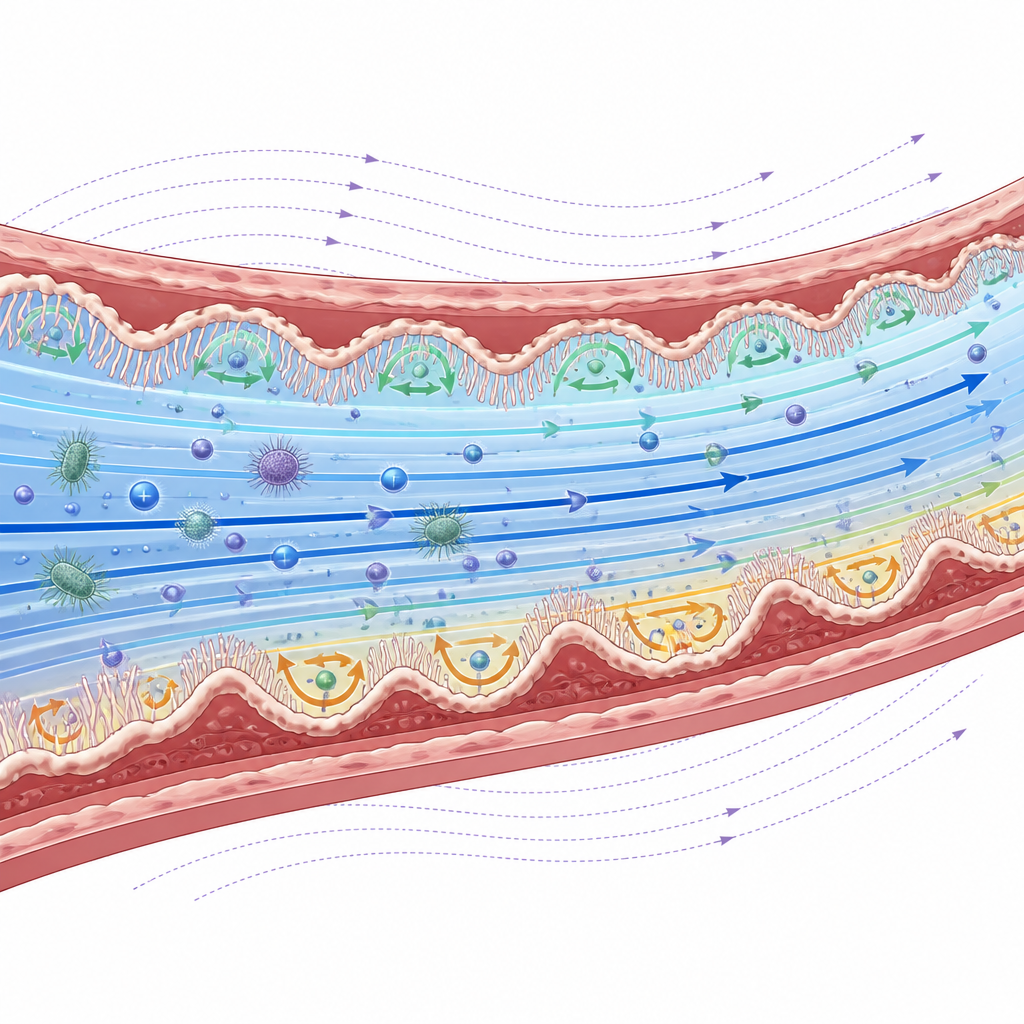
What this means for medicine and devices
In simple terms, the study shows that a narrowed artery lined with rough, beating cilia and carrying a particle rich, electrically conducting blood behaves like a highly tunable transport system. Small changes in cilia length, wall roughness, or magnetic and electrical conditions can either ease flow or choke it, can either smooth out temperature and chemical profiles or create pockets of trapped fluid and concentrated microbes. While the work is theoretical, it offers a framework that can help engineers design smarter stents, microfluidic pumps, and drug delivery tools, and helps clinicians understand how complex surface features inside arteries influence blood flow and treatment outcomes.
Citation: Mostapha, D.R., Eldabe Nabil, T.M. & Abbas, W. Peristaltic flow of sutterby nanofluid in a stenosed artery with ciliated endothelium and wall roughness under hall and ion slip effects. Sci Rep 16, 15223 (2026). https://doi.org/10.1038/s41598-026-48237-4
Keywords: peristaltic blood flow, stenosed artery, nanofluid, cilia dynamics, magnetohydrodynamics