Clear Sky Science · en
Polarization-driven twisted states in ferroelectric nematic liquid crystals under confinement
Why twisting liquids matter
At first glance, a liquid whose molecules can all line up and even carry an electric polarization sounds like science fiction. Yet ferroelectric nematic liquid crystals are just that: fluids whose molecules not only point in the same direction, but also act like a dense forest of tiny electric dipoles. This study explores how such a highly polarized liquid crystal behaves when squeezed between glass plates of different spacing. The answer is surprisingly rich: the liquid can remain straight, twist smoothly, or adopt a new in‑between state that could inspire future fast, low‑energy optical devices.
From simple order to electric super‑order
Ordinary nematic liquid crystals, familiar from display technology, are made of rod‑shaped molecules that prefer to point in roughly the same direction. Flipping all of them end‑to‑end makes no difference, because the rods themselves are not strongly polar. Ferroelectric nematic phases are different. Their rods carry strong dipoles along their length, so there is now a clear “head” and “tail”. When many such molecules align, they create a giant electric polarization comparable to that in solid ferroelectric materials. This intense polarization changes the rules: certain distortions of the molecular alignment, which are harmless in ordinary nematics, now create electric charges and become energetically costly. The material must balance the tendency of the molecules to stay aligned with the need to reduce electrostatic energy.
Why the liquid wants to twist
In a ferroelectric nematic, one way to reduce electrostatic energy is to let the direction of polarization gently rotate through space instead of pointing straight. Imagine a row of tiny bar magnets: placing them perfectly parallel side‑by‑side makes them strongly repel or attract, but if you slowly rotate them along the row, their effects can cancel out over a full turn. The same idea applies here. Theory has suggested for decades that a fluid with strong polarization should prefer a twisted ground state, and recent experiments on unconstrained samples confirmed that the polarization indeed tends to twist. However, most technological uses rely on confining liquid crystals between treated glass surfaces that try to enforce a specific in‑plane direction. The central question of this work is what happens when such surface instructions compete with the liquid’s own desire to twist.
What happens when the space between plates grows
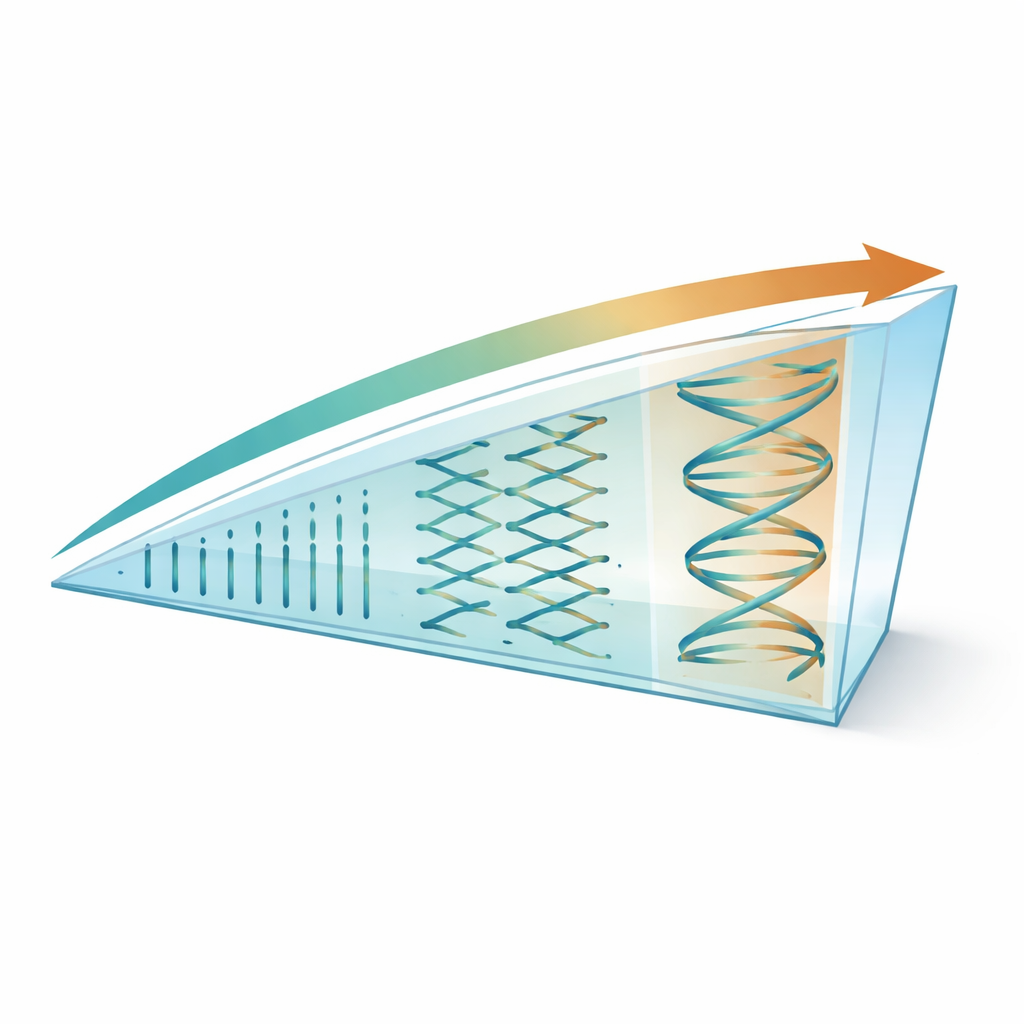
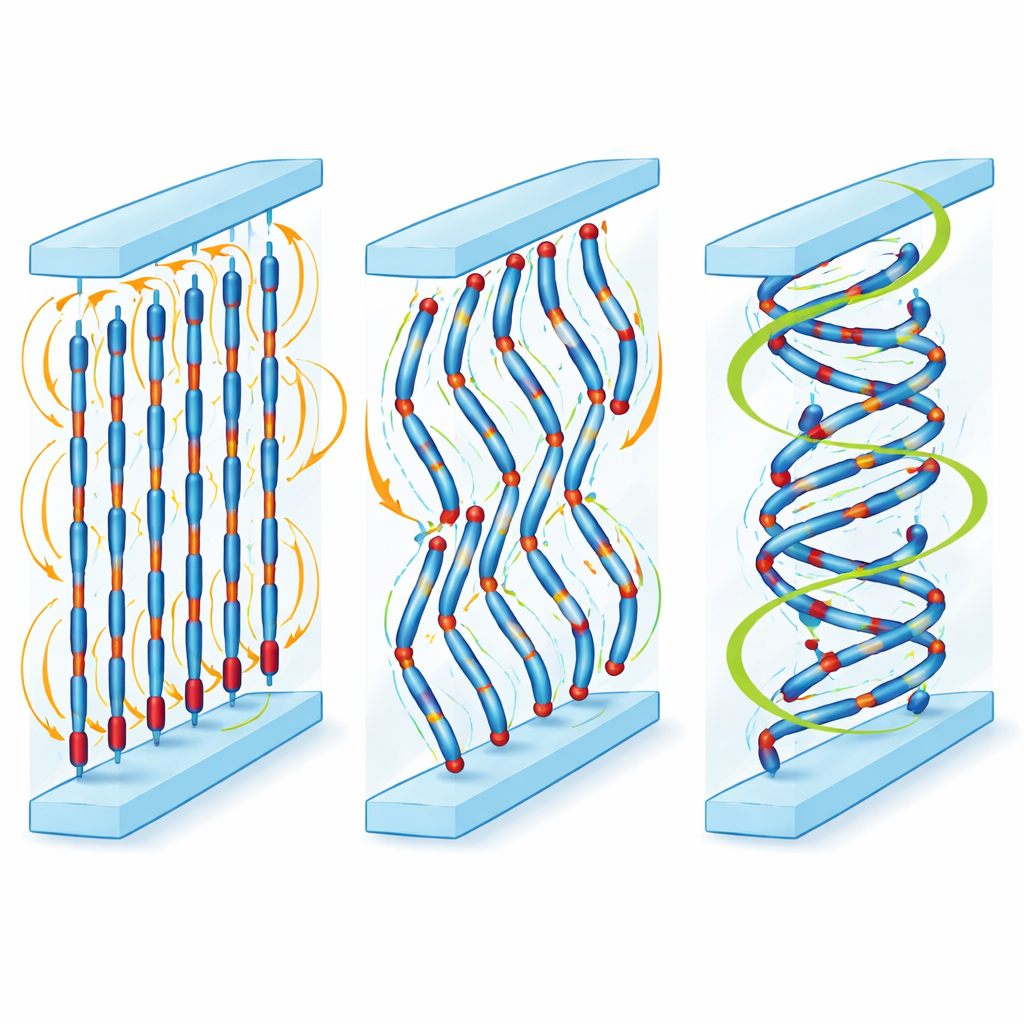
The authors study a specific ferroelectric nematic material, AUUQU‑2‑N, placed in a “wedge cell”, where the distance between two glass plates gradually increases from sub‑micrometer thickness to almost ten micrometers. Both plates are rubbed in the same direction, favoring parallel alignment of polarization at each surface. Using polarized optical microscopy and careful measurements of transmitted light, the team observes three regimes along the wedge. In the thinnest region, below about 2 micrometers, the liquid adopts a uniform state: molecules remain essentially straight from one plate to the other. As the cell thickens beyond roughly 5 micrometers, distinct domains appear in which the molecular orientation twists by about one full turn (2π) between the plates, with neighboring domains choosing left‑ or right‑handed twist. These twisted regions reveal themselves as bright, color‑changing bands when the polarizers are slightly rotated.
A hidden in‑between twist: the mesotwisted state
The most intriguing behavior occurs at intermediate thickness, between roughly 2 and 5 micrometers. Here, the textures do not show full twist domains, yet the light patterns cannot be explained by a simple uniform alignment. By analyzing how the colors change when the polarizers are rotated in opposite directions, and by simulating light transmission through various trial structures, the authors propose a new configuration they call a “mesotwist”. In this state, the liquid twists one way from each plate toward the middle, then reverses twist sense at the cell’s midplane. Locally, each half of the cell is chiral, like a right‑ or left‑handed spiral, but the two halves are mirror images, so the overall structure is achiral. This is analogous to a “meso” molecule with two chiral centers that cancel each other’s handedness. The mesotwist lets the liquid enjoy a strong local twist—reducing electrostatic energy—while still matching the surface alignment and keeping the total twist across the cell at zero.
Balancing forces and looking ahead
The observed sequence—from uniform to mesotwisted to fully twisted states—can be understood as a balance between two competing energies. Electrostatic interactions favor twisting to cancel the overall polarization, while elastic forces penalize distortions of the molecular orientation. When the gap is too thin, forcing a full twist would be too costly elastically, so the uniform state wins. At large gaps, a full 2π twist is favorable because it cancels polarization over a comfortable distance. In between, the mesotwist offers a compromise: strong local twist with zero net twist. These findings show that not only the surfaces, but also the cell thickness, can control how ferroelectric nematic liquids organize themselves. This insight could guide the design of new electro‑optic devices that exploit thickness‑tuned twisted states, much like surface‑stabilized ferroelectric smectics revolutionized display technology decades ago.
Citation: Savchenko, A., Grönfors, E., Tuffin, R. et al. Polarization-driven twisted states in ferroelectric nematic liquid crystals under confinement. Sci Rep 16, 12710 (2026). https://doi.org/10.1038/s41598-026-48218-7
Keywords: ferroelectric nematic, liquid crystals, twisted states, electrostatic energy, mesotwist