Clear Sky Science · en
Long-range structural and magnetic coherence in embedded mesospin metamaterials
Why tiny magnets in flat films matter
Modern technologies increasingly rely on controlling magnetism in ever smaller structures, from data storage to future low‑energy computing. This study shows a new way to build large, flat carpets of tiny, interacting magnets that naturally settle into an orderly state on their own. Because the magnets are embedded inside a smooth metal film rather than carved out as separate blocks, they are unusually uniform and easy to study with powerful X‑ray and neutron probes. That combination of self‑organized order and clean structure could open the door to new devices where information is carried and read out by waves of magnetism or by carefully shaped beams of light.
Building a magnetic pattern inside a smooth film
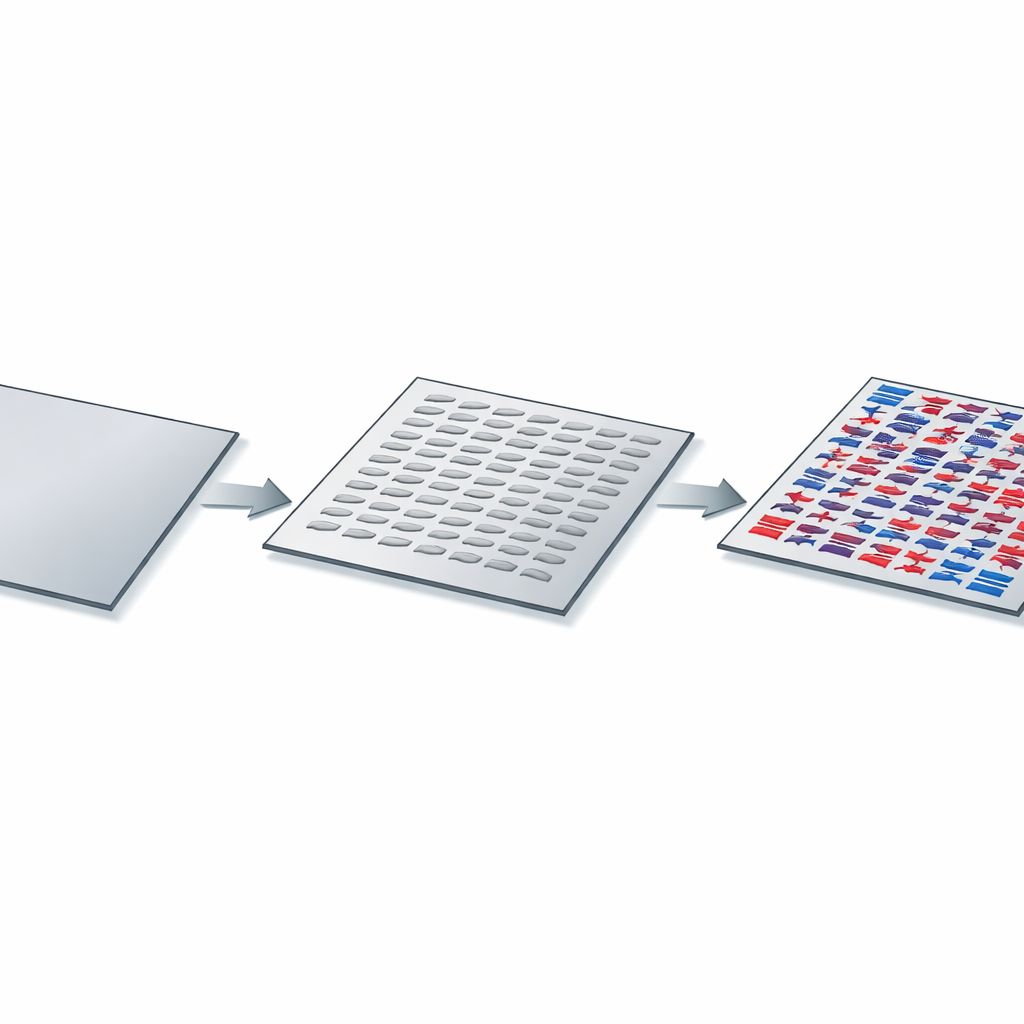
The researchers start from a simple metal film of palladium, a material that is not magnetic by itself but can be turned magnetic when mixed with a small amount of iron. Instead of etching tiny islands on top of the film, they use a focused beam of iron ions shot through a patterned mask. Wherever the ions pass, they embed themselves a few nanometres below the surface and locally turn the palladium into a ferromagnetic alloy. The result is a nearly flat surface that hides a regular array of elongated, single‑magnet “mesospins” inside the film. These elements form a square artificial spin ice: a grid where neighbouring magnets sit at right angles, a layout well known for its rich collective behaviour.
Peering beneath the surface in depth
To find out exactly where the implanted iron sits and how strongly it is magnetized, the team combines resonant X‑ray reflectivity and polarized neutron reflectivity on continuous (unpatterned) films. By tuning the X‑ray energy to an absorption edge of iron, they can separately track the electronic structure and the iron magnetic moments as a function of depth. The resulting profiles show that the implantation produces a well‑defined magnetic layer that peaks a few nanometres below the surface and extends only about 15 nanometres into the palladium. Neutron measurements confirm that not only the iron but also nearby palladium atoms become magnetically polarized. Crucially, this process preserves the overall smoothness and layering of the film, proving that the magnetic regions are sharply defined yet structurally coherent.
Watching the tiny magnets line up in the plane
Next, the scientists image the patterned arrays directly using photoemission electron microscopy combined with X‑ray magnetic circular dichroism, a technique sensitive to the direction of magnetization in each implanted element. These images reveal that every mesospin behaves as a single magnetic domain, with its moment pointing uniformly along its long axis. More strikingly, the islands naturally arrange themselves into large, nearly defect‑free domains that match the lowest‑energy, antiferromagnetic ground state of the square lattice: neighbouring mesospins tend to point in opposite directions so that their fields balance at each crossing point. This ordered pattern appears in the as‑implanted samples, without any post‑processing such as heating or applying strong magnetic fields, indicating that the system effectively “self‑anneals” during ion implantation.

Reading order from scattered X‑rays
While microscopy shows local patterns, scattering experiments reveal how order extends across much larger distances. By shining soft X‑rays onto the array and recording the scattered intensity on a detector, the team observes sharp peaks in reciprocal space that arise from the regular spacing of the mesospins. Off resonance, these peaks mainly reflect the slight density difference between implanted and non‑implanted regions. Their intensities follow a characteristic cross‑shaped envelope that encodes the elongated shape and arrangement of the mesospins. When the X‑ray energy is tuned to the iron resonance, new peaks appear at positions expected for antiferromagnetic order on the lattice. These “magnetic Bragg peaks” are only visible at resonance and match simulations that include both the lattice geometry and the sensitivity of the probe, demonstrating long‑range magnetic coherence tied directly to the structural pattern.
A new playground for light and magnetism
Taken together, these results show that ion implantation can create large‑area magnetic metamaterials that are structurally smooth, highly uniform, and magnetically ordered over long distances—without the usual imperfections that plague etched nano‑islands. Because the same embedded structures can be precisely modelled and cleanly probed by X‑rays and neutrons, they provide an ideal test bed for exploring how patterned magnetism interacts with light, including possibilities such as tailored spin–photon coupling and advanced scattering‑based readout schemes. More broadly, the work suggests a practical route to materials that acquire their desired magnetic order during fabrication itself, offering extra “design knobs” through ion choice, energy, and dose. Such control could ultimately support reconfigurable logic, magnonic signal processing, and unconventional computing platforms built from self‑organized carpets of tiny magnets.
Citation: Vantaraki, C., Bikondoa, O., Grassi, M.P. et al. Long-range structural and magnetic coherence in embedded mesospin metamaterials. Sci Rep 16, 12178 (2026). https://doi.org/10.1038/s41598-026-48207-w
Keywords: magnetic metamaterials, artificial spin ice, ion implantation, resonant X-ray scattering, spin-photon coupling