Clear Sky Science · en
Environmental and energy performance of cotton stalk residues for sustainable bioenergy production
Turning farm leftovers into useful fuel
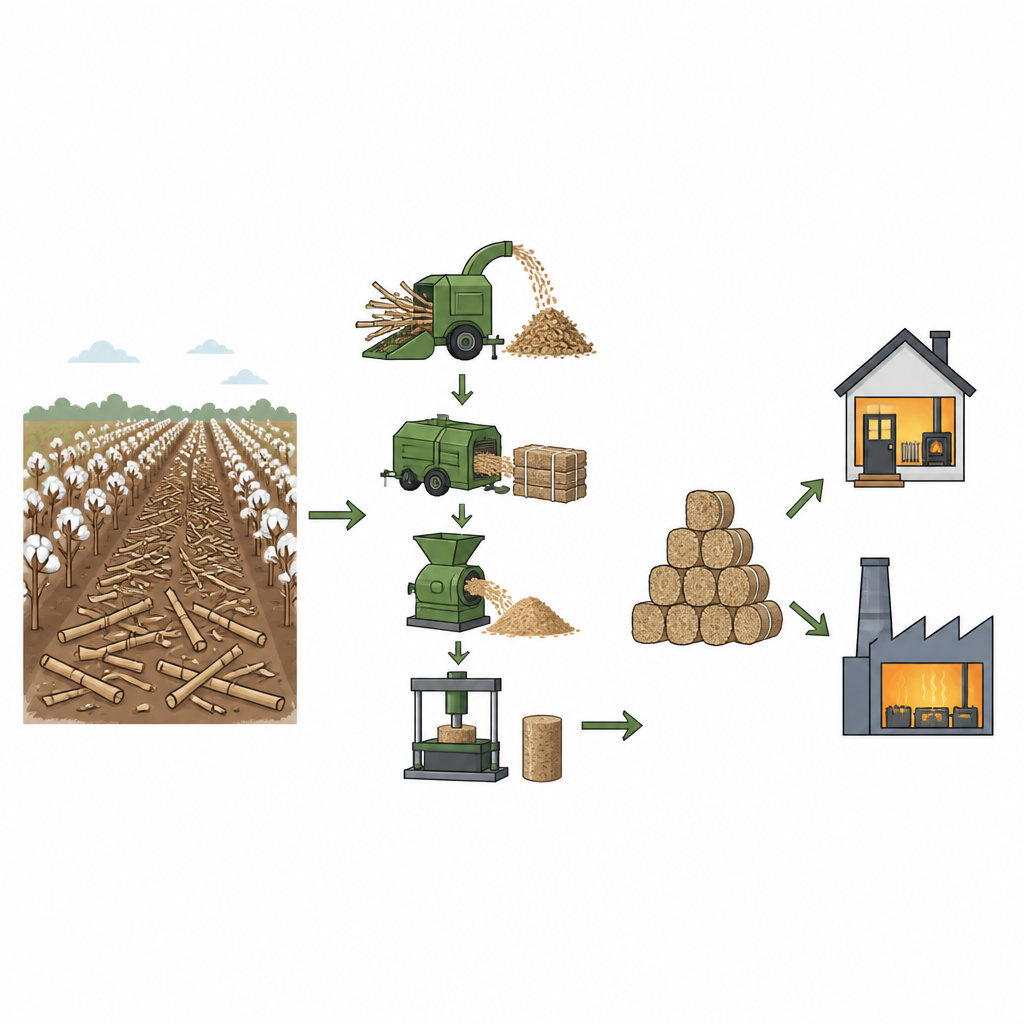
Cotton farms produce huge piles of woody stalks after harvest, and most of this material is still wasted or burned in open fields, adding smoke and greenhouse gases to the air. This study explores whether those stalks can instead be turned into tidy, easy-to-use fuel blocks that provide useful heat with limited pollution and reasonable energy costs during production.
From rough stalks to compact fuel blocks
The researchers collected cotton stalks from fields, dried them, chopped and ground them into different particle sizes, and then pressed the material into solid briquettes. They carefully controlled three practical knobs that any operator would care about: how wet the material was, how fine it was ground, and how hard it was squeezed. For each setting they measured how dense the briquettes became, how much power the machines needed, how much heat the briquettes could deliver, how much ash they left behind, and what gases came out when they were burned.
Finding the sweet spot in processing
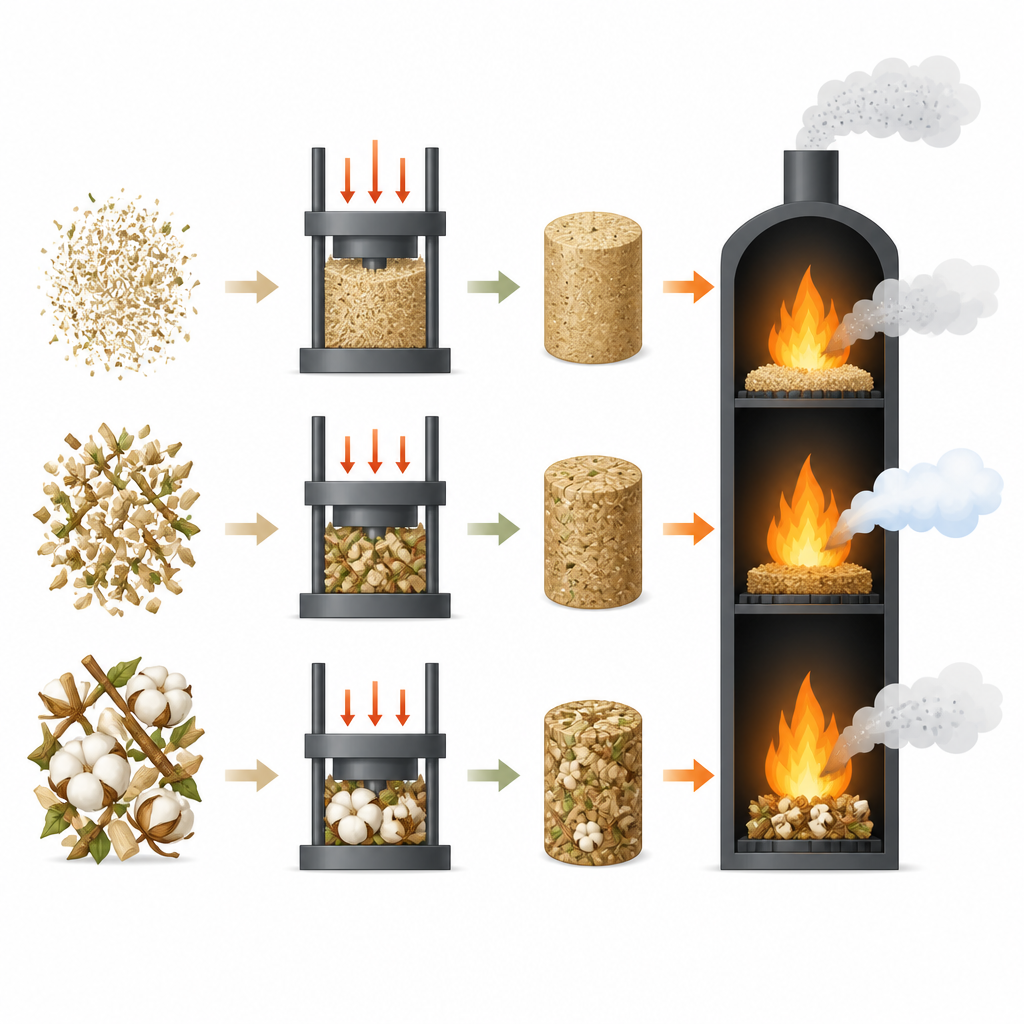
Making very dense briquettes may sound ideal, but it requires stronger pressing and more grinding, which both cost energy. The team found that finer particles and higher pressures did give the heaviest, most compact briquettes, with densities over one metric ton per cubic metre and a solid heating value similar to some wood fuels. At the same time, this "overdoing it" raised the power demand of the machines without giving much extra benefit in heat output. By contrast, slightly coarser particles and only moderate moisture produced briquettes that were still dense and strong, but with noticeably lower energy use in the press.
How cleanly the briquettes burn
Burn tests in a controlled stove showed that most of the gas leaving the chimney was carbon dioxide, which is expected when plant-based fuels burn completely. Levels of carbon monoxide, sulfur gases, and nitrogen oxides stayed comparatively low and declined as the burn finished, signalling efficient combustion with little leftover pollution. The briquettes also left only a small amount of ash, which means less cleaning and less material to dispose of after each firing. Heat-release tests and careful heating of tiny samples confirmed that the briquettes burn in clear stages, first driving off moisture, then releasing flammable vapors, and finally leaving a stable char that burns out gradually.
Balancing energy use and environmental impact
To judge the process in a simple, practical way, the authors built two combined scores. One score compares the heat you get from the briquettes to the energy needed to grind and press them. The other also factors in the measured exhaust gases. Using these scores, they showed that there is a clear trade-off: pushing the press too hard or grinding too fine lowers the overall benefit, because the extra machine energy outweighs the small gains in fuel quality. The best balance came from moderate pressing, moderate moisture, and somewhat coarser particles, which together cut machine energy use while keeping good fuel performance and low emissions.
What this means for farmers and energy users
For non-specialists, the message is straightforward: cotton stalks, usually treated as a nuisance, can be turned into compact fuel that burns cleanly and is practical to handle, as long as the preparation steps are tuned sensibly. The study shows that simple choices in grinding, drying, and pressing can make the difference between a wasteful, power-hungry process and one that efficiently converts field residues into useful heat with limited pollution, helping farming regions create local, renewable energy from material they already have.
Citation: Ibrahim, M.M., Alharbi, A. & Ghonimy, M. Environmental and energy performance of cotton stalk residues for sustainable bioenergy production. Sci Rep 16, 15997 (2026). https://doi.org/10.1038/s41598-026-48159-1
Keywords: cotton stalk briquettes, bioenergy, biomass fuel, combustion emissions, waste to energy