Clear Sky Science · en
Quaternized cellulose nanofibril paper coatings for sustainable packaging with improved barrier and antibacterial performance
Why safer packaging matters
Food and consumer goods are often wrapped in plastic that can persist in the environment for centuries. At the same time, packaging must keep air, moisture, and germs away from what we eat. This study explores a way to turn ordinary paper into a high performance, eco friendly wrapper that both blocks air and helps stop harmful bacteria, offering a potential path away from plastic without sacrificing safety.
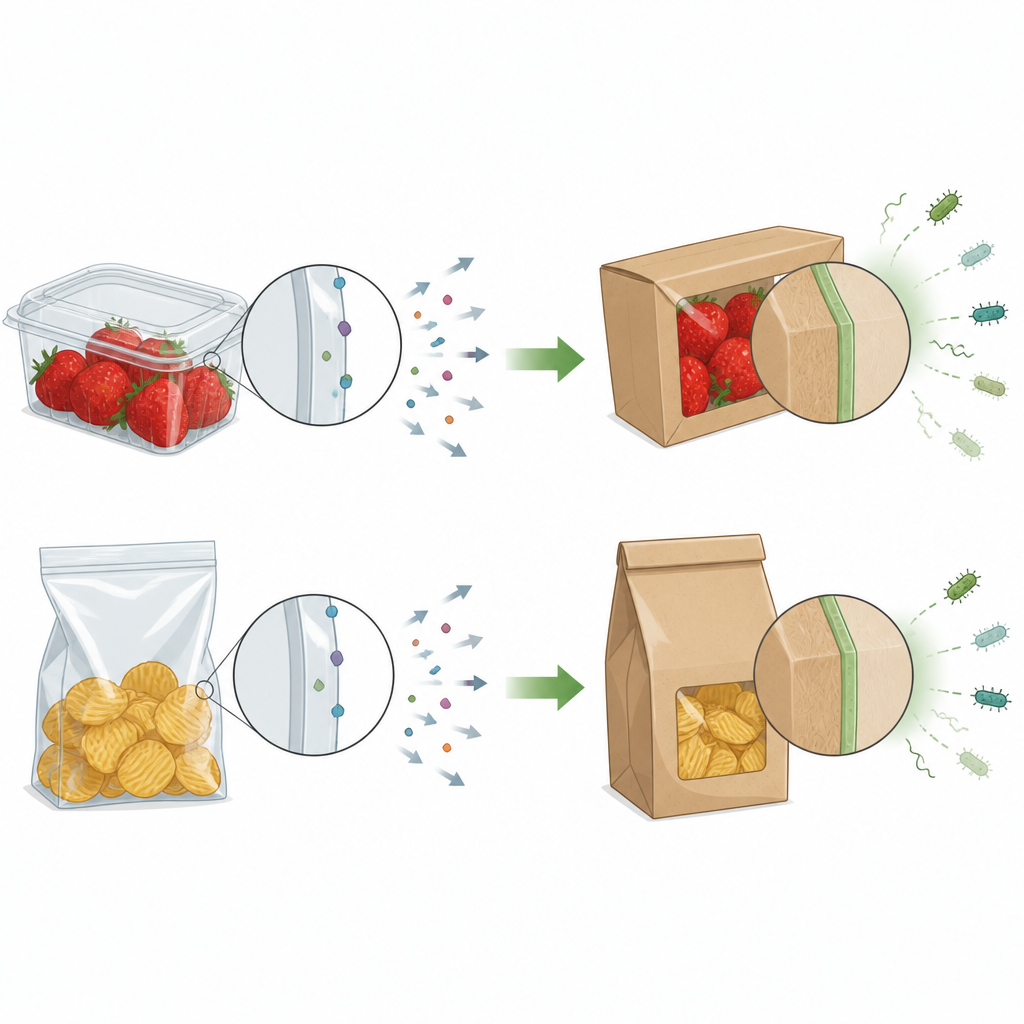
Turning plant pulp into a smart coating
The researchers start with cellulose, the main building block of plant cell walls and a natural, renewable material. They break wood pulp into extremely fine threads, called nanofibrils, which can form smooth, dense films on paper. To give these tiny fibers new abilities, they attach positively charged chemical groups to their surface. By adjusting how many of these charges are added, they create a family of slightly different coatings and examine how each version behaves when used on paper.
How charge changes the flow and film
Adding more positive charges along the fibers subtly shortens them and weakens the way they tangle together in water. This makes the liquid coating less thick and easier to spread evenly over paper. When the team measures the flow and stiffness of the fiber mixtures, they find that higher charge leads to lower resistance to flow and a softer internal network. In practical terms, the more strongly modified fibers form smoother, more continuous layers during coating, because the liquid can level out before it dries.
Building a tighter shield against air and water
The team then coats a sturdy base paper with either two or four layers of these modified fibers and examines the surfaces under an electron microscope. With more layers and higher charge levels, the rough texture and open pores of the original paper become almost completely hidden beneath a uniform skin. Tests show that even two layers reduce the passage of air, and that rising charge levels further improve this barrier by filling in gaps more effectively. When four layers are applied, all versions block air well, but the most highly charged coatings give the smoothest surface and hold water droplets at higher contact angles, meaning the paper resists wetting and absorbs water more slowly.
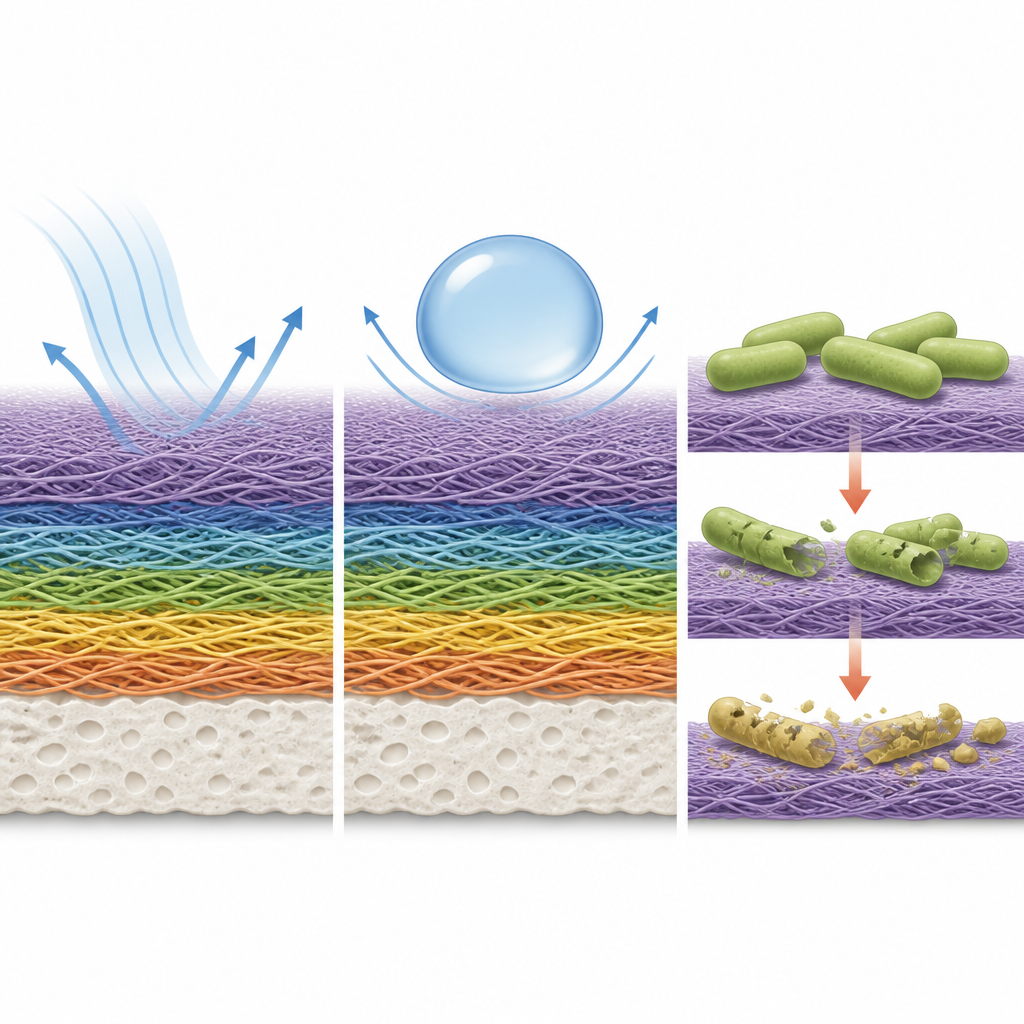
Giving paper a germ fighting surface
Beyond blocking air and water, the authors want the coated paper to help control microbes without releasing harmful chemicals into food or the environment. Because many bacteria carry a negative charge on their outer surface, they are attracted to the positively charged coating. When bacteria touch this surface, their outer membrane can be disturbed, causing them to leak and die. In tests with two common Gram positive species, the number of surviving cells drops sharply as the coating charge and the number of layers increase. In contrast, a Gram negative species with an extra outer membrane shows little loss of survival, suggesting that this extra barrier protects it from direct contact with the charged surface.
What these findings mean for future packages
This work shows that by tuning the number of positive charges on plant based nanofibers, it is possible to create paper coatings that flow easily, form dense films, slow the passage of air, resist water, and strongly reduce some types of bacteria on contact without relying on leaching biocides. For Gram positive germs, the charge level used here appears to be enough, while tougher Gram negative species may require even stronger or more complex designs. Together, the results point toward cleaner, safer paper packages that could help replace some plastic wraps while adding a built in layer of protection against spoilage.
Citation: Choi, Yh., Han, S., Shin, Sj. et al. Quaternized cellulose nanofibril paper coatings for sustainable packaging with improved barrier and antibacterial performance. Sci Rep 16, 16100 (2026). https://doi.org/10.1038/s41598-026-48158-2
Keywords: sustainable packaging, cellulose nanofibrils, paper coatings, antibacterial surfaces, food packaging