Clear Sky Science · en
Boronic acid affinity media conjugating with PEG enable precise pH-responsive HPLC separation of glycoproteins depending on differences of sugar chains
Why sorting sugar coated proteins matters
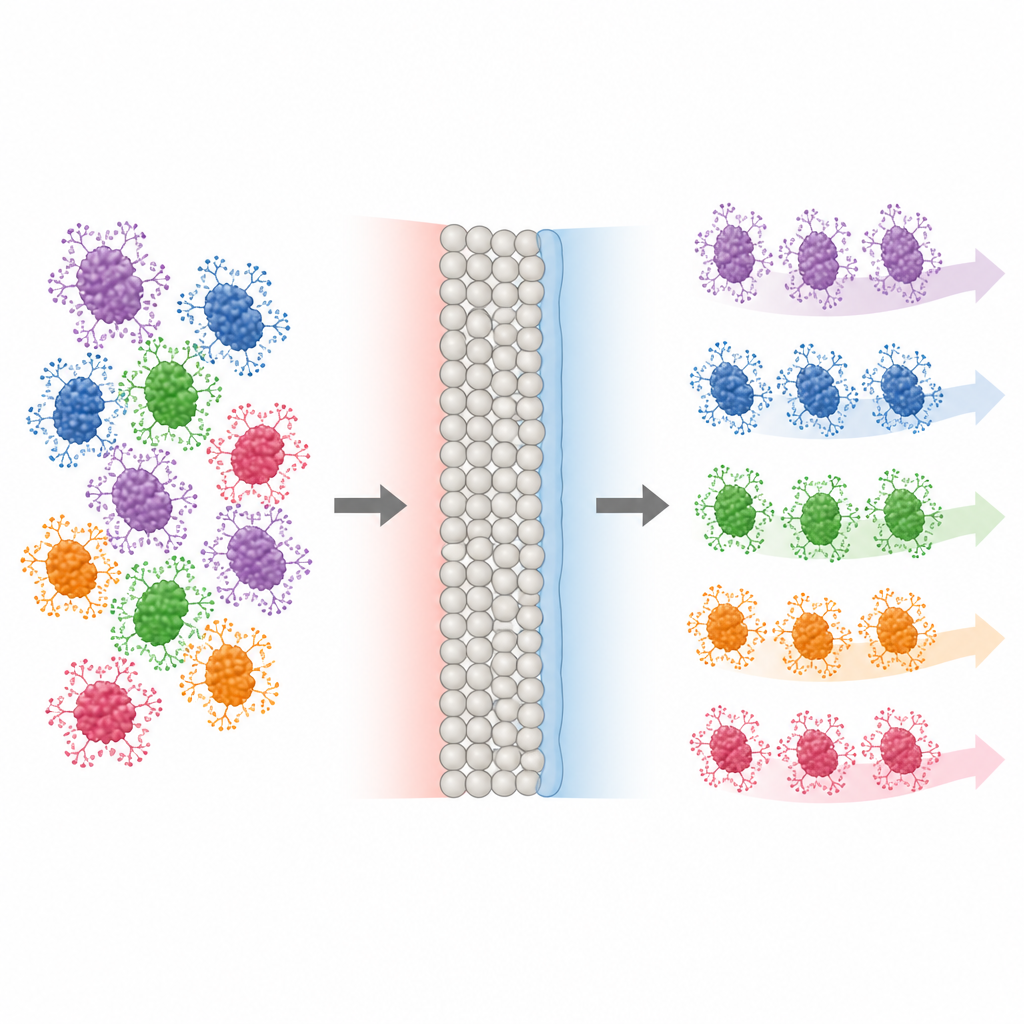
Many of the proteins in our bodies are decorated with complex sugar chains that influence how they signal, defend against infection, or become involved in disease. Being able to sort and analyze these sugar coated proteins gently and precisely is crucial for discovering disease markers and for making safer, more effective antibody drugs. This study reports a new way to separate such proteins using a chromatography column that responds to small changes in acidity without harming delicate samples.
A new type of smart filter material
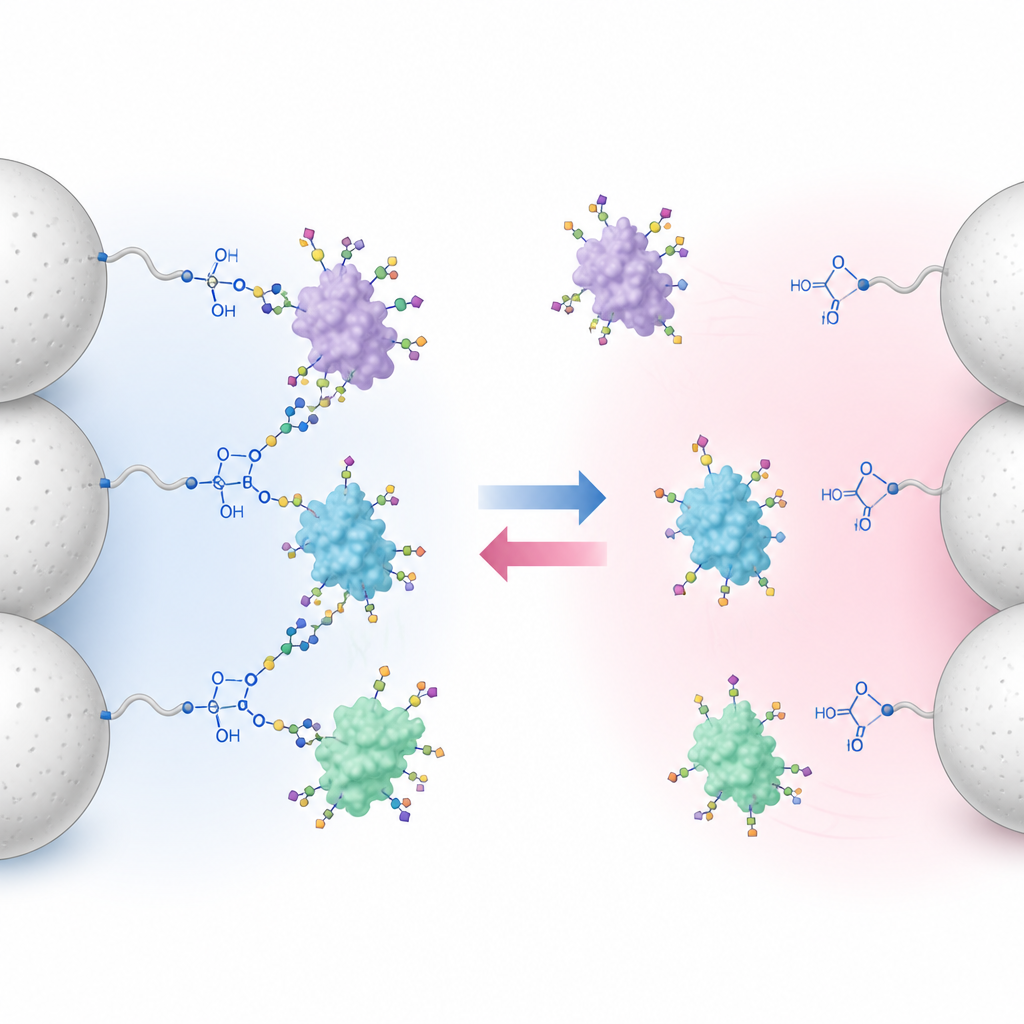
At the heart of the work is a redesigned solid material for high performance liquid chromatography, a technique widely used to separate molecules in solution. The authors modified tiny silica particles, which act like sand grains in a packed column, with two key components. First, they attached flexible chains of polyethylene glycol, a water loving polymer that forms a soft, protective layer and helps prevent proteins from sticking in unwanted ways. Second, they tethered special boronic acid groups to these chains. These groups can latch onto the sugar parts of glycoproteins in a way that depends on the acidity of the surrounding liquid.
Making boronic acids work at gentle conditions
Classic boronic acids used for recognizing sugars only bind well in fairly basic conditions, where many proteins begin to unfold or clump together. To avoid this, the team turned to four boronic acid variants that carry electron pulling chemical groups, which lowers the acidity level at which they switch between binding and releasing sugars. Measurements of their behavior in solution showed that some of these variants begin to bind sugars already around neutral pH, close to that of blood and other biological fluids. This means that sugar recognition can happen under much milder conditions than before, reducing the risk of damaging valuable protein samples.
Building a denser and more selective surface
Early versions of the new material did not hold onto glycoproteins strongly enough, even though they bound small sugar like molecules. The researchers solved this by inserting a branched polymer, polyethylenimine, between the polyethylene glycol layer and the boronic acids. This extra scaffold allowed many more boronic acid units to be anchored on each particle. Tests with a panel of glycoproteins and a non glycosylated protein showed that some sugar coated proteins were firmly retained while others passed through, and the plain protein behaved much like the ones with weak or absent sugar binding. These differences suggest that the surface recognizes not just the presence of sugars, but also details of the sugar structures.
Tuning separation with acidity and chemistry
The authors then explored how changing the acidity of the flowing liquid and swapping among the four boronic acid types affected behavior. Across a range of conditions, the non glycosylated protein eluted quickly, while glycoproteins showed patterns of sticking and release that were highly sensitive to both pH and the particular boronic acid on the column. By programming gradual shifts in pH during a run and by choosing different boronic acid coated columns, they were able to reverse the order in which several glycoproteins emerged. This ability to rearrange elution order indicates that very fine control over separation based on sugar chains is possible.
What this means for future protein medicines
Overall, the study demonstrates a gentle, tunable system for separating sugar coated proteins by harnessing pH responsive binding to specially designed boronic acids on a protective polymer layer. To a non specialist, this can be viewed as a smart filter that grabs different sugar patterns more or less tightly depending on how acidic the liquid is and how the surface is built. With further refinement of the polymer spacers and boronic acid choices, this approach could improve the way antibody drugs and other glycoprotein based therapies are purified and analyzed, making it easier to connect subtle sugar variations with function and safety.
Citation: Koda, K., Konishi-Yamada, S. & Kubo, T. Boronic acid affinity media conjugating with PEG enable precise pH-responsive HPLC separation of glycoproteins depending on differences of sugar chains. Sci Rep 16, 16203 (2026). https://doi.org/10.1038/s41598-026-48059-4
Keywords: glycoproteins, boronic acid, HPLC, protein separation, sugar chains