Clear Sky Science · en
Chemical composition and insecticidal activity of essential oils from Citrus limon, Citrus aurantium, and Citrus margarita against Musca domestica
Citrus peels as everyday pest fighters
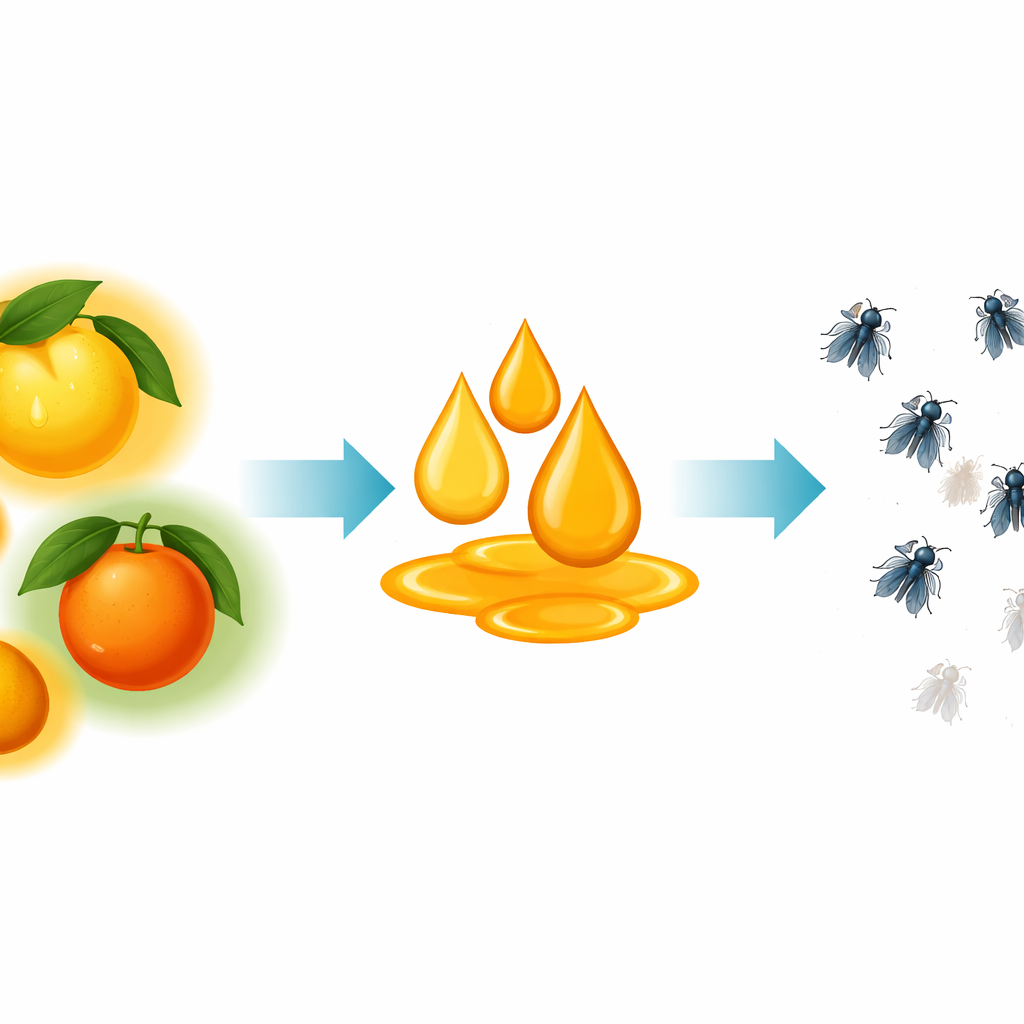
Most of us think of lemon, orange, and kumquat peels as kitchen scraps, but their fragrant oils may help solve a very down-to-earth problem: houseflies. This study explores whether the natural oils in common citrus peels can kill adult houseflies, which spread many human diseases, and asks a deeper question: which specific citrus ingredients are doing the killing, and how do they interfere with the insect’s nervous system?
From fruit peel to fragrant oil
The researchers collected ripe lemons (Citrus limon), bitter oranges (Citrus aurantium), and kumquats (Citrus margarita) from a garden in Egypt. They carefully separated the peels, distilled out the essential oils using hot water and steam, and then analyzed the oils with a sensitive instrument that separates and identifies chemical ingredients. Across the three species they found 31 different compounds, dominated by a family of light, easily evaporated molecules called monoterpenes. One familiar example is D-limonene, a citrus-scented ingredient common in cleaners and perfumes. Although all three oils shared major components, their exact mixes differed: lemon oil, for instance, contained a higher share of oxygen-rich compounds than the other two.
Putting houseflies to the test
To see whether these oils could truly act as natural insect killers, the team exposed adult houseflies (Musca domestica) to different concentrations of each oil in standardized test bottles. They counted how many flies died over two hours and used these data to calculate the dose needed to kill half the insects (a standard measure of potency). Lemon peel oil emerged as the star performer: it required only about 3 parts per million to kill half the flies and was set as the 100% reference for toxicity. Bitter orange oil worked almost as well, needing only slightly more. Kumquat oil, by contrast, was hundreds of times weaker, meaning far higher doses would be needed to get the same effect.
Zooming in on the fly nervous system
Because flies worldwide are becoming resistant to many synthetic insect sprays, the scientists also wanted to understand how citrus ingredients might act at the molecular level. They used computer tools to map how citrus compounds could interact with key fly proteins involved in nerve signaling and detoxification, such as enzymes that break down nerve messengers and systems that help the insect neutralize poisons. One protein stood out: acetylcholinesterase, a crucial enzyme that clears the chemical signal acetylcholine from nerve junctions. Many commercial insecticides work by blocking this enzyme; the team asked whether any citrus molecules might do something similar.

Finding a promising natural blocker
The researchers then ran large-scale computer docking experiments, which virtually “fit” each citrus molecule into the three-dimensional structure of the target enzyme to see how snugly and stably it could bind. Out of 31 tested compounds, a molecule called geranyl acetate showed the strongest grip on the enzyme’s active region, even better than a known reference inhibitor. Follow-up computer simulations that tracked the movements of the enzyme and geranyl acetate together over 100 billionths of a second suggested that this pairing remains stable, with the protein keeping its shape while the molecule stays nestled in the key pocket. These results support the idea that geranyl acetate, along with other citrus ingredients like D-limonene, could disrupt the fly’s nerve signaling and contribute to the observed insect-killing power.
Green tools for cleaner homes
For non-specialists, the takeaway is that something as familiar as citrus peel oil can seriously harm disease-carrying houseflies at very low doses, especially when sourced from lemon and bitter orange. The work also points to specific natural ingredients, such as geranyl acetate, that may act as gentle but effective nerve blockers for insects. While more real-world testing is needed, these findings lay the groundwork for developing safer, plant-based insect sprays that rely less on harsh synthetic chemicals, offering a more environmentally friendly way to keep flies—and the germs they carry—under control.
Citation: Elmaidomy, A.H., Mohamed, E.M., el-dien, R.T.M. et al. Chemical composition and insecticidal activity of essential oils from Citrus limon, Citrus aurantium, and Citrus margarita against Musca domestica. Sci Rep 16, 12858 (2026). https://doi.org/10.1038/s41598-026-48049-6
Keywords: citrus essential oils, natural insecticide, housefly control, lemon peel oil, acetylcholinesterase inhibitor