Clear Sky Science · en
WS-SSA: workflow scheduling in cloud computing using salp swarm algorithm
Why smarter digital traffic matters
Behind every online map, medical analysis, or gravitational-wave discovery lies a maze of computer tasks that must be run in the right order, on the right machines, and as quickly and cheaply as possible. In modern cloud computing, these jobs are split into thousands of interlinked steps spread across data centers around the world. If this digital traffic is directed poorly, scientists wait longer for answers and providers burn more electricity than needed. This paper introduces a new way to orchestrate such complex workflows, using inspiration from a surprising source: chains of tiny ocean creatures called salps.
How big scientific jobs are broken into pieces
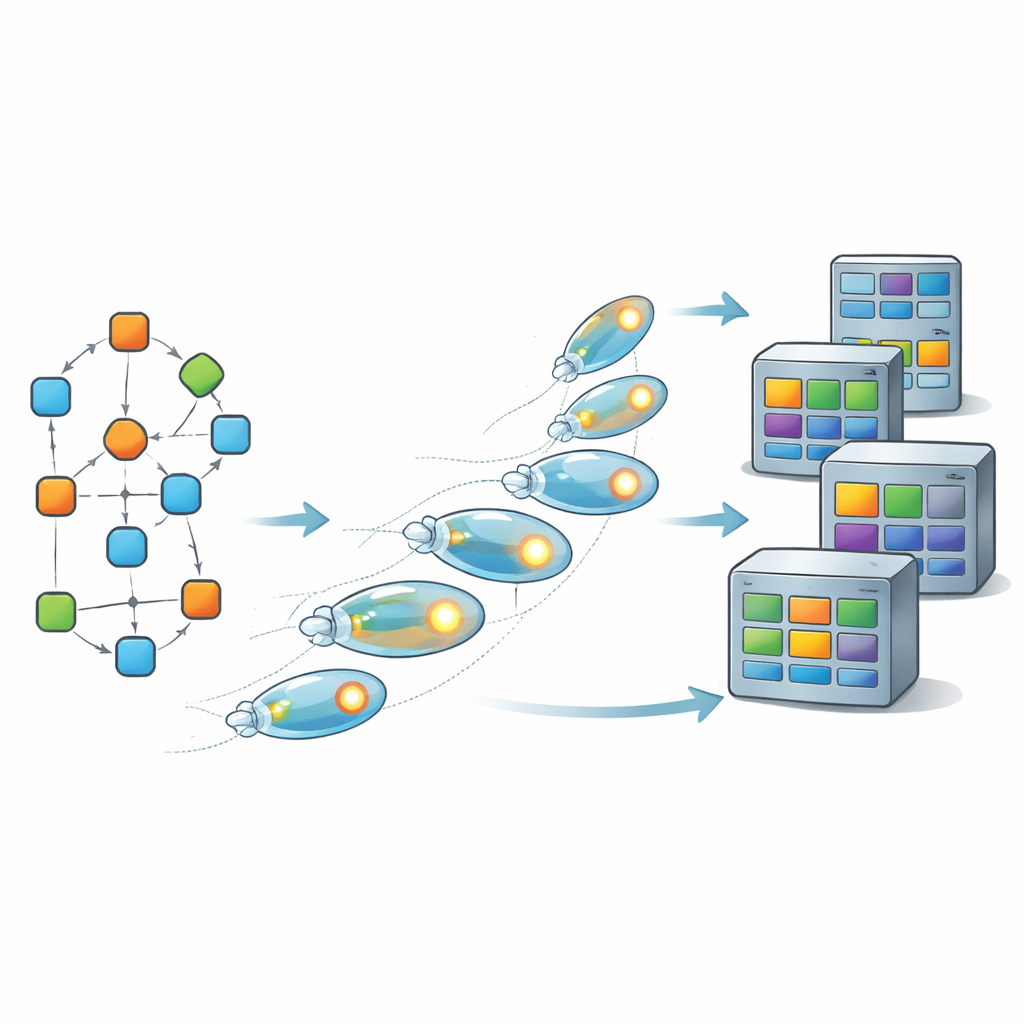
Large scientific and business applications rarely run as a single program. Instead, they are decomposed into many smaller tasks that depend on one another. Researchers represent this structure as a directed acyclic graph: nodes stand for tasks, and arrows show which results must be produced before other tasks can begin. In a cloud data center, these tasks are mapped onto virtual machines—software-based computers that differ in speed, memory, and network capacity. The challenge is to decide which task should run on which machine, and when, so that the entire workflow finishes as soon as possible while making good use of resources.
Why finding the best plan is so hard
Choosing an ideal schedule for thousands of interdependent tasks across many different machines is a classic example of a so‑called NP-hard problem: the number of possible assignments explodes so quickly that checking all of them is impossible in practice. Because of this, cloud systems rely on clever shortcuts, known as heuristics and metaheuristics, to search for good—but not guaranteed perfect—solutions. Traditional rules such as first-come-first-served or round robin are simple but wasteful at scale. More advanced approaches, including genetic algorithms, particle swarm optimization, and ant colony optimization, search more intelligently but can still get stuck in mediocre solutions, require careful parameter tuning, or ignore important task dependencies.
Learning from salp chains in the ocean
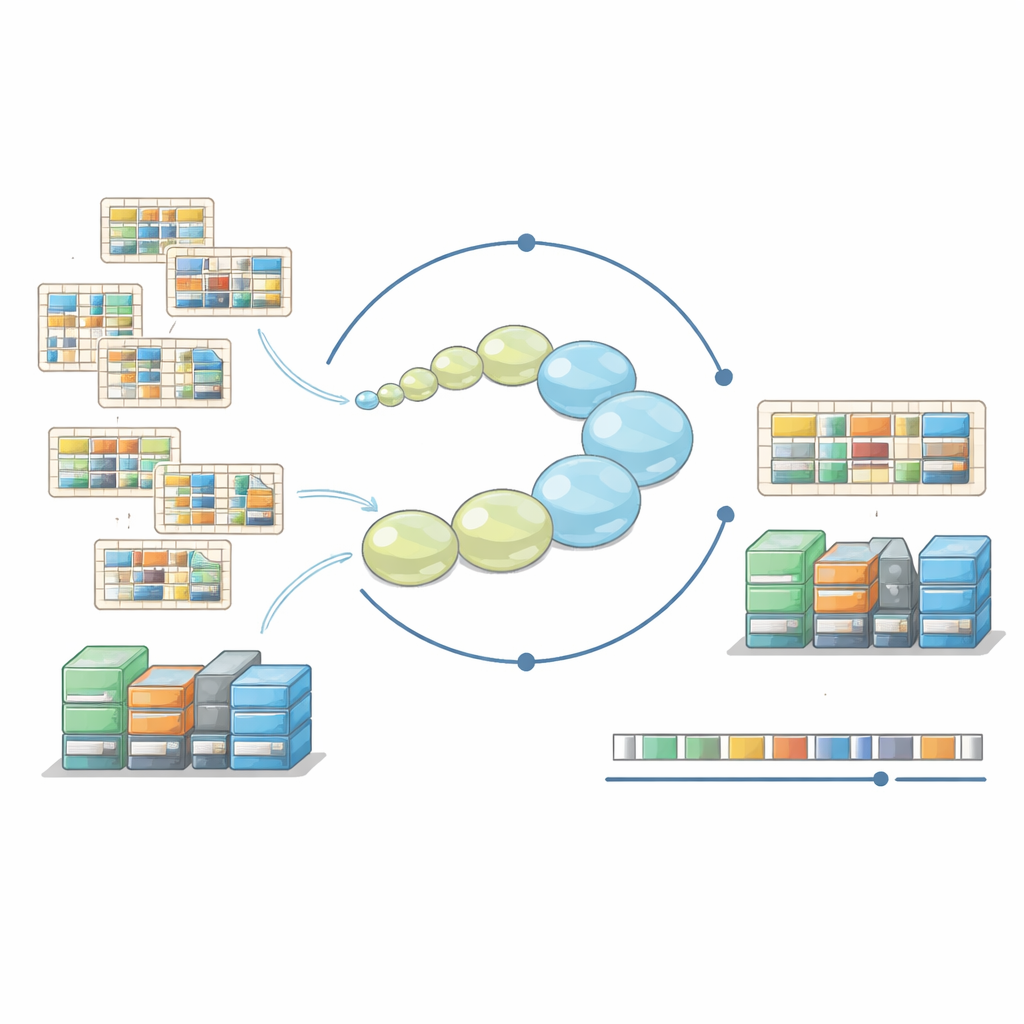
The new method, called WS-SSA, adapts the Salp Swarm Algorithm to the realities of cloud workflows. In nature, salps move through the sea in chains with a leader at the front and followers behind, adjusting course as they search for food. WS-SSA treats each possible scheduling plan as one member of such a chain. The best known plan plays the role of “food,” guiding the movement of the leader schedule, while the followers gradually adjust toward promising regions. A key design choice is that each position in this artificial swarm directly encodes which virtual machine runs each task, using simple integers rather than continuous values that must later be translated. Combined with a careful ordering of tasks that always respects their dependencies, this ensures that every candidate schedule considered by the swarm is valid and immediately executable.
Putting the new planner to the test
To see how well WS-SSA performs, the authors ran extensive simulations using WorkflowSim, a toolkit that mimics real scientific workflows on top of the widely used CloudSim environment. They tested five benchmark applications from astronomy, seismology, gravitational-wave physics, and bioinformatics, with workflow sizes ranging from a few dozen to a thousand tasks and cloud setups ranging from a handful to a hundred virtual machines. WS-SSA was compared against six classic scheduling rules and three modern metaheuristic methods, including the whale optimization algorithm, genetic algorithms, and particle swarm optimization. The main score was the total completion time, or makespan, while total energy use by the virtual machines was tracked as a closely related secondary measure.
What the results mean for time and energy
Across this wide set of experiments, WS-SSA consistently produced faster schedules than competing methods. On average, it reduced makespan by roughly a third compared with traditional heuristics, and still gained several to more than twenty percent over well-established metaheuristics. Because idle time and wasted computation were also reduced, total energy consumption fell in parallel—often by similar margins—without requiring the algorithm to explicitly optimize for power use. Statistical tests over 30 independent runs confirmed that these improvements were not due to chance, especially for larger and more complex workflows. The study shows that a simple, discrete version of the salp-inspired strategy can reliably navigate the enormous space of possible schedules and adapt to different workflow structures and machine configurations.
Faster science with leaner clouds
In everyday terms, WS-SSA is a smarter traffic controller for the data highway that underpins modern science and cloud services. By coordinating when and where each task runs, it shortens the time between launching a complex job and getting the final result, while trimming the energy bill for the underlying data centers. The work does not change how workflows themselves are defined; instead, it offers a more efficient way to run them on existing cloud platforms. Future extensions that consider cost, energy, and deadlines all at once could make such swarm-inspired schedulers an important tool for greener, more responsive computing infrastructures.
Citation: Sharawy, A.A., Sakr, R.H., Eladrosy, W. et al. WS-SSA: workflow scheduling in cloud computing using salp swarm algorithm. Sci Rep 16, 13402 (2026). https://doi.org/10.1038/s41598-026-48037-w
Keywords: cloud workflow scheduling, metaheuristic optimization, salp swarm algorithm, scientific computing, energy-efficient cloud