Clear Sky Science · en
Impact of construction and demolition wastes on the performance of sustainable LC3-based structural lightweight concrete
Turning Building Rubble into Strong New Structures
Every year, mountains of broken bricks and concrete from demolished buildings pile up in landfills, while making fresh cement pours more carbon dioxide into the atmosphere than almost any other building material. This study asks a timely question: can yesterday’s rubble become tomorrow’s low‑carbon, lightweight building material—strong enough for real structures, not just filler? The researchers show how carefully processed brick and concrete waste can replace much of the most polluting part of cement, cutting emissions while still meeting international standards for structural concrete.
Why Lighter, Greener Concrete Matters
Concrete’s hidden cost is its weight and its climate footprint. Heavier structures need more material in columns and foundations, and ordinary cement production releases large amounts of greenhouse gases. Lightweight concrete helps by reducing the “dead load” of buildings, allowing slimmer elements and smaller foundations, which in turn saves materials and energy. At the same time, construction and demolition waste—especially old bricks and concrete—creates its own environmental headache when simply dumped. This work brings these two challenges together, exploring whether waste materials can both lighten concrete and slash the need for fresh cement.
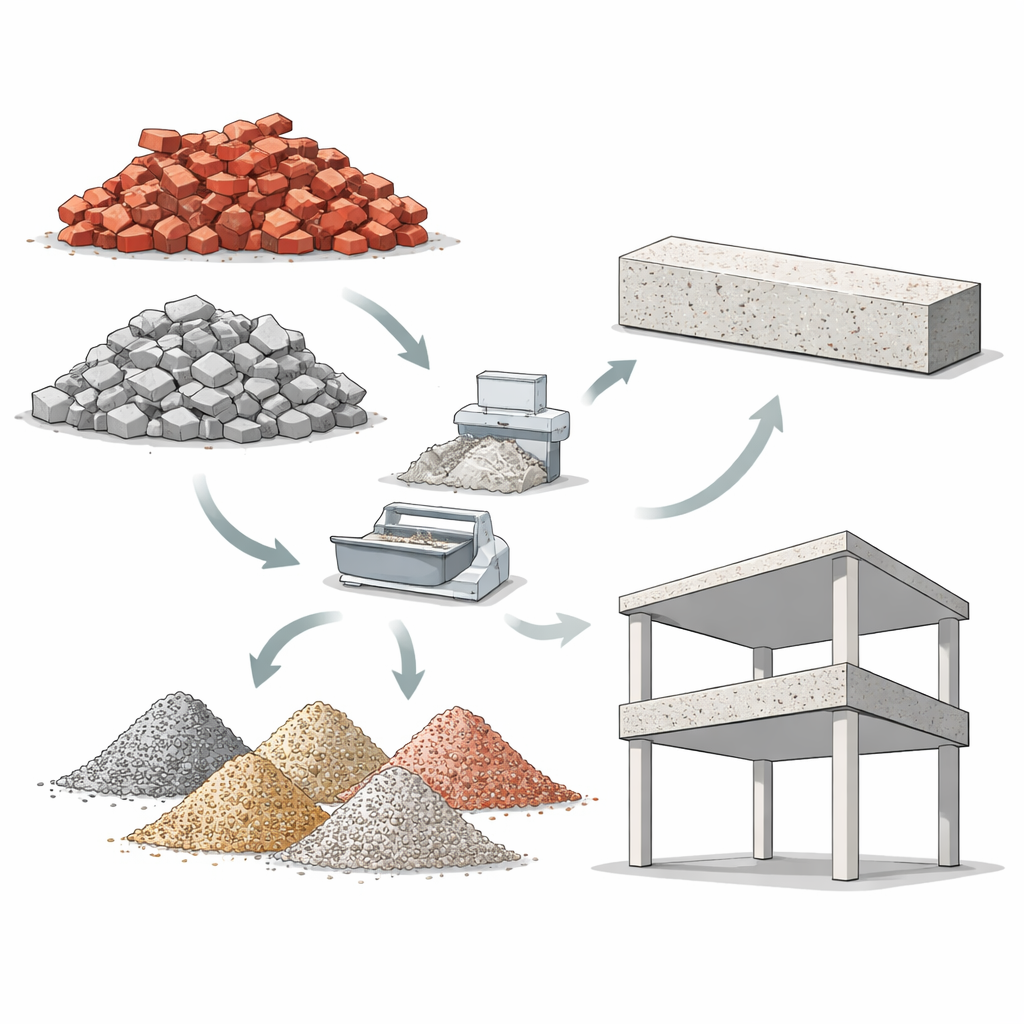
From Rubble to Building Blocks
The team focused on a newer, lower‑carbon binder called limestone calcined clay cement, or LC3. Instead of relying mostly on traditional cement clinker, LC3 blends it with limestone powder and a heat‑treated clay. In this study, the researchers swapped the usual ingredients for waste‑derived ones: finely ground brick powder took the place of the special clay, and recycled concrete powder replaced limestone powder. Old bricks were also crushed and used as both fine and coarse aggregates, while a small amount of air‑entraining additive introduced tiny bubbles to further cut weight. In total, nine different concrete mixes were prepared, all with the same basic proportions of water, binder, and brick aggregates, but with varying amounts and types of the waste powders.
Testing Strength, Durability, and Heat Resistance
To judge whether these mixes were more than just eco‑friendly experiments, the researchers put them through a demanding suite of tests. They measured how easily the fresh concrete flowed, how dense it became after drying, and how sound waves traveled through it—an indicator of internal quality. They tracked how its compressive strength grew over 7, 28, and 90 days, and whether it could still perform as structural lightweight concrete under European design rules. Durability was probed by soaking samples in a harsh magnesium sulfate solution for up to six months, a stand‑in for aggressive soils and seawater, and by heating them to 200 and 400 degrees Celsius to mimic fire or high‑temperature exposure. Water absorption and overall pore content were also checked, since more open, thirsty concrete is usually more vulnerable over time.
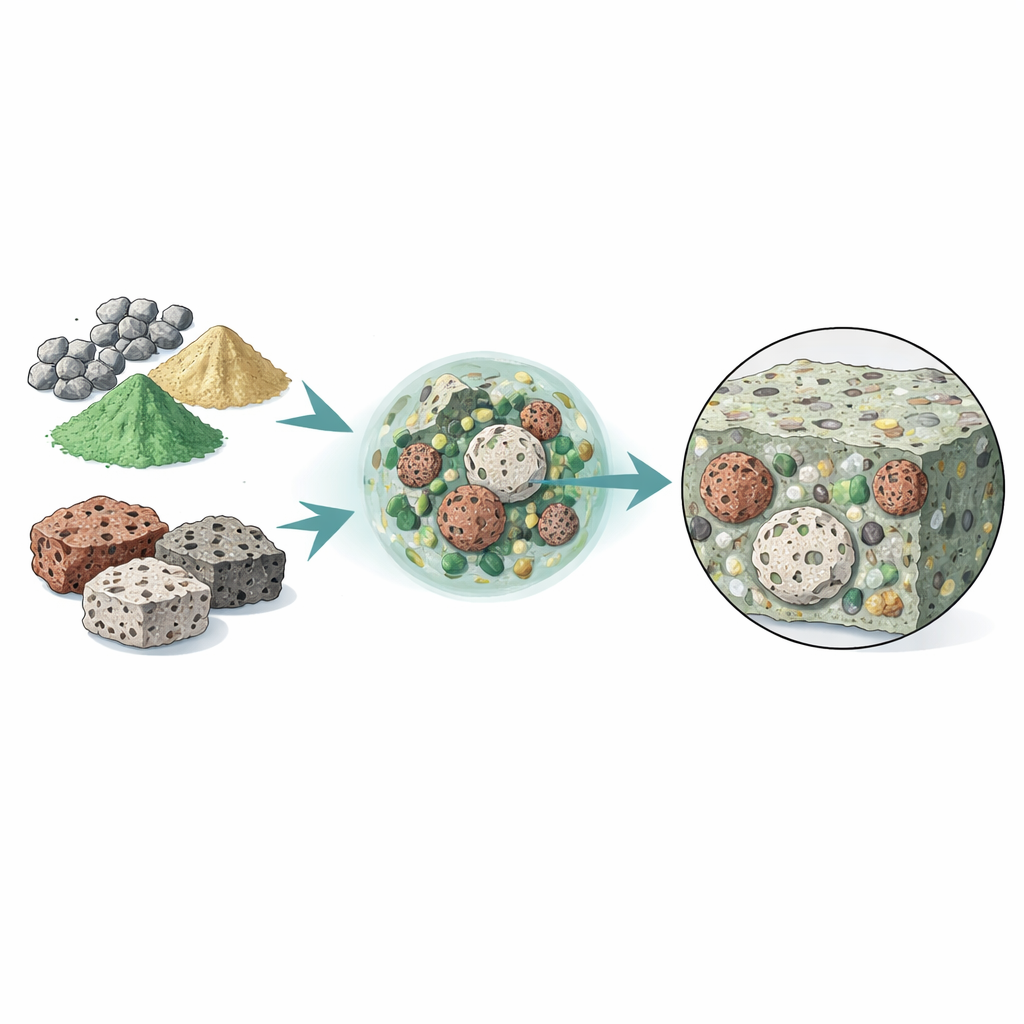
How the Waste‑Based Concrete Performed
The surprising result is that mixes using crushed brick powder in the binder behaved very much like those using the more refined commercial clay, with only a small drop in strength and a modest rise in water uptake. Even with up to 60% of the clinker replaced, all of these concretes reached 28‑day strengths between about 24 and 38 megapascals and dry densities between 1650 and 1850 kilograms per cubic meter—comfortably within the range for structural lightweight concrete. Recycled concrete powder proved a rougher substitute for limestone powder: concretes that used it were somewhat weaker and more porous, reflecting the more irregular, porous nature of this waste. Still, every mix that relied on waste powders and brick aggregates met the threshold for structural use. Across the board, the LC3‑based mixes stood up well to harsh conditions, losing less than 0.7% of their mass under long sulfate exposure and retaining more than 80% of their strength after heating to 400 degrees Celsius.
What This Means for Future Buildings
For non‑specialists, the bottom line is that concrete made largely from ground‑up bricks and old concrete—combined in a carefully tuned low‑carbon binder—can be both light and strong enough for real buildings. There are trade‑offs: waste‑rich mixes absorb more water and, when recycled concrete powder is used, sacrifice some strength compared with the best conventional blends. But they still meet structural standards while replacing much of the most carbon‑intensive cement and giving a second life to demolition debris. This points to a future where the skeletons of new buildings could be made from the remains of old ones, cutting emissions, saving raw materials, and shrinking the footprint of construction waste without giving up safety or performance.
Citation: Sadik, E.K., Elrahman, M.A., Eltawil, K.A. et al. Impact of construction and demolition wastes on the performance of sustainable LC3-based structural lightweight concrete. Sci Rep 16, 13397 (2026). https://doi.org/10.1038/s41598-026-48036-x
Keywords: sustainable concrete, construction waste recycling, lightweight concrete, low carbon cement, recycled brick and concrete