Clear Sky Science · en
Development of a bioassay-guided genome mining approach for antifungal natural product discovery from pseudomonads
Why wheat farmers should care
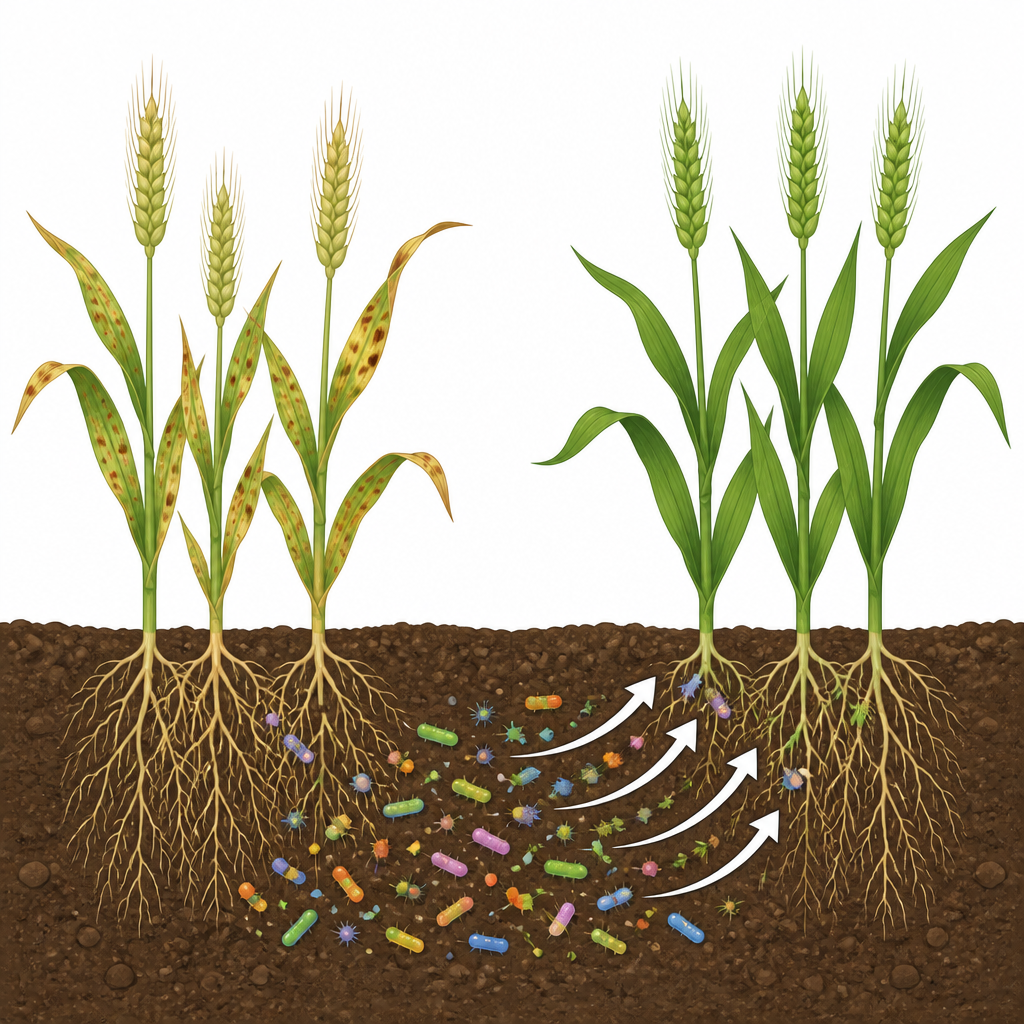
Wheat is a staple food around the world, yet a single leaf disease can wipe out almost half of a crop. In the UK and many other countries, a fungus called Zymoseptoria tritici causes Septoria leaf blotch, a disease that has already shrugged off most available fungicides and outsmarted wheat’s genetic resistance. This study explores a different line of defence: recruiting helpful soil bacteria that naturally produce antifungal chemicals, and using modern genetics to discover which of their hidden molecules can keep this damaging wheat disease in check.
Looking for friendly microbes in the soil
The researchers began with a large collection of 534 Pseudomonas bacteria isolated from wheat roots. These bacteria are common members of the soil and root community and are known to include strains that protect plants. To see which of them could slow the wheat fungus, the team developed a simple petri dish test. They spread a dense lawn of fungal spores across agar and then spotted different bacterial strains on top. If a bacterium secreted something harmful to the fungus, a clear halo formed around the colony where the fungus failed to grow. Using this high throughput screen, they found 52 bacterial isolates that visibly suppressed the fungus in vitro.
Measuring how strongly fungus and bacteria clash
Next, the team wanted to know not just whether bacteria could stop the fungus, but how strongly they did so and whether all fungal strains responded the same way. They selected 5 strongly antagonistic and 6 non-antagonistic Pseudomonas isolates and tested them against 12 genetically diverse fungal isolates collected from across Europe. By carefully measuring the radius of the clear zones around each bacterial colony, they showed that all five antagonistic bacteria suppressed growth of every fungal isolate, while non-antagonistic bacteria never produced a clear zone. Importantly, the size of the clear zones varied significantly between fungal genotypes, revealing that natural populations of the wheat pathogen differ in how sensitive they are to bacterial attack.
Reading bacterial genomes to find antifungal chemistry
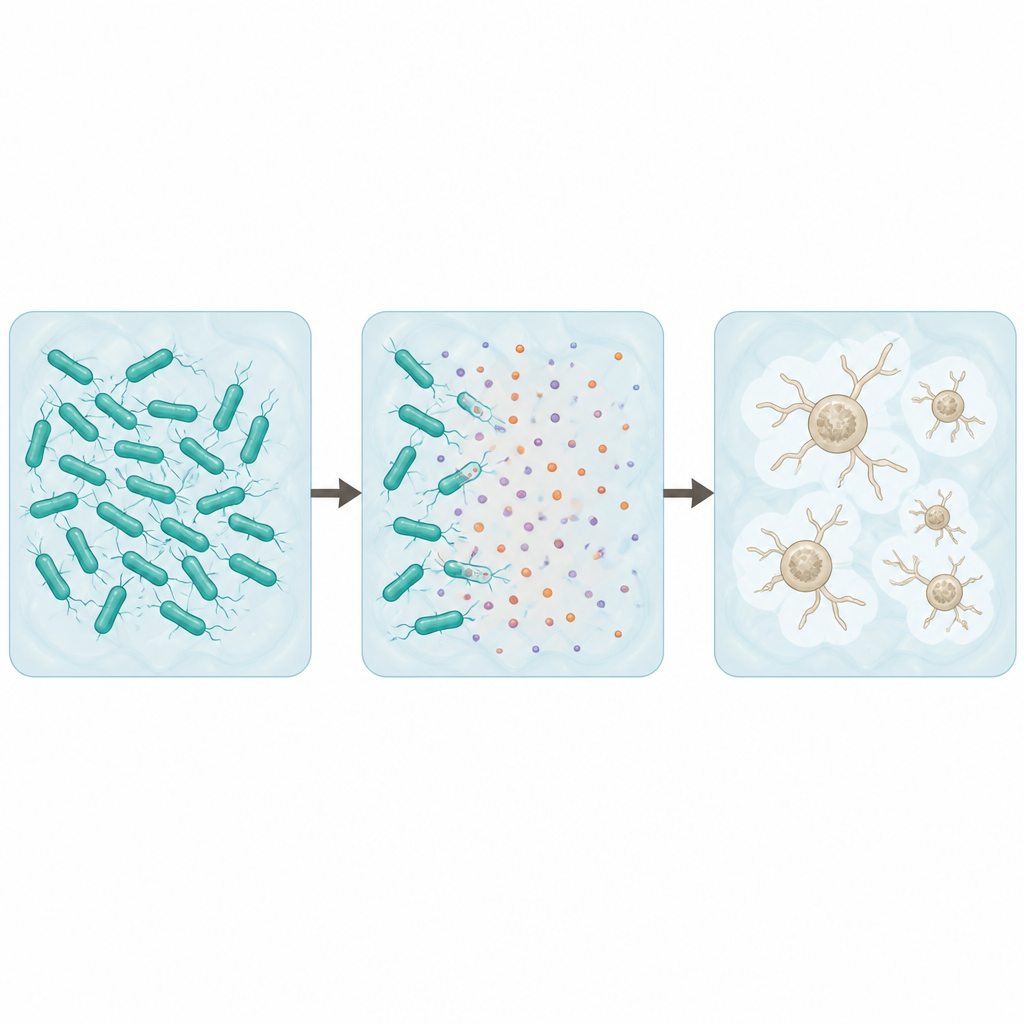
To understand which bacterial genes and molecules were behind this suppression, the researchers sequenced the genomes of the 11 tested Pseudomonas strains. They used specialised software to scan each genome for biosynthetic gene clusters, stretches of DNA that encode the enzymes required to build complex secondary metabolites such as antibiotics. This analysis predicted 131 such clusters, grouped into families based on sequence similarity and compared with a reference database of known natural product genes. Several gene cluster families were found only in the antagonistic strains, making them prime candidates for producing antifungal compounds. A key family matched genes known to synthesise 2,4-diacetylphloroglucinol, or 2,4-DAPG, a well-studied antifungal molecule.
Proving one molecule’s role in stopping the fungus
One standout bacterium, named Roth82, carried this 2,4-DAPG gene cluster and showed strong suppression of the wheat fungus. To test whether 2,4-DAPG was truly responsible, the team knocked out a central gene in the cluster, phlD, which is essential for building the molecule’s core. The mutant bacterium lost its ability to create a visible clear zone on the fungal lawn. Chemical analysis of agar around the colonies using liquid chromatography–mass spectrometry confirmed that the wild type strain produced 2,4-DAPG, while the mutant did not. This tight link between gene disruption, loss of the molecule and loss of antifungal activity validates their combined bioassay and genome mining strategy.
What this means for future crop protection
This research shows that soil bacteria associated with wheat roots can produce potent antifungal compounds, and that a simple plate assay combined with genome analysis can reveal which genes and molecules are responsible. It also highlights that the wheat pathogen itself varies in how easily it is suppressed, hinting at an arms race between fungi and bacteria in the field. While these tests were done in the lab and may not directly translate to performance on leaves in real fields, the approach provides a powerful way to discover and prioritise natural antifungal products. In the long run, such molecules, or the bacteria that make them, could help diversify the toolbox for protecting wheat and other crops when traditional fungicides no longer work.
Citation: Lund, G., Mosquito, S., Withall, D.M. et al. Development of a bioassay-guided genome mining approach for antifungal natural product discovery from pseudomonads. Sci Rep 16, 15990 (2026). https://doi.org/10.1038/s41598-026-48020-5
Keywords: wheat disease, soil bacteria, natural antifungals, Pseudomonas, Septoria leaf blotch