Clear Sky Science · en
Temporal forecasting of electric vehicle charging load using an IVY-VMD-TCN-BiLSTM model with cross-zone evaluation
Why electric car charging patterns matter
As electric vehicles become common on city streets, their charging habits can strain local power grids in sudden and unpredictable ways. Knowing in advance when and where drivers will plug in is vital for keeping the lights on, avoiding costly grid upgrades, and giving drivers convenient charging options. This study presents a new way to forecast short term electric vehicle charging demand in a big city, aiming to help utilities plan ahead with far greater accuracy.
From simple guesses to data rich predictions
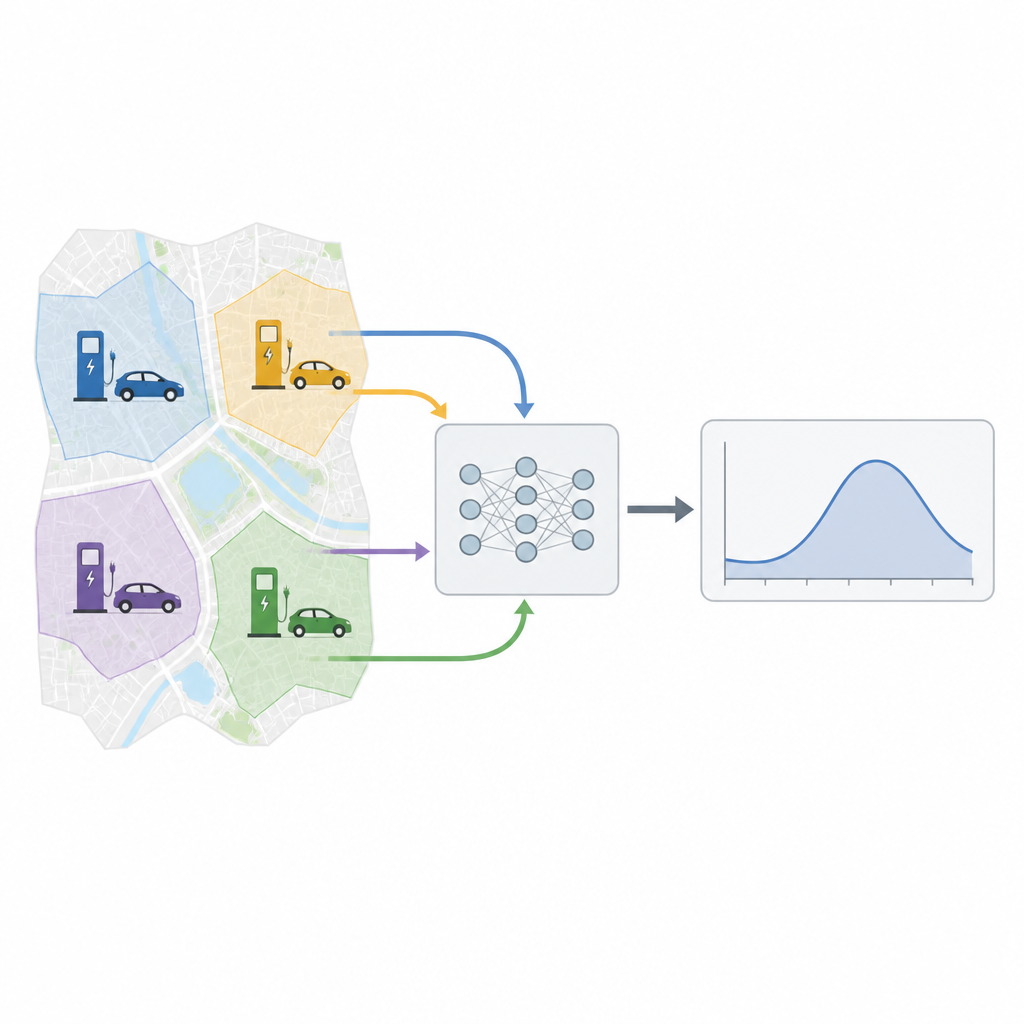
Older forecasting methods often tried to model how people travel and charge using simplified rules or probability. These approaches struggle in modern cities, where charging stations are unevenly spread out and behavior changes with traffic, weather, and prices. The authors instead turn to data driven tools that learn patterns directly from large datasets. They use real charging records from 275 zones in Shenzhen, China, along with information such as temperature, humidity, station occupancy, and prices, to build a more flexible forecasting system that can adapt to complex urban conditions.
Breaking a noisy signal into clearer pieces
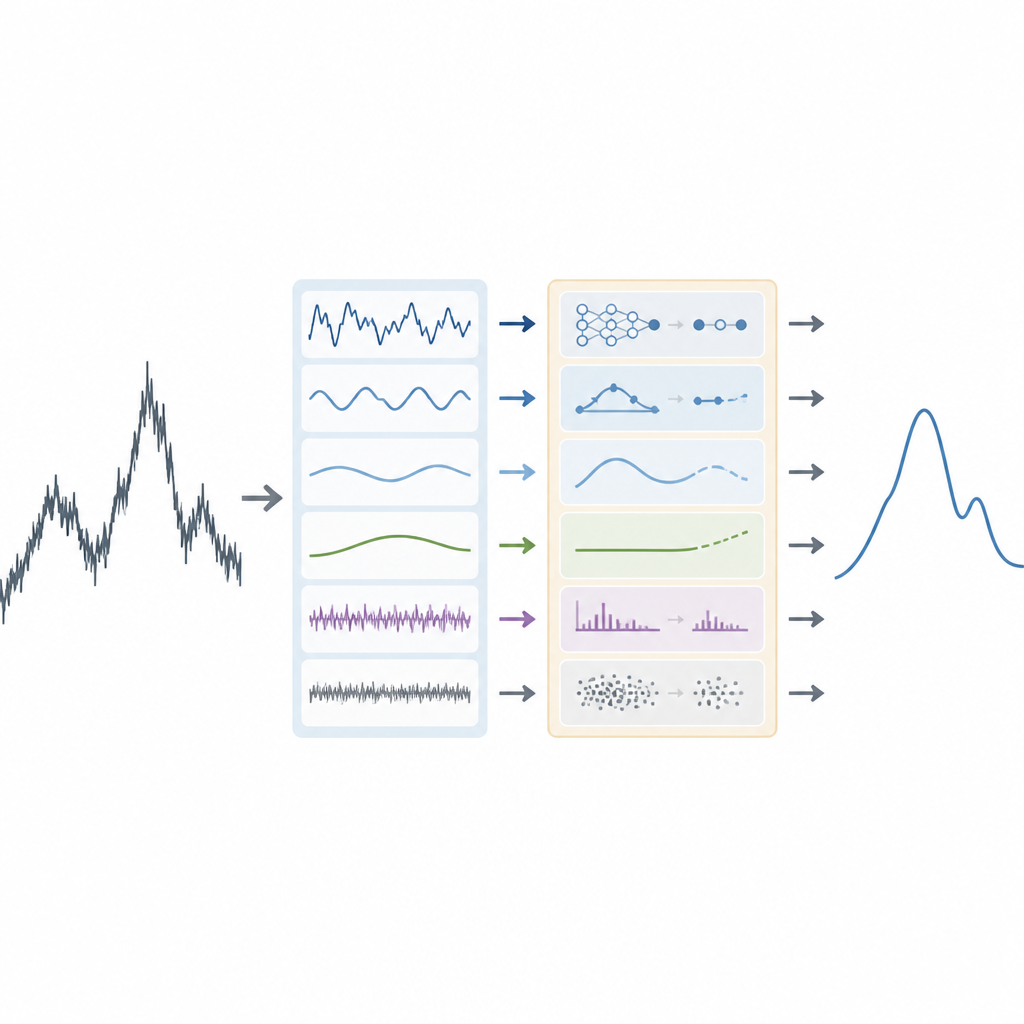
Electric vehicle charging demand jumps up and down because of work schedules, weekends, holidays, and weather, which makes it hard to predict. To tackle this, the study first cleans and reshapes the load data using an advanced signal processing step. The method, called variational mode decomposition, splits the raw charging curve into several simpler components that each capture a particular rhythm or pattern. A nature inspired search procedure, modeled on how ivy plants grow toward light, automatically chooses how many components to extract and how long to refine them. This reduces guesswork, filters out noise, and highlights the regular cycles hidden in the data.
Letting two time aware networks work together
Once the charging signal has been separated into smoother pieces, each piece is fed into a forecasting engine that combines two kinds of neural network. The first, a temporal convolutional network, is good at spotting short and medium term trends by sliding small filters along the time axis. The second, a bidirectional long short term memory network, looks both forward and backward in time to understand how past and anticipated patterns connect. The same ivy inspired optimizer fine tunes the key settings of this combined model, such as how many filters it uses and how strongly it guards against overfitting, so that it can learn rich patterns without becoming unstable.
How well the method works in the real city
To test the approach, the authors train and compare several versions of their model using six months of hourly data. They show that the full pipeline with both the decomposition step and the optimized dual network predicts future charging loads much more accurately than simpler models or those tuned with other popular search procedures. Errors in the forecast drop to roughly half of what they are for basic neural networks, and the model tracks sharp peaks and valleys far better. The researchers also check how the method performs in different kinds of neighborhoods, such as mostly residential areas and busy commercial zones, which have very different charging rhythms.
What this means for grids and drivers
The study finds that the new method captures both smooth daily cycles and sudden shifts in charging behavior, reaching a very tight match with real world data in both home focused and business focused districts. While commercial areas with fast changing traffic still pose a tougher challenge, accuracy remains high. For a lay reader, the key message is that by carefully cleaning the data and letting two complementary learning tools cooperate, utilities can gain a much clearer short term view of upcoming electric vehicle charging demand. This insight can support smarter pricing, better placement and operation of chargers, and more reliable grid service as electric cars continue to spread.
Citation: Zhang, W., Ma, B. & Wang, D. Temporal forecasting of electric vehicle charging load using an IVY-VMD-TCN-BiLSTM model with cross-zone evaluation. Sci Rep 16, 16101 (2026). https://doi.org/10.1038/s41598-026-47962-0
Keywords: electric vehicle charging, load forecasting, smart grid, time series modeling, urban energy planning