Clear Sky Science · en
A modified HIV model with Beddington–DeAngelis incidence and cure rate
Why this study matters
HIV is often described in terms of viral load counts and drug regimens, but beneath those numbers lies a complex battle inside the body. This paper uses mathematics as a kind of microscope to explore how HIV, immune cells, and treatment-like effects interact over time. By building a more realistic equation-based model of infection inside one person, the authors show which factors tip the balance between virus clearance, long term control, or persistent disease, offering insights that can guide future therapies and vaccine strategies.
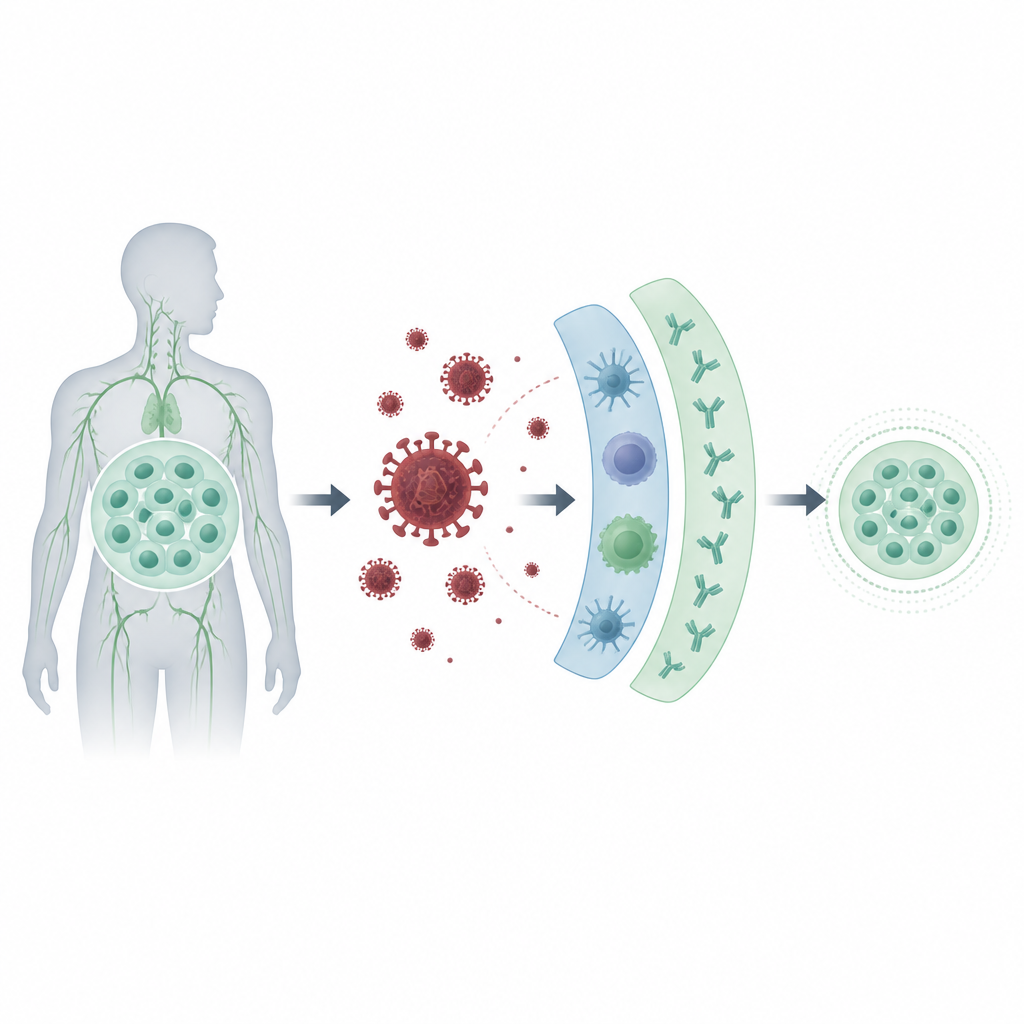
Looking inside the HIV battle
The authors focus on what happens within a single person after HIV enters the bloodstream. They track five key players: healthy immune cells that HIV targets, infected cells that produce new virus, free virus particles, killer immune cells that destroy infected cells, and antibodies that neutralize virus outside cells. Instead of running lab experiments, they write a system of equations that describes how each of these populations grows, dies, and interacts from moment to moment. This within host view helps bridge the gap between clinical measures like viral load and the hidden processes that create them.
A smarter way to describe infection
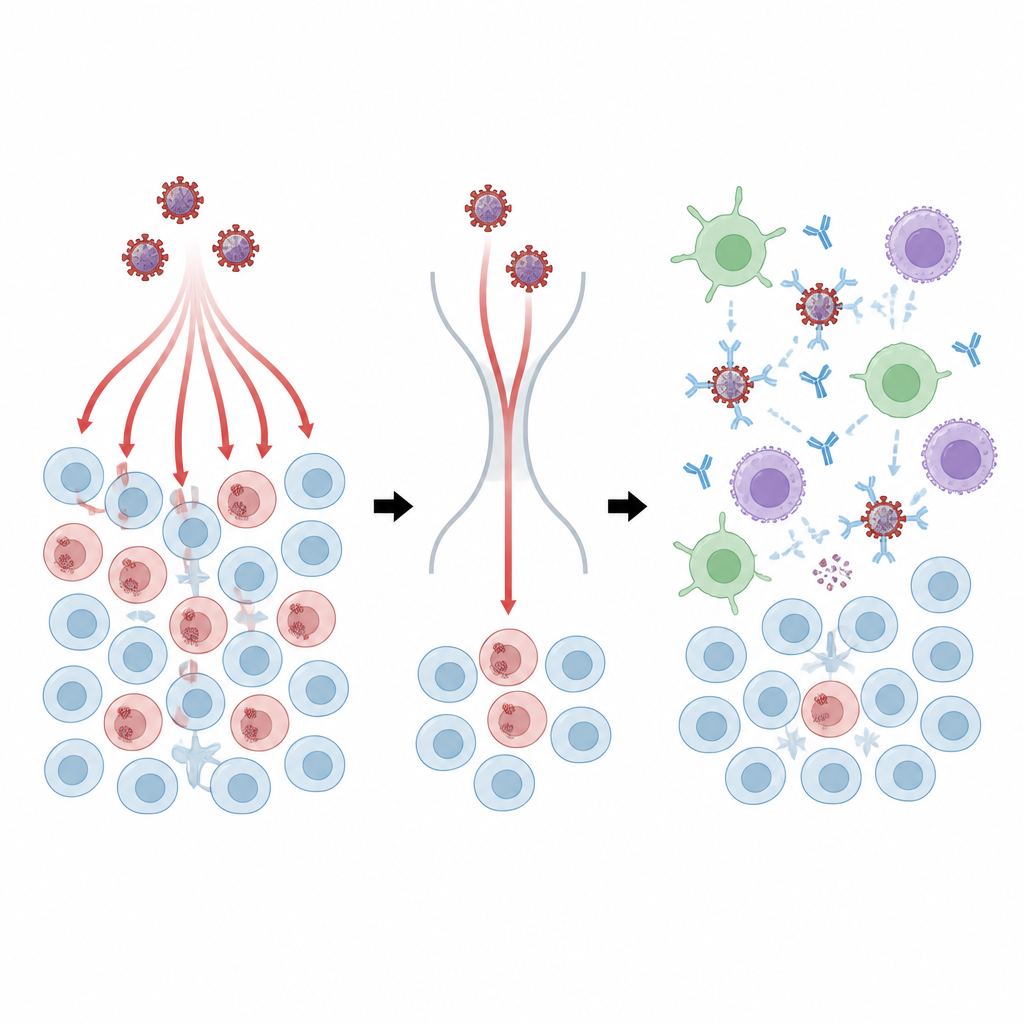
Classic HIV models assume that the infection rate simply rises in direct proportion to how many target cells and viruses are present. In reality, infection does not keep speeding up forever. Cells become scarce, viruses interfere with one another, and the immune system imposes limits. To capture this, the authors adopt a more flexible infection rule that slows down when either cells or virus are plentiful, preventing unrealistically explosive spread. They also allow some infected cells to be “cured” and return to the healthy pool, a process that stands in for the effects of potent drugs or rapid immune clearance. In addition, healthy immune cells grow in a self limiting way, so they cannot increase without bound.
Adding both arms of the immune defense
Many earlier models focused on one part of the immune system at a time. Here, the model includes both cellular defenders that kill infected cells and antibodies that bind to free virus. These two arms are activated by different triggers and act in different places, so combining them in a single framework is important. Through careful analysis of the equations, the authors derive a key threshold number that summarizes how easily HIV can establish itself. If this threshold is at or below one, infection ultimately fades; if it is above one, the system settles into a long term state where virus, target cells, and immune responses coexist.
Testing the model on a computer
To see what their equations imply in practice, the researchers run detailed computer simulations. They pay special attention to two saturation parameters that control how quickly infection slows as cells or virus become abundant. Raising the parameter that reflects limited target cells can push the system below the threshold and clear infection. Raising the parameter that reflects viral interference mainly lowers the long term viral level without eliminating it. They also compare scenarios with no immune response, only killer cells, only antibodies, and both. The combination of the two defenses gives the strongest control, with higher healthy cell counts and lower virus levels. To ensure that numerical experiments do not introduce artificial behavior, the authors design a special step by step scheme that preserves the key stability and positivity properties of the original model.
What the results mean for HIV control
Taken together, the work shows that small changes in infection efficiency, cure like processes, and immune strength can shift the outcome from persistent disease to effective control. The model highlights several levers for therapy, such as reducing the success rate of new infections, boosting the chance that infected cells are rendered harmless, and supporting both cellular and antibody responses. While the study does not test specific drugs in patients, it offers a clear, logically consistent picture of how different interventions might interact inside the body, helping researchers reason about combinations that move the system toward low viral load and preserved immune function.
Citation: Ramadan, S., Salman, S. & EL-Sayed, A. A modified HIV model with Beddington–DeAngelis incidence and cure rate. Sci Rep 16, 16284 (2026). https://doi.org/10.1038/s41598-026-47946-0
Keywords: HIV dynamics, immune response, mathematical model, viral load, treatment strategies