Clear Sky Science · en
Experimental investigation of sustainable concrete production using ceramic waste powder as partial fine aggregate replacement
Turning Broken Tiles into Stronger Concrete
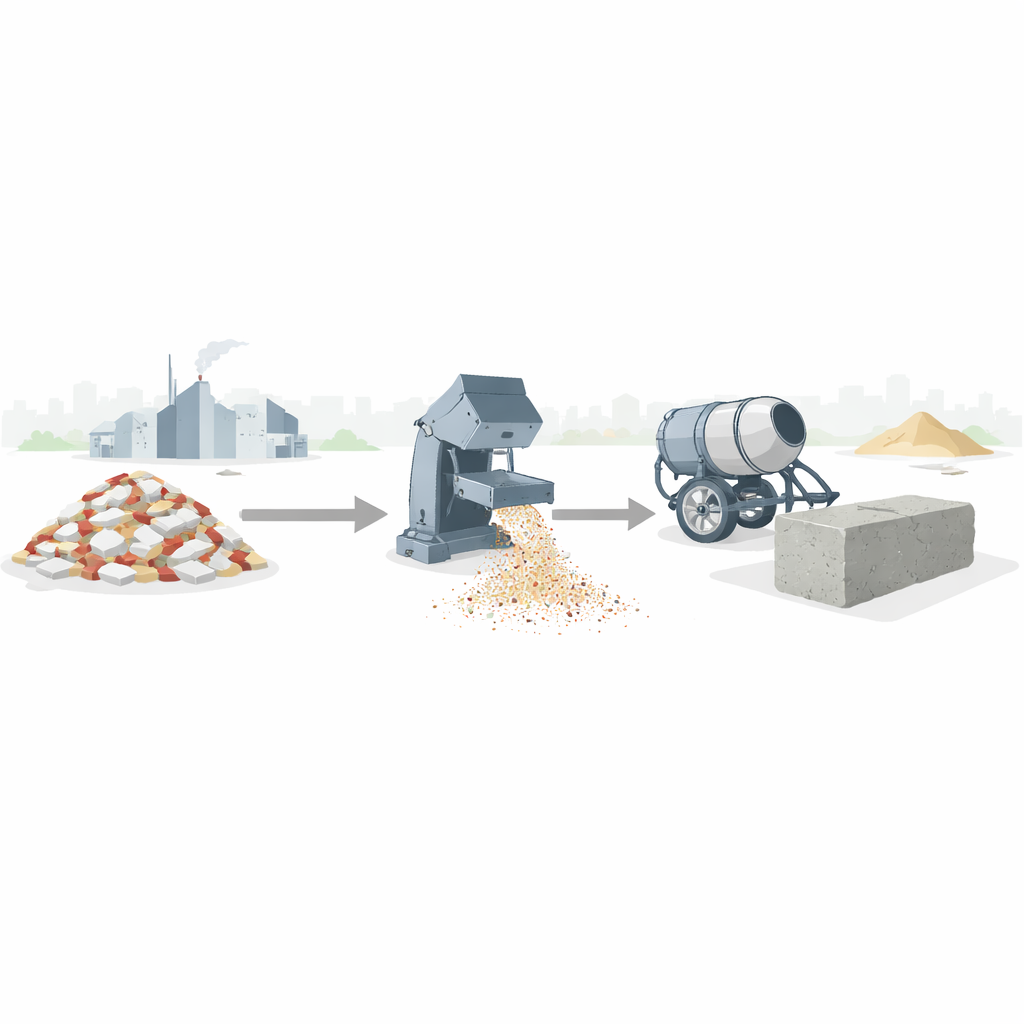
Every year, ceramic tile factories around the world throw away huge piles of cracked and miscut tiles. In the Pakistani city of Faisalabad alone, more than a million tons of ceramic waste are generated annually, much of it dumped in the open. This study asks a simple but powerful question: instead of treating these piles as useless trash, could the ground-up tiles be blended into concrete to save natural sand, cut costs, and even make buildings more durable?
From Factory Waste to Fine Powder
The researchers began by visiting several large ceramic factories in Faisalabad to confirm that the waste stream was abundant, free, and easy to collect. Broken floor tiles from three major plants were washed, dried, crushed, and ground into a fine powder, with grain sizes similar to those of natural sand. Chemical tests showed that this powder is rich in silica, the same key ingredient that helps give concrete its stone-like strength. That meant the tile powder was not just an inert filler; it had the potential to interact beneficially with the cement.
Mixing New Concrete Recipes
Next, the team produced a series of concrete mixes in which ceramic powder replaced part of the natural fine aggregate (sand) by volume. They tested six levels of replacement: 0% (ordinary concrete), 10%, 20%, 30%, 40%, and 50%. For each mix, they measured how easy the fresh concrete was to place and shape, and then, after curing, how heavy, strong, and water-absorbing it became. Standard tests captured compressive strength (how much pressure the concrete can bear), tensile and flexural strength (how well it resists cracking and bending), along with simple durability checks such as water absorption and behavior in an acidic environment.
Finding the Sweet Spot for Strength
The results revealed that a moderate amount of ceramic powder actually improves performance. At about 30% replacement of sand, the concrete’s ability to resist squeezing forces rose by roughly 10%, and its resistance to bending also increased. Water absorption dipped at this level, indicating a denser internal structure with fewer empty spaces. However, increasing the ceramic content beyond 30% reversed these gains: workability dropped sharply, more water was soaked up, and strengths declined as excessive powder introduced extra voids and disrupted the cement network. For cracking resistance specifically, a slightly lower 20% replacement gave the best splitting tensile strength, suggesting that different kinds of stress favor slightly different balances of ingredients.
What Happens Inside the Concrete
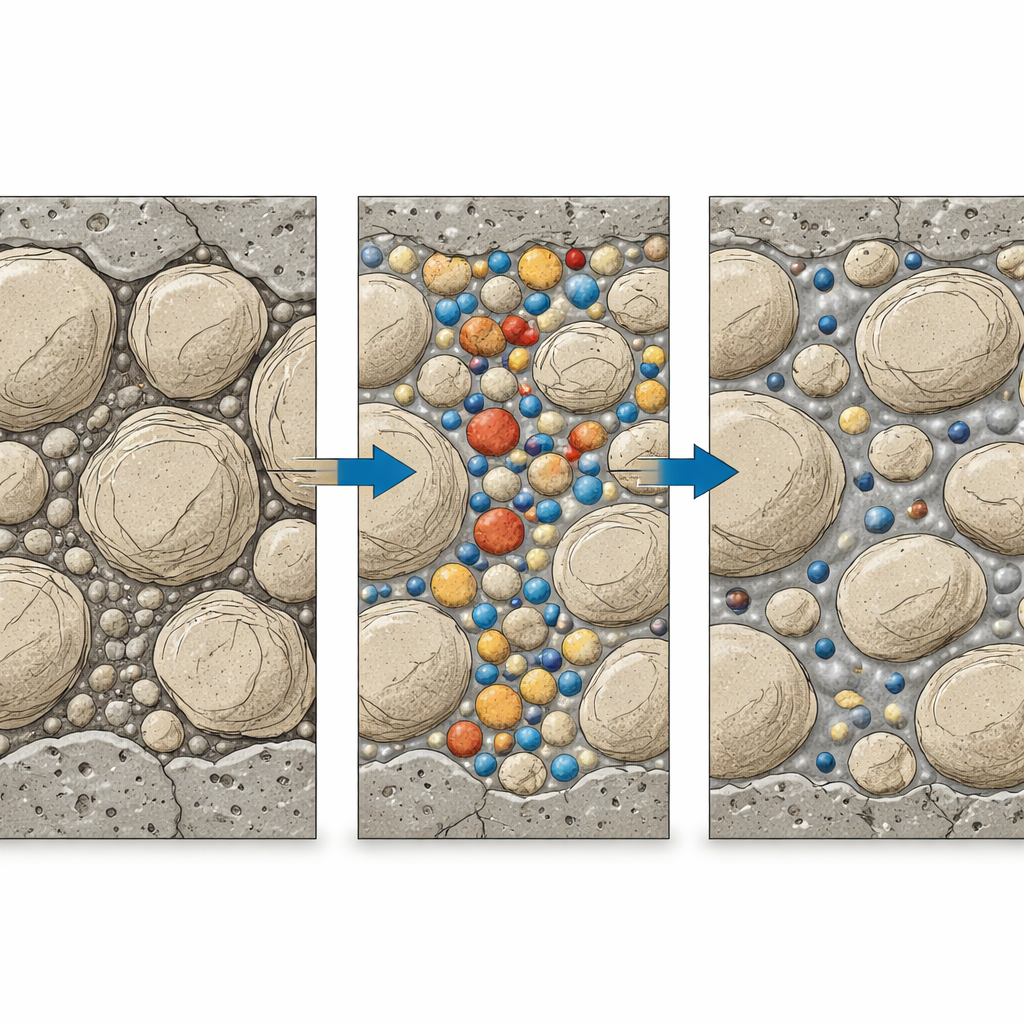
To understand why 30% worked so well, the researchers examined the hardened concrete using X-ray techniques that reveal its internal crystal structure. They found that at this level, the silica-rich ceramic powder helps consume a less useful cement by-product and turns it into more of the glue-like material that truly holds concrete together. The ceramic particles also pack tightly between sand and gravel grains, filling gaps and reducing microscopic pathways for water and aggressive chemicals. When the ceramic share rises too high, there is not enough cement left to form this bonding gel, and the structure becomes weaker and more porous again.
Environmental and Cost Benefits
Beyond the lab, the study highlights clear real-world advantages. Using ceramic waste powder up to 30% reduces the need for river sand, a resource whose extraction scars landscapes and ecosystems. It also diverts large volumes of tile waste away from landfills and open dumps, easing local pollution. In an economic comparison for a typical 3-cubic-meter batch of concrete, the mix with 30% ceramic powder was about 2.3% cheaper than conventional concrete, since the waste material itself cost essentially nothing. The ceramic-rich mix also stood up better in an aggressive acid bath, hinting at longer service life in harsh environments.
What This Means for Everyday Building
Put simply, this work shows that broken floor tiles do not have to end their lives on a trash heap. When ground into a fine powder and used in the right proportion, they can help produce concrete that is slightly stronger, denser, more durable, and cheaper, all while sparing natural sand and reducing waste. For builders, engineers, and city planners in rapidly growing regions, the message is encouraging: by thoughtfully reusing local industrial leftovers, it is possible to pour concrete that supports both sturdy structures and a more sustainable future.
Citation: Tariq, K.A., Adil, W.A., Salhi, A. et al. Experimental investigation of sustainable concrete production using ceramic waste powder as partial fine aggregate replacement. Sci Rep 16, 11659 (2026). https://doi.org/10.1038/s41598-026-47927-3
Keywords: ceramic waste concrete, sustainable building materials, recycled aggregates, green construction, industrial waste reuse