Clear Sky Science · en
Habitability at the edge of the redox boundary during the Permian–Triassic mass extinction
Life Clinging to the Edge
Roughly 252 million years ago, Earth experienced its worst known die-off: the end-Permian mass extinction, when about nine out of ten marine species vanished. This study asks a deceptively simple question with big implications for how life survives catastrophe: when most of the deep ocean turned starved of oxygen, were there still pockets of breathable water where marine life could hang on? By examining rock layers from ancient tropical seas in what is now central Iran, the authors explore how some shallow marine zones may have acted as last refuges during a global crisis. 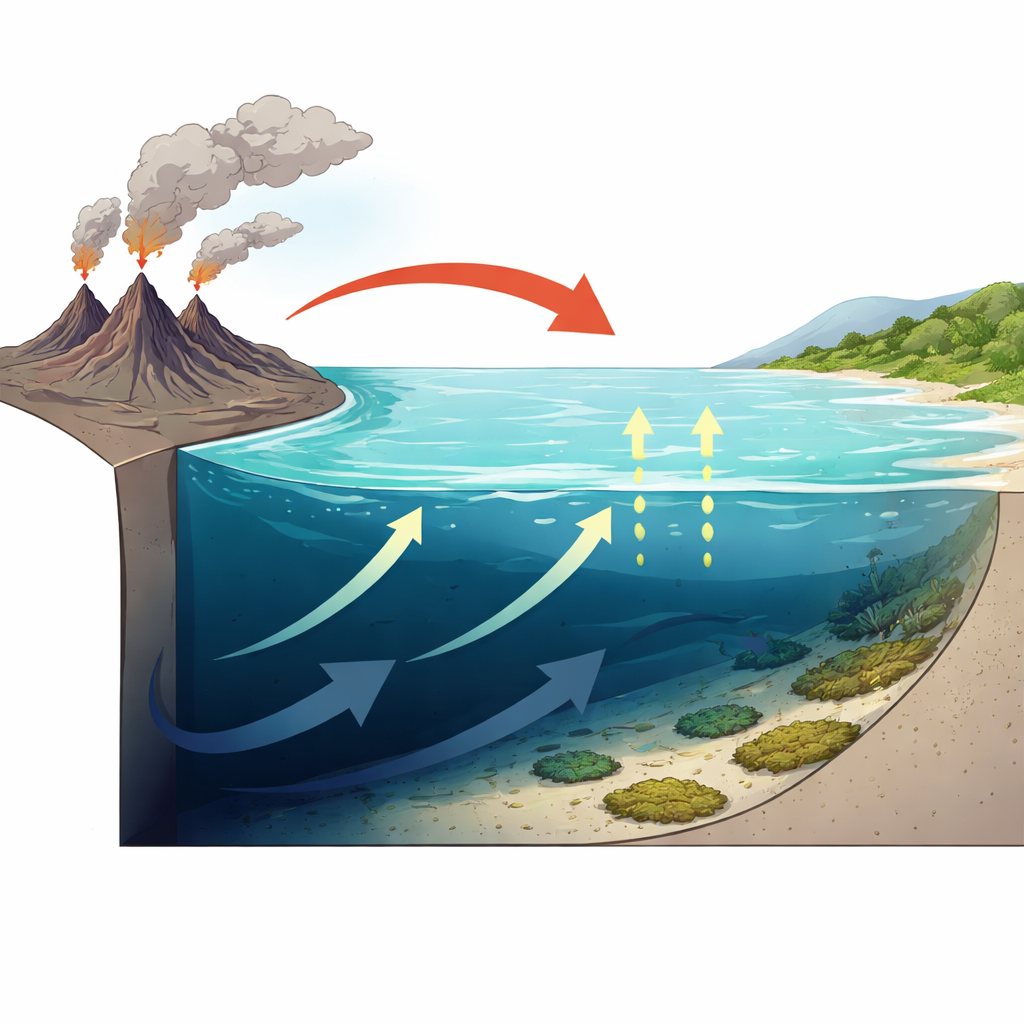
A Deadly Time in Earth’s History
The end-Permian crisis was driven by intense volcanic activity, particularly in Siberia, which released huge amounts of greenhouse gases. The climate warmed rapidly; surface waters in equatorial oceans heated into ranges that would be lethal for many organisms. Warming helped stratify the oceans, separating surface waters from deeper layers and promoting widespread loss of oxygen in the depths. Many researchers have pictured this as a nearly global “dead ocean,” but computer models and some fossil evidence suggest the picture was more patchy, with some regions—and some water depths—remaining livable.
Reading the Rocks of an Ancient Tropical Shelf
To test this idea, the team focused on two rock sections, Abadeh and Baghuk, that formed on a broad tropical shelf along the margin of the Tethys Ocean, near the equator. These sites are special because their sediments accumulated continuously across the extinction interval, preserving a detailed record rather than a broken one. The rocks include fossil-rich limestones from the Late Permian, curious knobby limestone structures built by microbial communities, and overlying thin-bedded limestones and black shales from the earliest Triassic. By combining field observations, fossil content, and measurements of many chemical elements and isotopes, the researchers reconstructed how oxygen and nutrients in these ancient seas changed through time.
Chemical Clues to Hidden Breathable Waters
Certain elements in the rocks act like trackers for ancient water conditions. Very low levels of uranium and molybdenum, along with high ratios of thorium to uranium, point to well-oxygenated seawater during the Late Permian at these sites. Those same patterns continue across the extinction horizon and through both the microbial limestones and the black shales, indicating that the shallow-water column above the seafloor generally remained oxygenated even as much of the global deep ocean lost oxygen. Meanwhile, elements tied to biological productivity, such as nickel, zinc, and phosphorus, decline sharply before the main extinction peak. This suggests that local productivity—and thus the amount of decaying organic matter that consumes oxygen—dropped, helping the water stay breathable despite global environmental stress. 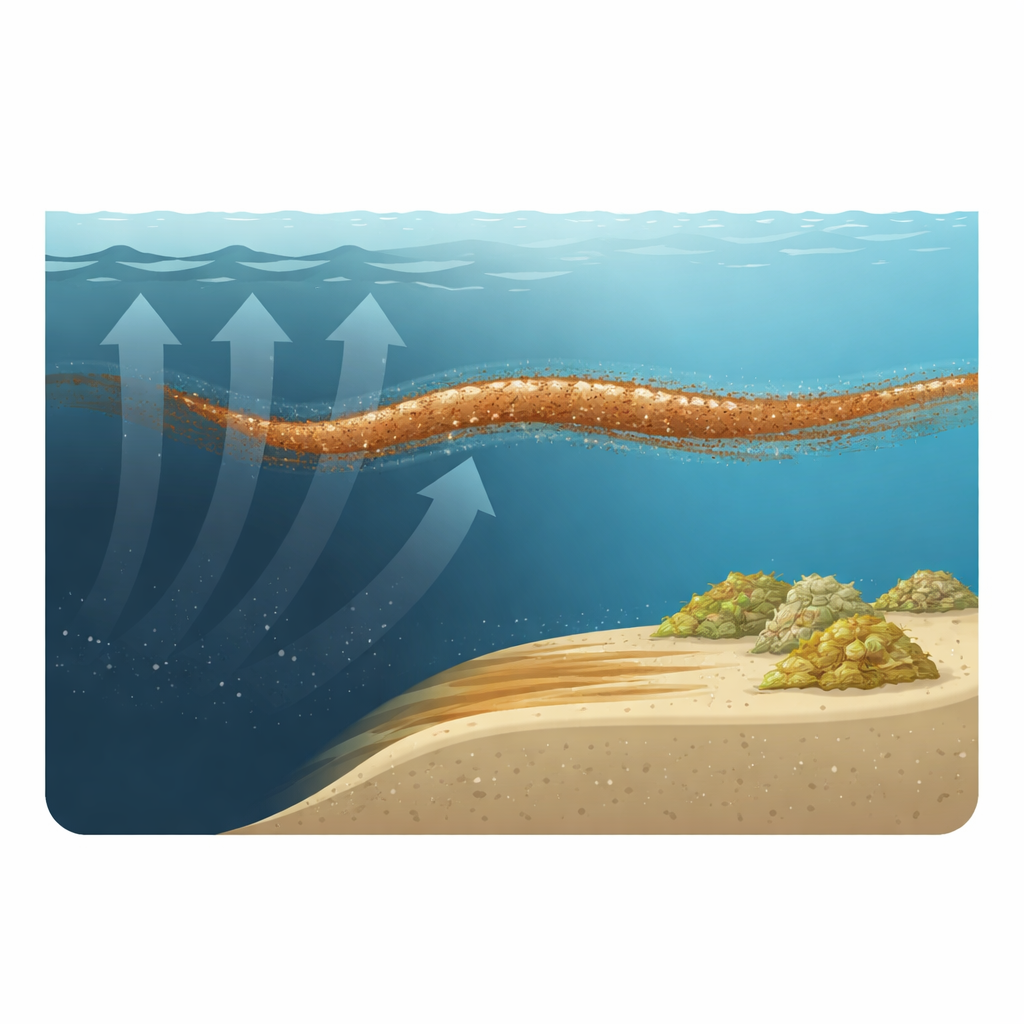
A Moving Invisible Boundary
One of the most revealing signals comes from manganese, an element that behaves differently in oxygen-rich versus oxygen-poor waters. The rocks show strong spikes in manganese content right around the extinction interval in both sections. This pattern fits a scenario in which manganese dissolved in oxygen-starved deep water rose upward until it met oxygenated surface water, where it turned into solid particles and sank. These enrichments imply that the invisible boundary between oxygen-poor and oxygen-rich layers repeatedly shifted up and down, sometimes invading the shallow shelf but never settling there permanently. In other words, the central Tethys shelf sat on the edge of a moving redox boundary—a dynamic front between deadly and survivable conditions.
Tiny Oxygen Factories and Stirred Seas
The study also considers how oxygen was supplied to these precarious refuges. Two main sources are likely: direct mixing with the atmosphere, especially in wave-agitated shallow waters, and local oxygen generation by photosynthetic microbes building the microbialite structures. Fossils and textures within the rocks show diverse bottom-dwelling animals living between and within these microbial mounds, suggesting that at least brief windows of hospitable conditions existed. However, modern microbial mats typically oxygenate only a very thin layer of surrounding water, so the authors argue that air–sea exchange, aided by wind and waves, probably played a major role alongside microbial activity.
What This Means for Life Under Stress
Put together, the evidence shows that even during Earth’s greatest marine extinction, some shallow tropical shelves remained mostly oxygenated, though repeatedly threatened by incursions of oxygen-poor deep water. Lower productivity kept oxygen demand down, while mixing with the atmosphere and local photosynthesis kept the surface waters supplied. These zones would have offered rare sanctuaries for oxygen-dependent organisms, even as rapidly shifting boundaries and chemical stress took a heavy toll on biodiversity. The work underscores that past mass extinctions did not produce uniformly dead oceans; instead, they created a patchwork of hostile depths and fragile havens—a pattern that may be crucial for understanding how life responds to severe environmental change today.
Citation: Bagherpour, B., Ardakani, O.H., Herwartz, D. et al. Habitability at the edge of the redox boundary during the Permian–Triassic mass extinction. Sci Rep 16, 12469 (2026). https://doi.org/10.1038/s41598-026-47893-w
Keywords: Permian Triassic extinction, ocean oxygen, Tethys Ocean, shallow marine refugia, mass extinction