Clear Sky Science · en
Domain-guided engineering of a thermoresistant Vip3A toxin for enhanced functional robustness
Making Natural Pest Control More Reliable
Farmers increasingly rely on natural pest killers made by bacteria to protect crops while reducing chemical pesticide use. One such protein, called Vip3A, is very good at killing caterpillar pests that damage maize and cotton. But there is a practical problem: Vip3A does not tolerate heat well and gradually falls apart during storage, especially in warm climates. This study shows how scientists redesigned Vip3A so it becomes tougher against heat without losing its ability to control pests, paving the way for more dependable, eco‑friendly biopesticides. 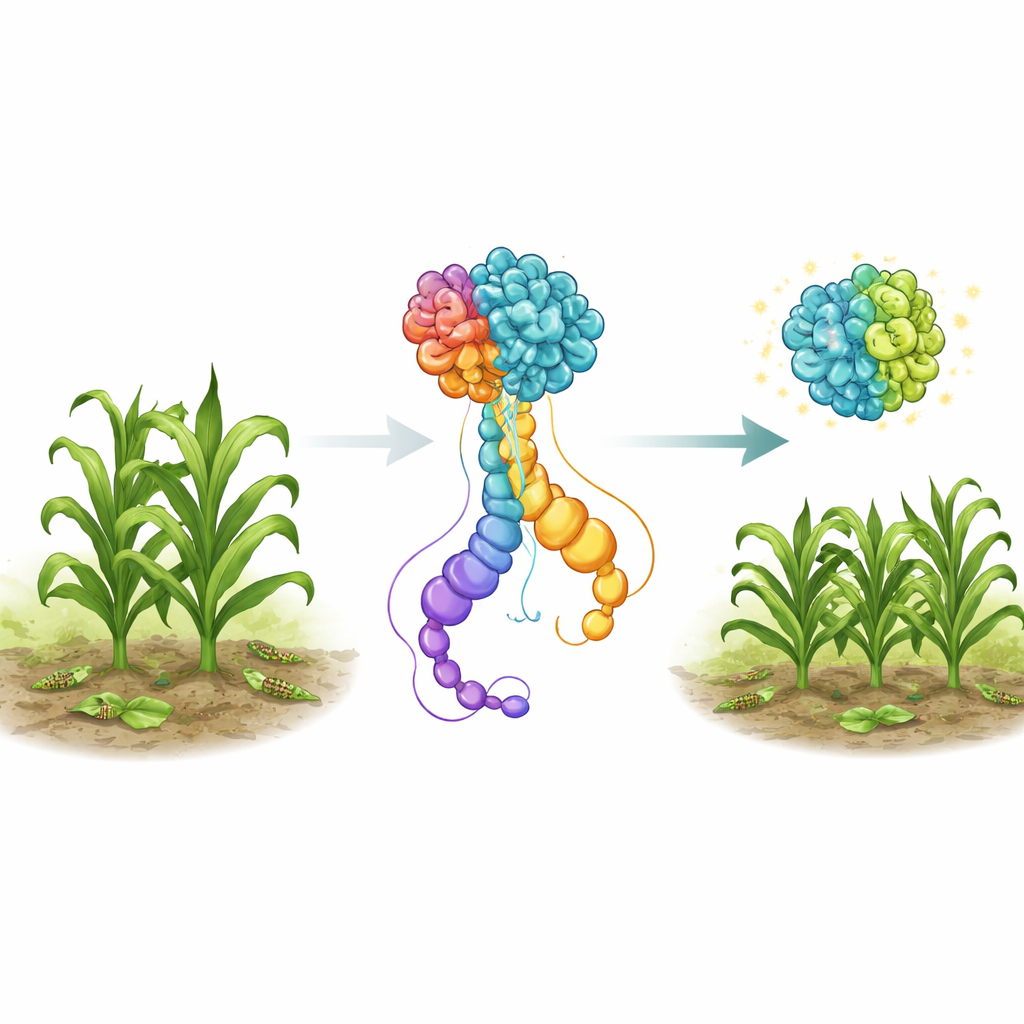
Why This Protein Matters on the Farm
Biopesticides, derived from living organisms, are attractive because they break down naturally and usually target only specific pests, helping to protect beneficial insects and reduce chemical residues in food and soil. The bacterium Bacillus thuringiensis is a workhorse in this field. For decades, its so‑called Cry proteins have been sprayed on fields and built into genetically modified crops to fight major caterpillar pests. However, overuse of Cry toxins has allowed some insects to evolve resistance. Vip3A, a different toxin secreted by the same bacterium, kills many Cry‑resistant caterpillars and is already used in commercial maize and cotton varieties. Unfortunately, Vip3A begins to unfold and clump together at only about 56 °C, which can happen during storage, shipping, or use in hot regions, weakening its pest‑killing power.
Finding the Weak Spots in the Toxin
The Vip3A protein is built from five connected parts, or domains, that together form a four‑part bundle. Earlier work showed that the two tail domains (called IV and V) start to unravel at much lower temperatures than the rest of the protein. In this study, the researchers first confirmed that these tail regions are indeed the weak links by measuring how the protein’s natural glow changes as it is slowly heated. When they tested the full toxin, a version missing the last domain, and the last domain alone, they saw that the isolated tail unfolded at the lowest temperature. This told them that if they could stiffen and better anchor these tail pieces, they might make the entire protein more resistant to heat‑induced damage.
Redesigning the Protein with Smart and Random Changes
The team then used a two‑pronged strategy to strengthen Vip3A. For domain V, they used a “rational design” approach, guided by 3D models and computer programs that predict which tiny changes in the amino‑acid sequence might stabilize the structure. They focused on the contact area between the core of the protein and domain V, introducing new charge‑based links that act like extra fasteners. One designed variant, called TR1, raised the temperature at which the protein unfolds by about 2.6 °C. For domain IV, where no obvious design targets stood out, they turned to “directed evolution”: they randomly mutated this region in thousands of variants, produced them in bacteria, and rapidly screened their heat resistance using a miniaturized melting test. From this library, they discovered several single changes that made domain IV more stable.
Combining Mutations Without Losing Killing Power
Next, the researchers combined the best stabilizing changes from both domains into full‑length proteins and tested not only their melting temperatures but also their ability to kill larvae of the beet armyworm, Spodoptera exigua, an important crop pest. Some combinations made the protein more heat resistant but also less toxic, especially one change in an exposed loop of domain V. By carefully removing this problematic change while keeping the beneficial ones, they arrived at a final variant, Vip3A‑TR6, carrying four substitutions. This redesigned toxin melted about 5.1 °C higher than the original yet retained essentially the same insect‑killing strength. 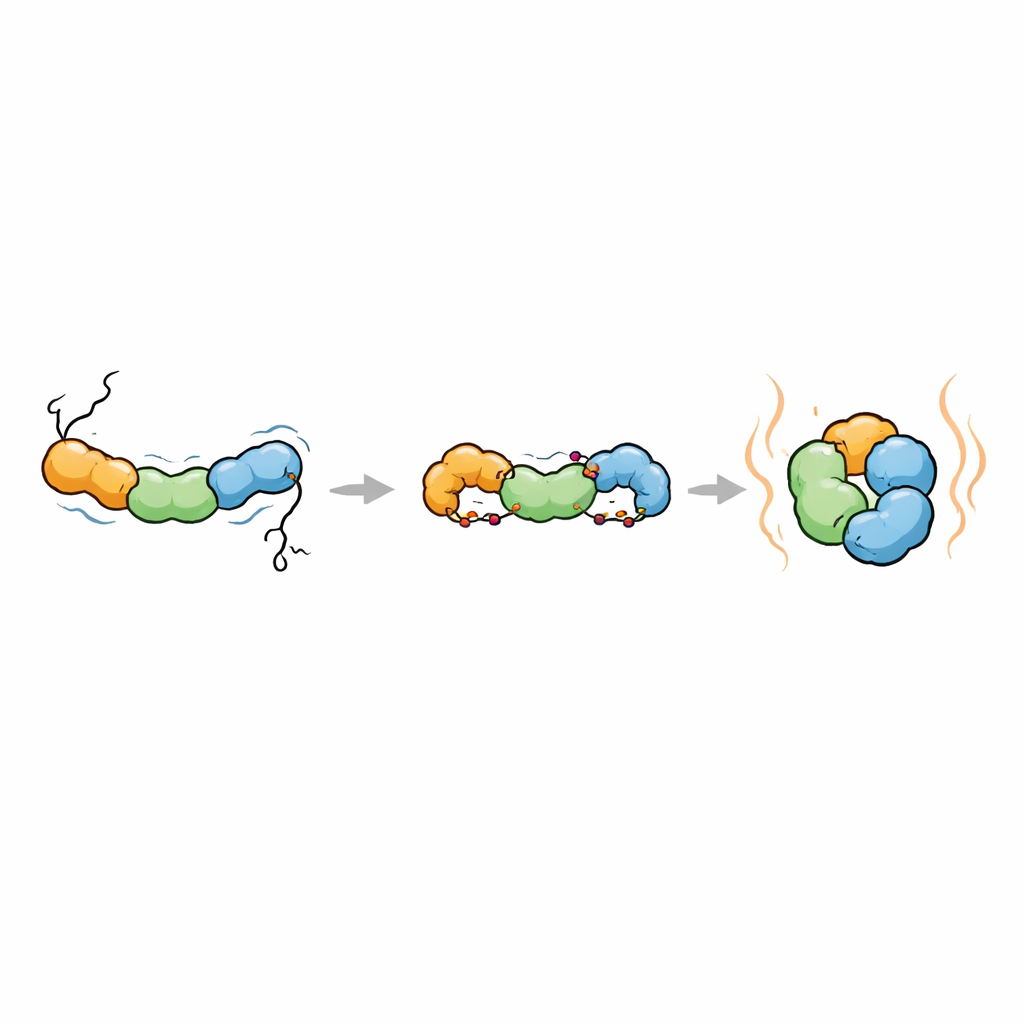
Putting the Tougher Toxin to the Test
To see if the improved melting point translated into real‑world robustness, the team exposed both the original Vip3A and Vip3A‑TR6 to prolonged heating and to weeks of storage at room and body‑like temperatures. Under these harsher conditions, the original protein quickly clumped and lost nearly all activity, while Vip3A‑TR6 stayed soluble longer and kept much more of its killing power. After several hours near its original melting temperature, the wild‑type toxin was essentially inactive, whereas the engineered version still killed most larvae. Over two months of storage, Vip3A‑TR6 consistently outperformed the original at both 25 °C and 37 °C. Importantly, when they inserted the new gene into the natural bacterial producer, the modified bacterium secreted Vip3A‑TR6 just as efficiently as the original toxin and showed the same pattern of increased heat resilience in culture.
What This Means for Future Crop Protection
For non‑specialists, the key message is that the scientists have made a natural, highly selective insect killer more durable without making it more dangerous. By pinpointing flexible “weak seams” in the protein and either reinforcing them with new internal links or subtly reshaping local structures, they produced a version that better withstands heat and storage while keeping its ability to control crop‑damaging caterpillars. This kind of protein engineering could make biological pest control products more reliable in hot climates and reduce waste from spoiled batches. More broadly, the study showcases a general strategy—combining structure‑based design with evolutionary screening—that can be applied to toughen many other temperature‑sensitive proteins used in agriculture, industry, or medicine.
Citation: Kunlawatwimon, T., Bourdeaux, F., Boonserm, P. et al. Domain-guided engineering of a thermoresistant Vip3A toxin for enhanced functional robustness. Sci Rep 16, 13016 (2026). https://doi.org/10.1038/s41598-026-47865-0
Keywords: biopesticides, Vip3A toxin, protein thermostability, directed evolution, crop pest control