Clear Sky Science · en
Active disturbance rejection-based decentralised sensor fault-tolerant control in DC microgrids
Keeping the Lights Steady When Sensors Go Wrong
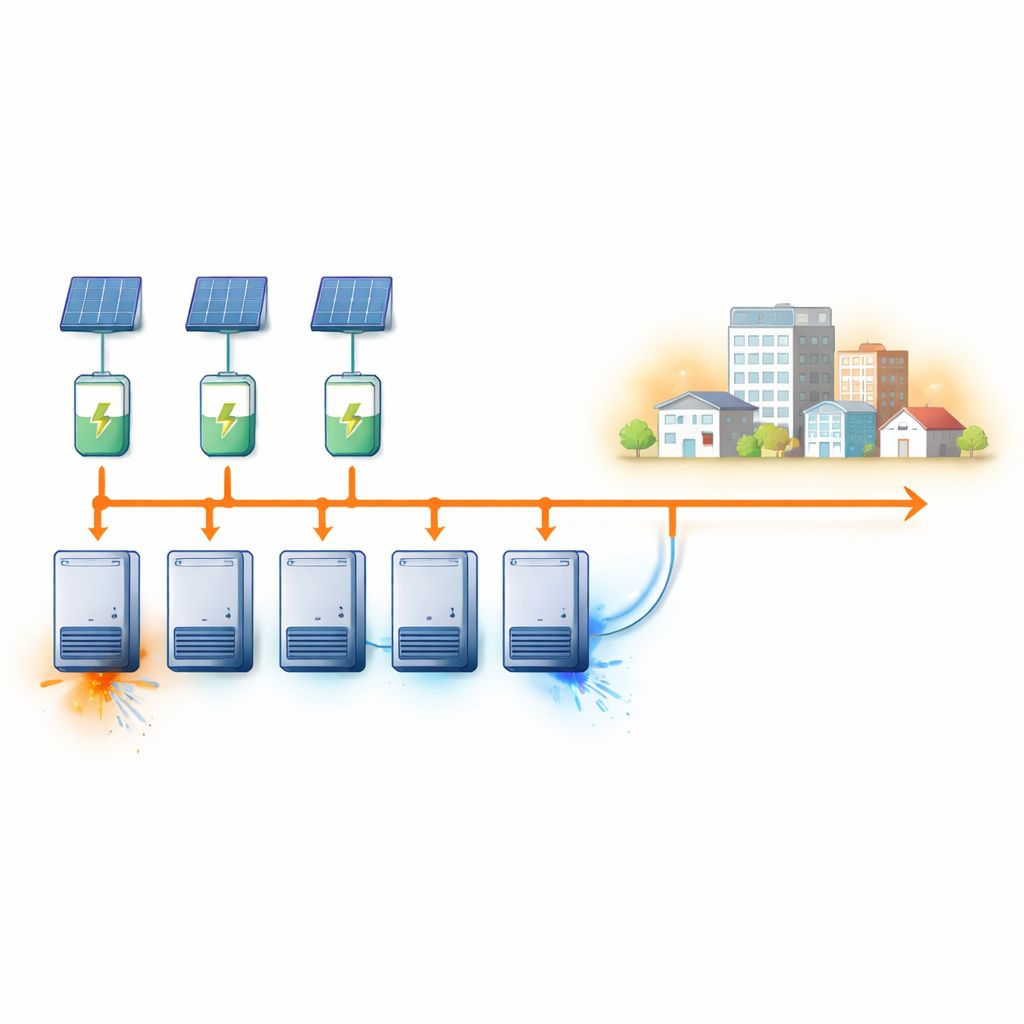
Modern homes, factories, and remote villages are increasingly powered by small local power networks known as DC microgrids, often fed by solar panels and batteries. These systems promise higher efficiency and easier use of renewables, but they also depend heavily on tiny electronic sensors that measure voltages and currents. When those sensors age, drift, or fail, the whole microgrid can wobble or even collapse. This paper explores a new way to keep a DC microgrid stable and reliable even when its sensors misbehave, using a smart control strategy that treats faults as disturbances to be absorbed rather than problems to be hunted down one by one.
Why Small Power Networks Need Extra Care
Low-voltage DC microgrids are attractive because they match naturally with solar panels, batteries, and many modern electronic devices that already run on direct current. Unlike traditional AC grids, they avoid complications like reactive power and complex synchronization. Yet their reliability hinges on accurate measurements. If a voltage or current sensor drifts by 20–30%, a conventional controller may “believe” faulty data and overreact, causing large voltage dips, slow recovery, or oscillations that spread from one generator to others. Previously proposed fault-tolerant methods either assumed very accurate mathematical models or required extra software layers that first detect and diagnose faults and then reconfigure the controller, adding complexity, cost, and delay.
A Different Way to Think About Faults
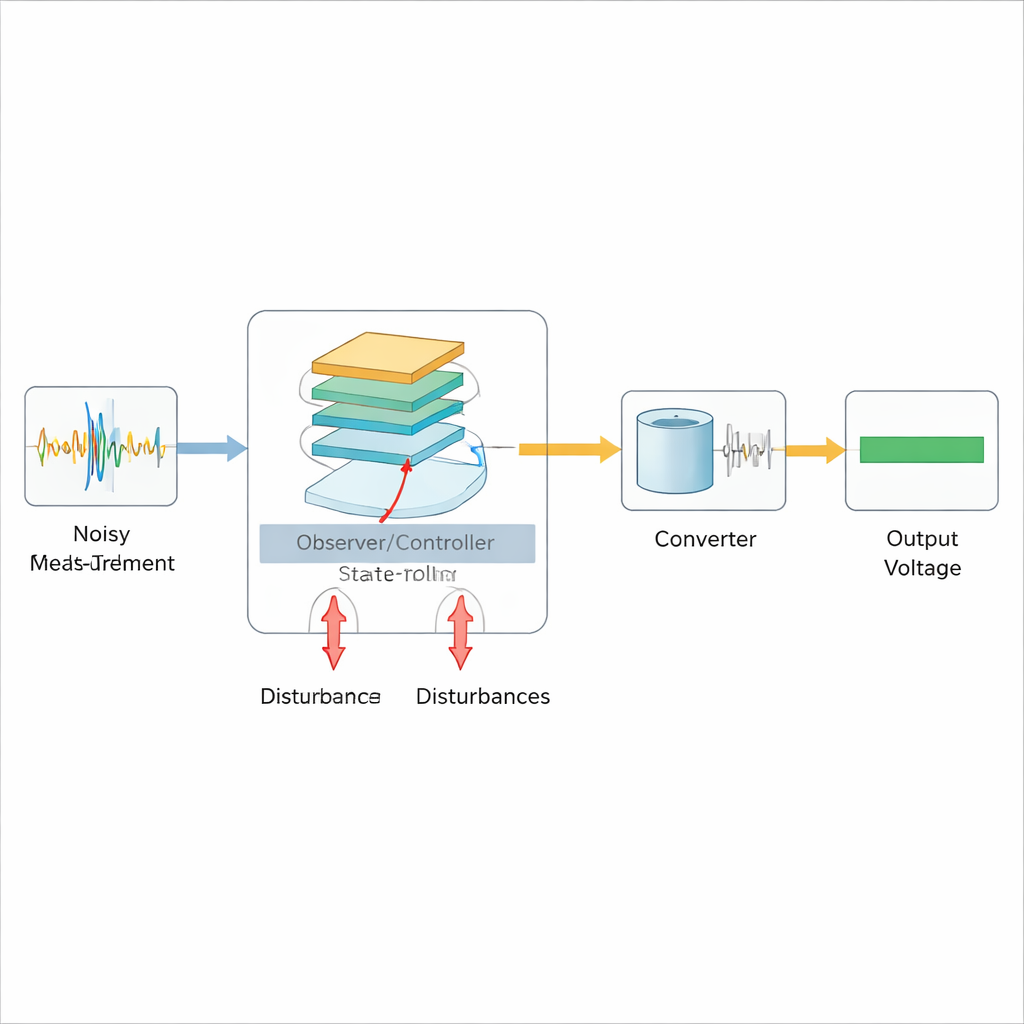
The authors propose an approach based on Active Disturbance Rejection Control (ADRC), which takes a more forgiving view of the real world. Instead of trying to model every detail or explicitly detect each sensor fault, ADRC bundles together all “bad influences” on the system—sensor errors, parameter changes, line interactions, and load swings—and treats them as one combined disturbance. At the heart of ADRC is an extended state observer, a mathematical module that continuously estimates both the true internal state of each generator and this lumped disturbance in real time. A feedback rule then uses these estimates to counteract the disturbance on the fly, keeping the DC bus voltage close to its target without needing to know exactly what went wrong or where.
How the New Control Method Was Tested
To see how this plays out in practice, the researchers built a detailed computer model of an islanded DC microgrid with six distributed generators connected along a radial DC bus. Each unit includes a DC source (representing solar panels and batteries), a DC–DC converter, filters, and loads. For each generator, a local ADRC controller uses only its own voltage and current measurements, so there is no central brain that can become a single point of failure. The team then introduced realistic sensor problems by artificially degrading measurement signals—sometimes on one generator, sometimes on two, sometimes one after another, and sometimes both at once with very severe loss of accuracy. These scenarios mimic what might happen over years of operation as sensors age or partially fail.
Stacking Up Against Established Controllers
The performance of ADRC was compared with two other decentralized strategies: commonly used auto-tuned PI controllers and a more advanced attractive ellipsoid method designed specifically for robustness. Under mild and moderate sensor degradations, the PI controllers suffered large voltage sags (often above 40–50%), long settling times around 1–2 seconds, and noticeable oscillations that spread across the microgrid. The ellipsoid-based controllers improved damping and limited fault propagation, but responded more slowly and required higher control effort. In contrast, the ADRC controllers kept voltage deviations modest, recovered in well under half a second in most cases, and maintained essentially zero long-term error, even when two generators were hit simultaneously with harsh sensor loss that lay outside the design range of the competing method.
What This Means for Future Power Systems
In plain terms, this work shows that a microgrid can be made much more forgiving of sensor problems by embedding intelligence that constantly “listens” for anything that disturbs its balance and cancels it out before it grows. By not depending on explicit fault detection, signal classification, or controller switching, the ADRC-based design stays simple enough for real-time implementation while remaining scalable to larger networks. For future DC distribution systems that must integrate renewables, operate in remote areas, and withstand aging hardware, this disturbance-focused control strategy offers a promising path toward power networks that quietly ride through sensor faults without the users ever noticing.
Citation: Mohamad, A.M.I., Ibrahim, A.M. & Bayoumi, E.H.E. Active disturbance rejection-based decentralised sensor fault-tolerant control in DC microgrids. Sci Rep 16, 12468 (2026). https://doi.org/10.1038/s41598-026-47847-2
Keywords: DC microgrids, fault-tolerant control, sensor faults, active disturbance rejection control, renewable energy systems