Clear Sky Science · en
Distinct long-term effects on lung function and airway remodeling in ovalbumin and house dust mite mouse models of experimental asthma
Why long-term asthma damage matters
Asthma attacks may come and go, but their impact on the lungs can linger for months or years. This study looks at what happens to the lungs long after an allergic flare-up has faded, using mice as stand-ins for people with asthma. By comparing different common research models and tracking how their lungs work and look over time, the authors show that not all “asthma” in the lab is the same—and that choosing the right model is crucial for developing better, longer-lasting treatments.
Different ways to trigger asthma-like disease
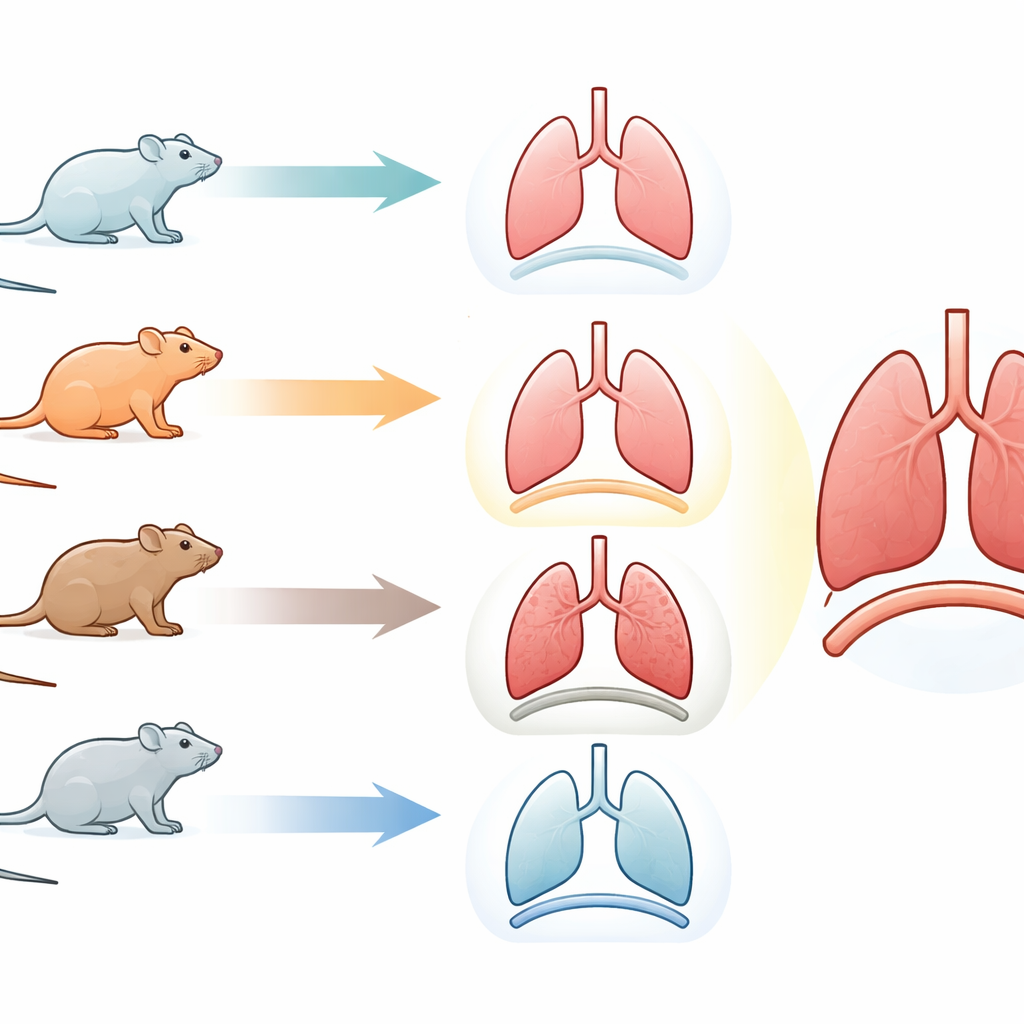
Researchers often induce asthma-like illness in mice by exposing them to specific substances that provoke allergic reactions in the airways. In this work, the team compared three such approaches: a mild and a severe version of a model based on ovalbumin (a protein from egg white), and a model based on house dust mite, a common real-world allergen for people. All animals were exposed for a short period and then left alone for about four months—roughly the span needed for the initial inflammation to resolve. Including both untouched animals and animals given only a salt solution allowed the scientists to see which changes were due to allergens and which arose from the procedures themselves.
Watching breaths with gentle x-rays
Instead of relying only on invasive tests at the end of the experiment, the authors used a low-dose x-ray method to follow lung function over time. This technique records rapid movies of the chest while the mouse breathes under light anesthesia. By tracking how much x-rays pass through the lungs as they inflate and deflate, the team could calculate how quickly the lungs empty—a sign of how springy, or elastic, the lung tissue is. They also measured how far the breathing muscle, the diaphragm, moved and how large the lungs appeared at the end of a breath out. These non-invasive measurements were sensitive enough to pick up subtle differences between models that might otherwise appear similar.
Same attack, different scars
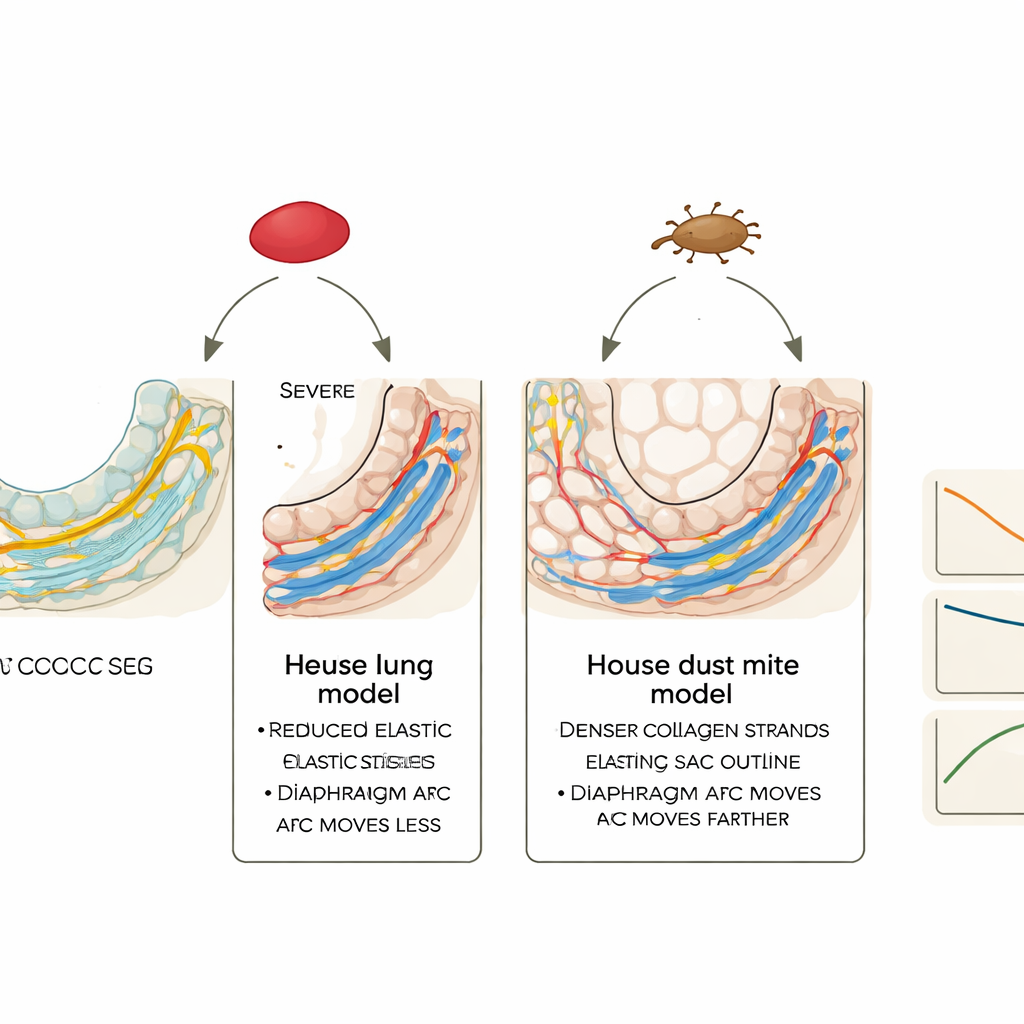
The severe ovalbumin model caused the strongest immediate damage, with clearly impaired lung emptying during the acute phase. Even four months later, these mice still had slower lung recoil compared with healthy controls, suggesting a lasting loss of tissue springiness. In contrast, the mild ovalbumin model showed little long-term disturbance in lung function. Interestingly, mice exposed to house dust mite also displayed impaired lung recoil during the attack, but by the recovery time their overall emptying rate looked closer to normal.
Hidden stiffness and tissue changes
Despite this apparent recovery, the house dust mite group showed a different kind of long-term change. Their diaphragms moved more, and the lungs appeared smaller at the end of exhalation, hinting that the lung tissue had become stiffer and harder to inflate. Microscopic analysis of lung slices supported this idea of distinct “scars.” In the severe ovalbumin model, the team saw more collagen—a structural protein linked to scarring—and significantly less elastin, the protein that gives lung tissue its snap-back quality. Around the airways, a contractile protein called alpha-smooth muscle actin was reduced, pointing to remodeling of the airway walls. House dust mite–exposed lungs, in contrast, showed only mild, non-significant increases in collagen and preserved elastin and muscle markers, despite their functional changes. Surprisingly, even repeated instillation of simple salt solution caused subtle remodeling, implying that the procedure itself can alter the lung.
What this means for asthma research and care
For non-specialists, the key message is that not all experimental asthma models leave the same long-term mark on the lungs. A single bout of severe allergy can permanently reduce lung springiness, while other exposures may quietly stiffen the tissue without obvious microscopic scarring. These patterns echo the diversity seen in people with chronic asthma, where lung function can remain impaired even when symptoms and inflammation are under control. The study also shows that gentle x-ray imaging can detect these small but important shifts in lung behavior. Together, these findings highlight the need to match animal models carefully to the type of human asthma being studied, so that future drugs are tested in systems that truly reflect the long-term damage they aim to prevent.
Citation: Markus, M.A., Albers, J., Alves, F. et al. Distinct long-term effects on lung function and airway remodeling in ovalbumin and house dust mite mouse models of experimental asthma. Sci Rep 16, 12737 (2026). https://doi.org/10.1038/s41598-026-47822-x
Keywords: asthma, lung remodeling, allergic inflammation, mouse model, lung imaging