Clear Sky Science · en
Physics guided fused image learning with enhanced squeeze excitation for failure analysis of multistage centrifugal pumps
Why smarter pump monitoring matters
Behind many factories, power plants, and water systems sit multistage centrifugal pumps that quietly keep liquids moving. When these pumps develop hidden damage, companies can lose thousands of hours to repairs and millions of dollars to downtime and accidents. This study shows how combining physics knowledge with modern image-based artificial intelligence can spot subtle problems inside these pumps early, even when signals are noisy and operating conditions change.
The hidden life of industrial pumps
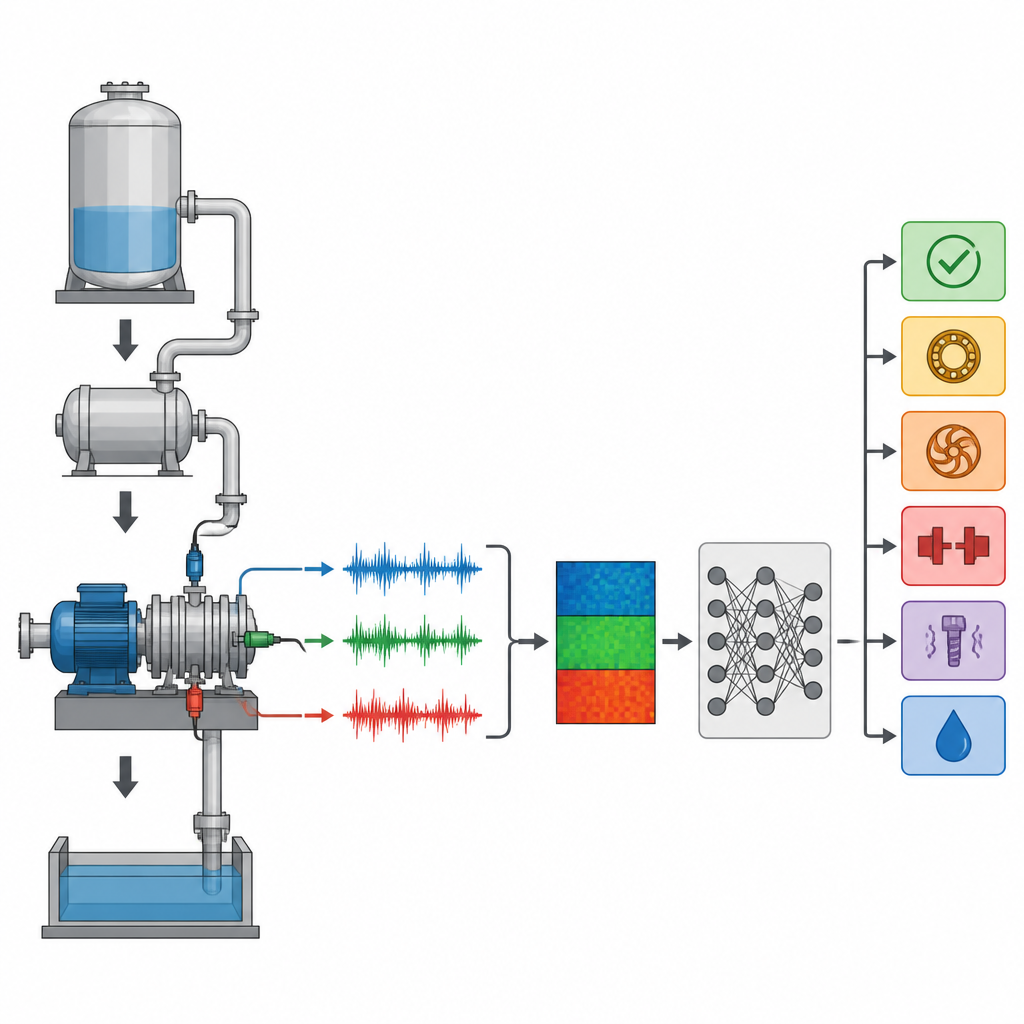
Multistage centrifugal pumps use several spinning impellers in series to build up pressure and push fluid through pipes. In real plants, failures in these pumps have led to thousands of maintenance hours and tens of millions of dollars in losses. The most troublesome issues often start as “soft” faults: tiny holes or scratches in mechanical seals and early corrosion on impellers. These defects do not stop the pump immediately but slowly erode performance and safety. Because the pumps run under different pressures and are surrounded by other vibrating equipment, the early signs of trouble are buried in complex, noisy vibration data.
Turning vibrations into informative pictures
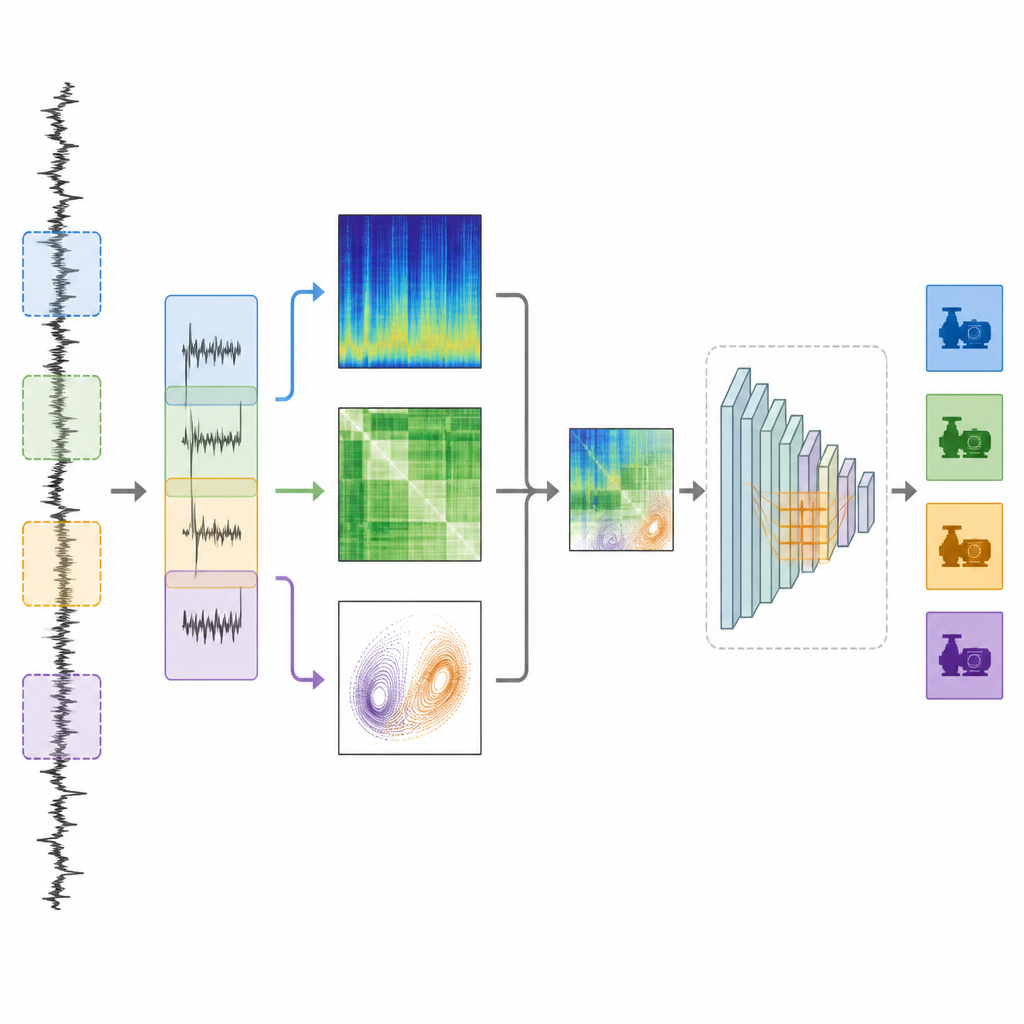
The authors built a test rig based on an industrial pump and deliberately introduced three realistic soft faults: a drilled hole in a seal, a scratch on a seal, and a material loss on one impeller, along with a normal condition. Vibration sensors were mounted on the pump casing, near the seals, and near the impeller. Instead of treating the entire vibration record as equally useful, the team first broke each signal into many short time windows. They then scored these windows using three physically meaningful measures: overall energy, impulsiveness, and how much of the energy lay in a frequency band known from pump physics to be fault sensitive. Only the highest scoring windows, most likely to contain useful fault information, were kept for further analysis.
Fusing three views of the same signal
From each selected window, the researchers created a special “fused” image designed to capture different aspects of the pump’s behavior. One channel is a physics-guided version of a Mel spectrogram, which highlights how vibration energy is distributed over time and frequency, with extra emphasis on the frequency range where faults typically show up. A second channel, called a Gramian Angular Difference Field, turns the time signal into a patterned image that reveals how points in the signal relate to each other over time, making irregular impacts and nonlinear changes stand out. A third channel, the Cross Interaction Map, strengthens areas where both of the other views agree and weakens those likely caused by noise. Stacking these three channels produces a compact image that encodes time, frequency, and temporal structure together.
Guiding artificial intelligence with physics
These fused images are then fed into a compact convolutional neural network that learns to recognize patterns linked to specific pump conditions. A key innovation is an “enhanced squeeze excitation” attention mechanism. In simple terms, the network not only looks at the image features it has learned, it also receives a small side vector of classic vibration indicators derived from physics, such as root mean square level, impulsiveness, crest factor, and the share of energy in the fault-sensitive band. The attention module uses this side information to decide which internal feature channels to emphasize or downplay, nudging the network to focus on patterns that match real mechanical behavior rather than spurious correlations in the data.
How well does the approach work?
The framework was tested on real vibration data from the pump rig running at three pressures representative of industrial use: 3 bar, 3.5 bar, and 4 bar. For each pressure, the model had to distinguish normal operation from the three fault types. Across all pressures, it achieved classification accuracy above 99 percent, with a macro F1 score (a balance of precision and recall) also above 0.99, and it reached perfect scores at the highest pressure. The authors compared their method against several advanced alternatives, including transfer learning from standard image networks, entropy-based feature extraction, and other physics-inspired deep models. In every case, the physics guided fused image plus attention framework matched or outperformed these competitors, especially when operating conditions varied.
What this means for real-world maintenance
For engineers and plant operators, this work illustrates a practical way to combine their understanding of pump physics with the pattern-finding power of deep learning. By carefully selecting the most informative parts of vibration signals, converting them into rich yet compact images, and steering the network with simple physical indicators, the method can reliably flag early-stage seal and impeller damage long before catastrophic failure. In the long run, such physics-aware AI tools could help shift pump maintenance from reactive fixes after breakdowns to planned interventions based on trustworthy early warnings.
Citation: Ullah, S., Umar, M. & Kim, JM. Physics guided fused image learning with enhanced squeeze excitation for failure analysis of multistage centrifugal pumps. Sci Rep 16, 16179 (2026). https://doi.org/10.1038/s41598-026-47809-8
Keywords: centrifugal pump faults, vibration monitoring, physics guided deep learning, condition based maintenance, industrial diagnostics