Clear Sky Science · en
OHAM analysis of quadratic radiative heat flux and chemical reactions in hybrid nanofluid flow over variable thickness stretching surface
Why smarter coolants matter
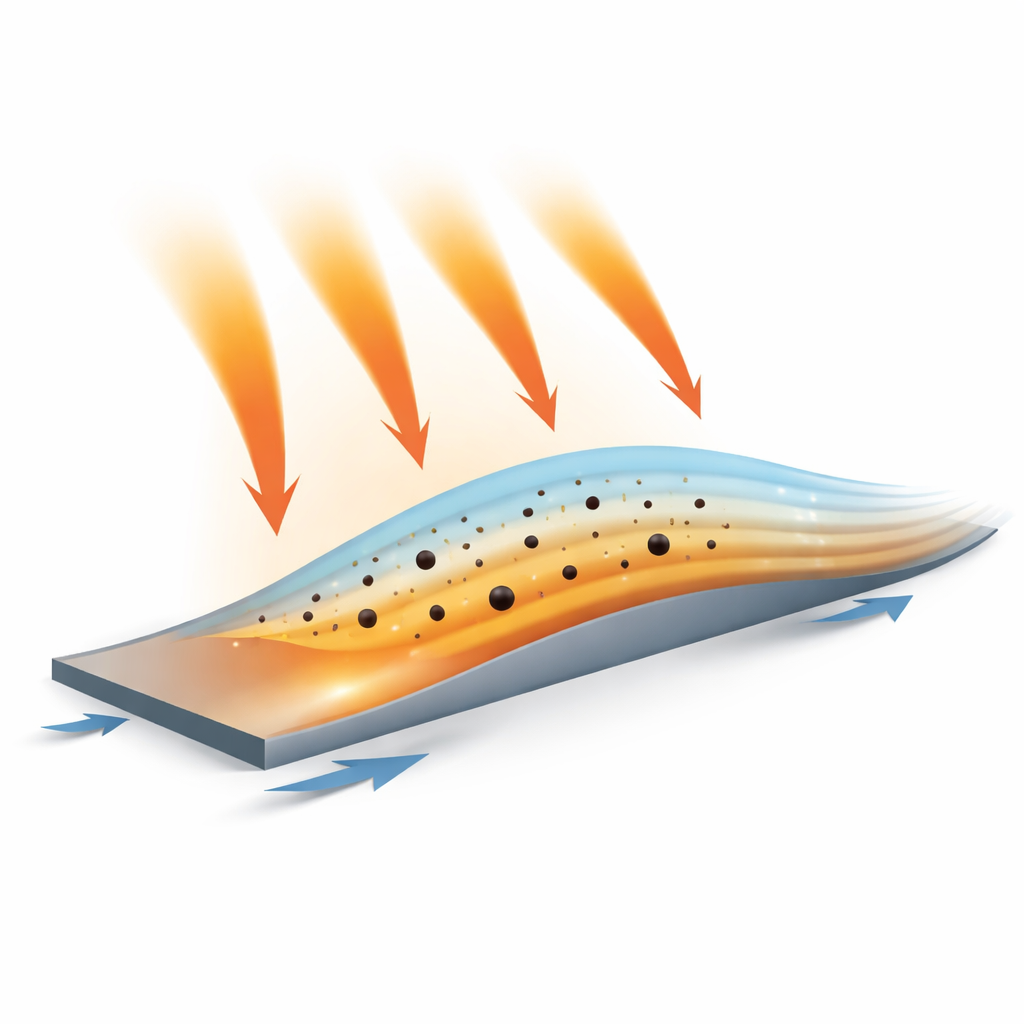
From jet engines to high‑power electronics, many modern machines run so hot that getting heat out of them safely becomes a major design challenge. Ordinary liquids like water or oil often cannot carry heat away fast enough, especially when temperatures swing sharply near hot surfaces. This study explores a new kind of engineered coolant—a water‑based liquid loaded with tiny solid particles—that can move heat far more effectively when exposed to intense thermal radiation, the kind of heat that travels as invisible light.
Mixing tiny solids into liquids
The authors focus on “hybrid nanofluids,” which are ordinary liquids seeded with more than one kind of solid nanoparticle. Here, water contains two ceramic carbides, silicon carbide (SiC) and titanium carbide (TiC), chosen because they conduct heat very well, remain stable at high temperatures, resist corrosion, and are relatively light and inexpensive. When dispersed properly, these particles form a kind of thermal scaffold within the fluid, giving heat many extra pathways to travel compared with plain water. The work targets situations where the liquid flows over a sheet that is being stretched during manufacturing—mimicking real processes such as polymer extrusion, metal rolling, coating, and cooling of moving strips or films.
When heat moves like light
In very hot environments, heat does not move only by direct contact; it is also carried as radiation. Simple models usually assume that this radiative heat flow grows in a straight, proportional way with temperature. That assumption breaks down when temperature differences are large, as in gas turbines or high‑temperature reactors. The researchers instead use a “quadratic” description, which keeps more of the temperature terms and better captures strong variations across the thin thermal layer near the surface. This richer description allows them to predict how radiation and the nanoparticle mixture work together to raise the fluid temperature and alter how heat spreads away from the hot wall.
Chemistry at and within the flow
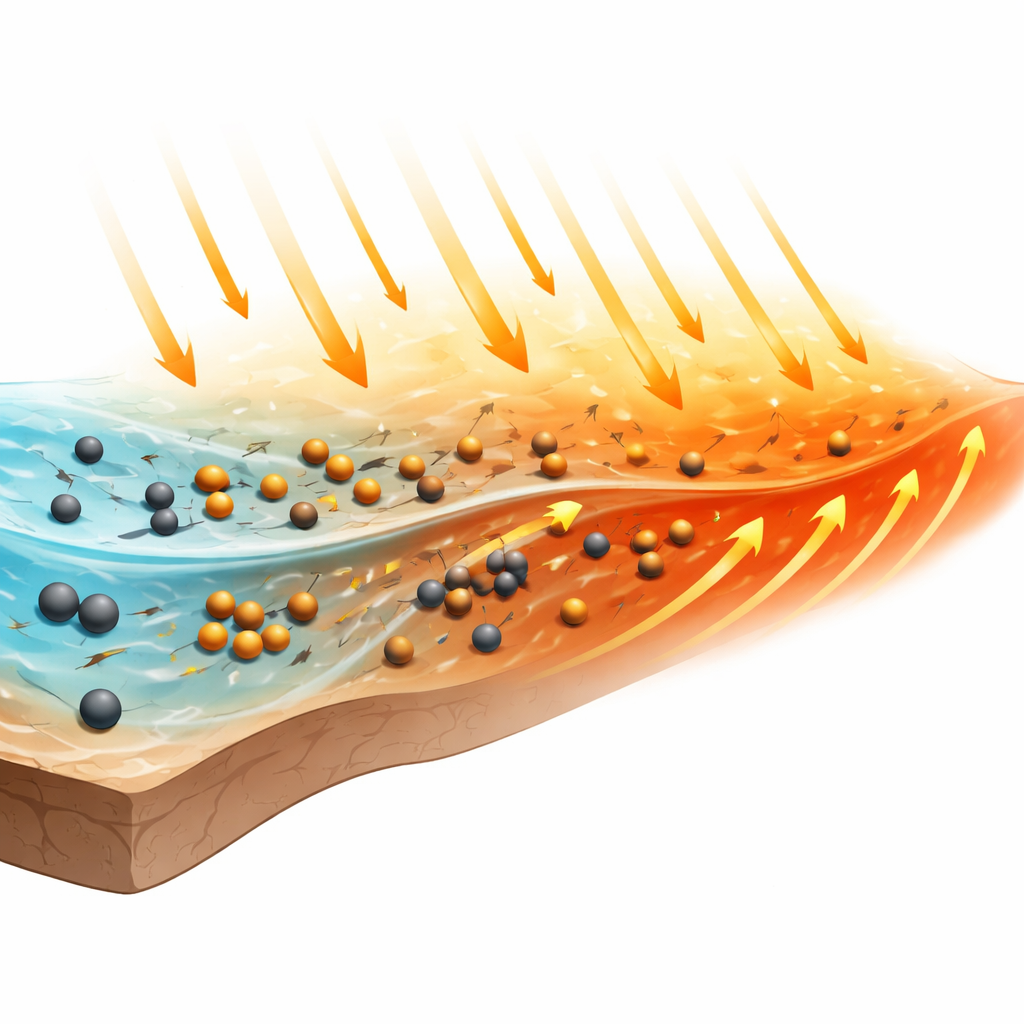
Besides heat transfer, the team also builds in chemical reactions that can occur both throughout the liquid and right at the solid surface. In their model, one dissolved species is gradually converted into another through a pair of reaction steps: one taking place uniformly in the fluid and another acting mainly at the boundary. These reactions, combined with molecular diffusion, reshape how concentrations of the chemical species vary with distance from the wall. By tracking this, the study connects heat management with processes such as catalysis, corrosion control, or reactive coating, where both temperature and chemistry must be steered simultaneously.
Solving a tough problem on paper
The full mathematical description of this flow is highly nonlinear: it couples fluid motion, heat carried by conduction and radiation, and the two‑way chemical reactions. Rather than relying only on numerical simulations, the authors use an analytical technique called the Optimal Homotopy Asymptotic Method. This approach generates series solutions whose accuracy can be tuned and checked, giving clear formulas for how key quantities depend on design parameters such as nanoparticle loading, wall thickness, radiation strength, and reaction rates. They then explore these relationships with graphs and tables, and validate parts of their model by comparing limiting cases to earlier published solutions.
What the results reveal
The calculations show that adding more carbide nanoparticles makes the fluid thicker in a mechanical sense: its effective viscosity rises, which slows the flow and increases drag on the surface. For the ranges studied, the characteristic fluid speed near the wall can drop by about half as the particle fraction is raised. At the same time, however, the stronger solid network of particles boosts the overall heat‑carrying capacity. For moderate particle loadings, the rate of heat transfer at the surface can rise by more than a third. Strengthening radiative effects also markedly raises the fluid temperature near the hot wall, thickening the region where heat is actively exchanged. Meanwhile, faster surface and bulk reactions deplete the reacting species near the wall, sharpening concentration gradients and narrowing the zone where chemistry is active.
Big picture for real devices
In everyday terms, this work explains how to blend very small, very conductive solid grains into water to create a “smart coolant” tailored for harsh, high‑temperature conditions. It shows that carefully choosing particle type and amount, accounting for strong radiative heating, and recognizing surface chemistry can significantly improve how quickly heat is pulled from a moving hot surface—despite some penalty in flow resistance. These insights offer designers of thermal management and chemical processing equipment a roadmap for using hybrid nanofluids and more realistic radiation models to build safer, more efficient high‑temperature systems.
Citation: Ramzan, M., Bashir, S., Shahmir, N. et al. OHAM analysis of quadratic radiative heat flux and chemical reactions in hybrid nanofluid flow over variable thickness stretching surface. Sci Rep 16, 14157 (2026). https://doi.org/10.1038/s41598-026-47751-9
Keywords: hybrid nanofluid, thermal radiation, heat transfer, chemical reactions, cooling technologies